

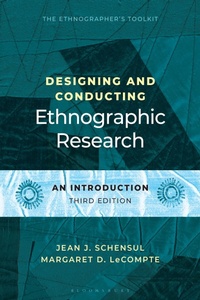
Designing and Conducting Ethnographic Research
An Introduction
3. Auflage
Erscheint ca. am 15. August 2026
Buch
Softcover
376 Seiten
978-1-5381-9124-8 (ISBN)
Beschreibung
Who can and should conduct ethnographic research? How can we transform an idea into a research question, and how can that question, in turn, be developed into a design that produces data?
Designing and Conducting Ethnographic Research, Third Edition, is a comprehensive introduction to ethnographic methods. It opens by defining ethnography and considering ethical challenges in the field before exploring major theories and ways of thinking in ethnographic research. The book then offers a general overview of qualitative and quantitative research and dives into developing a good research question. A discussion of data collection and analysis are then followed by an exploration of how ethnography is used to solve critical social, health, education, and cultural issues as well as emerging trends in ethnography.
Designing and Conducting Ethnographic Research is the first book in The Ethnographer's Toolkit, a series of texts on how to plan, design, carry out, and use the results of applied ethnographic research.
New to This Edition:
-- New discussion of the decolonization of research and changes in researcher stance sheds light on alternative ethnographic interventions, such as co-constructed ethnography
--Exploration of new ethical challenges in the field, including in digital and online research as well as the uses of artificial intelligence, offers early ethnographers the knowledge and tools to address ethical concerns
--New discussion of what research questions are, how they are formulated at different levels, and how they guide data collection, enables beginner researchers to create stronger studies
--New Chapter 10, "Emerging Trends in Ethnography", covers burgeoning uses of artificial intelligence and other digital technologies for research as well as indigenous research approaches and methods
Designing and Conducting Ethnographic Research, Third Edition, is a comprehensive introduction to ethnographic methods. It opens by defining ethnography and considering ethical challenges in the field before exploring major theories and ways of thinking in ethnographic research. The book then offers a general overview of qualitative and quantitative research and dives into developing a good research question. A discussion of data collection and analysis are then followed by an exploration of how ethnography is used to solve critical social, health, education, and cultural issues as well as emerging trends in ethnography.
Designing and Conducting Ethnographic Research is the first book in The Ethnographer's Toolkit, a series of texts on how to plan, design, carry out, and use the results of applied ethnographic research.
New to This Edition:
-- New discussion of the decolonization of research and changes in researcher stance sheds light on alternative ethnographic interventions, such as co-constructed ethnography
--Exploration of new ethical challenges in the field, including in digital and online research as well as the uses of artificial intelligence, offers early ethnographers the knowledge and tools to address ethical concerns
--New discussion of what research questions are, how they are formulated at different levels, and how they guide data collection, enables beginner researchers to create stronger studies
--New Chapter 10, "Emerging Trends in Ethnography", covers burgeoning uses of artificial intelligence and other digital technologies for research as well as indigenous research approaches and methods
Weitere Details
Reihe
Auflage
3rd edition
Sprache
Englisch
Verlagsort
USA
Verlagsgruppe
Bloomsbury Publishing Plc
Zielgruppe
Für höhere Schule und Studium
Illustrationen
25 tables
Maße
Höhe: 229 mm
Breite: 152 mm
Dicke: 28 mm
Gewicht
454 gr
ISBN-13
978-1-5381-9124-8 (9781538191248)
Copyright in bibliographic data and cover images is held by Nielsen Book Services Limited or by the publishers or by their respective licensors: all rights reserved.
Schweitzer Klassifikation
Weitere Ausgaben
Andere Ausgaben
Jean J. Schensul | Margaret D. LeCompte
Designing and Conducting Ethnographic Research
An Introduction
E-Book
ca. 07/2026
3. Auflage
Bloomsbury Academic
40,99 €
Als Download verfügbar
Jean J. Schensul | Margaret D. LeCompte
Designing and Conducting Ethnographic Research
An Introduction
E-Book
ca. 07/2026
3. Auflage
Bloomsbury Academic
40,99 €
Als Download verfügbar
Personen
Margaret D. LeCompte is professor emerita of education and sociology at the University of Colorado, Boulder. She is internationally known as one of the leading proponents of qualitative and ethnographic research and evaluation in education.
Jean J. Schensul is founding director and senior scientist at the Institute for Community Research, Hartford, Connecticut. She plays a national role in promoting community-initiated research partnerships with universities, building community research capacity and mentoring diverse young scholars to conduct community based participatory research.
Jean J. Schensul is founding director and senior scientist at the Institute for Community Research, Hartford, Connecticut. She plays a national role in promoting community-initiated research partnerships with universities, building community research capacity and mentoring diverse young scholars to conduct community based participatory research.
Inhalt
Introduction
List of Tables and Figures
List of Examples
Chapter 1. What Is Ethnography?
Chapter 2. When, Where, and By Whom Should Ethnography Be Used?
Chapter 3. Paradigms for Framing the Research of Ethnographic Research
Chapter 4. An Overview of Research Design
Chapter 5. Choosing and Designing an Ethnographic Research Project
Chapter 6. Collecting Ethnographic Data
Chapter 7. Data Analysis: How Ethnographers Make Sense of their Data
Chapter 8. Identifying and Building Research Items and Research Partnerships
Chapter 9. Applying Ethnography
Chapter 10. Protection of Risk to Human Subjects and the Ethics of Ethnographic Fieldwork
References
Index
List of Tables and Figures
List of Examples
Chapter 1. What Is Ethnography?
Chapter 2. When, Where, and By Whom Should Ethnography Be Used?
Chapter 3. Paradigms for Framing the Research of Ethnographic Research
Chapter 4. An Overview of Research Design
Chapter 5. Choosing and Designing an Ethnographic Research Project
Chapter 6. Collecting Ethnographic Data
Chapter 7. Data Analysis: How Ethnographers Make Sense of their Data
Chapter 8. Identifying and Building Research Items and Research Partnerships
Chapter 9. Applying Ethnography
Chapter 10. Protection of Risk to Human Subjects and the Ethics of Ethnographic Fieldwork
References
Index