

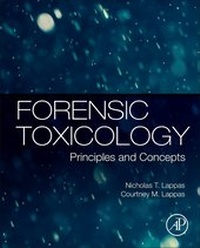
Forensic Toxicology
Principles and Concepts
Erschienen am 14. Januar 2016
Buch
Hardcover
376 Seiten
978-0-12-799967-8 (ISBN)
Beschreibung
Forensic Toxicology: Principles and Concepts takes the reader back to the origins of forensic toxicology providing an overview of the largely unchanging principles of the discipline. The text focuses on the major tenets in forensic toxicology, including an introduction to the discipline, fundamentals of forensic toxicology analysis, types of interpretations based on analytical forensic toxicology results, and reporting from the laboratory to the courtroom. Forensic Toxicology also contains appendices covering the principles of pharmacokinetics and pharmacodynamics, immunology and immunological assays, toxicogenomics, and case studies.
Rezensionen / Stimmen
"...the text certainly meets its aim and I would recommend students studying forensic toxicology to view this as a useful reference book." --Interfaces"...a very useful reference for students, professionals, and instructors. It provides a synthesis of scientific and ethical methods as they apply to the field of forensic toxicology. This book appears to be unique in this regard. Score: 83 - 3 Stars" --Doody's
Weitere Details
Sprache
Englisch
Verlagsort
San Diego
USA
Verlagsgruppe
Elsevier Science Publishing Co Inc
Zielgruppe
Für höhere Schule und Studium
Maße
Höhe: 235 mm
Breite: 191 mm
Gewicht
950 gr
ISBN-13
978-0-12-799967-8 (9780127999678)
Copyright in bibliographic data and cover images is held by Nielsen Book Services Limited or by the publishers or by their respective licensors: all rights reserved.
Schweitzer Klassifikation
Weitere Ausgaben
Nachauflagen
Buch
02/2022
2. Auflage
Academic Press
101,50 €
Versand in 15-20 Tagen
Andere Ausgaben
E-Book
11/2015
Academic Press
62,99 €
Als Download verfügbar
Personen
Dr. Nicholas T. Lappas, an Associate Professor Emeritus in the Department of Forensic Sciences at the George Washington University, has extensive experience and demonstrated expertise in both the teaching and practice of forensic toxicology. In 1975, Dr. Lappas, was one of the first two full time faculty members appointed to the faculty of the Department of Forensic Sciences at the George Washington University. Prior to this appointment, he was a forensic toxicologist in the Allegheny Coroner's Office in Pittsburgh, Pennsylvania. At GWU, he developed the MFS program in forensic toxicology, through which he has mentored hundreds of students and taught several graduate courses, including Forensic Toxicology, Analytical Toxicology, Medicinal Chemistry and Forensic Serology. Dr. Lappas' research interests have been focused on the development of analytical toxicology methods and the evaluation of factors that influence the interpretation of analytical toxicology results. His professional activities include serving as a forensic toxicology consultant in more than 500 criminal and civil cases and as an expert witness in more than 100 cases. Dr. Courtney Lappas, Professor of Biology and Biochemistry and Molecular Biology at Lebanon Valley College is a Molecular Pharmacologist who has extensive experience teaching and conducting biomedical research. Previously a Fellow at the National Institutes of Health, Dr. Lappas' research interests focus on the utilization of novel pharmacological tools in the treatment and/or prevention of immunological pathologies. Dr. Lappas incorporates her experience in translational research into her teaching and mentoring in courses including Pharmacology, Immunology, Molecular Biology and Drugs and Society.
Inhalt
Chapter 1: The Development of Forensic Toxicology Chapter 2: The Duties and Responsibilities of Forensic Toxicologists Chapter 3: Forensic Toxicology ResourcesChapter 4: The Laboratory Chapter 5: Analytical Strategy Chapter 6: Sample Handling Chapter 7: Storage Stability of AnalytesChapter 8: Analytical SamplesChapter 9: Sample PreparationChapter 10: Methods of Detection, Identification and Quantitation Chapter 11: Quality Assurance and Quality ControlChapter 12: Types of Interpretations Chapter 13: Reports Chapter 14: Testifying
APPENDICESAppendix A: Principles of Pharmacokinetics Appendix B: Principles of PharmacodynamicsAppendix C: Immunoassays Appendix D: Toxicogenomics Appendix E: Famous Cases in Forensic Toxicology
APPENDICESAppendix A: Principles of Pharmacokinetics Appendix B: Principles of PharmacodynamicsAppendix C: Immunoassays Appendix D: Toxicogenomics Appendix E: Famous Cases in Forensic Toxicology