

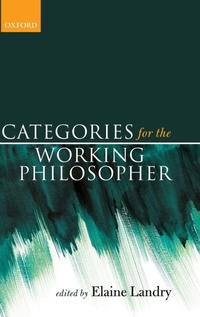
Categories for the Working Philosopher
Erschienen am 30. November 2017
Buch
Hardcover
486 Seiten
978-0-19-874899-1 (ISBN)
Beschreibung
Often people have wondered why there is no introductory text on category theory aimed at philosophers working in related areas. The answer is simple: what makes categories interesting and significant is their specific use for specific purposes. These uses and purposes, however, vary over many areas, both "pure", e.g., mathematical, foundational and logical, and "applied", e.g., applied to physics, biology and the nature and structure of mathematical models.
Borrowing from the title of Saunders Mac Lane's seminal work "Categories for the Working Mathematician", this book aims to bring the concepts of category theory to philosophers working in areas ranging from mathematics to proof theory to computer science to ontology, from to physics to biology to cognition, from mathematical modeling to the structure of scientific theories to the structure of the world.
Moreover, it aims to do this in a way that is accessible to non-specialists. Each chapter is written by either a category-theorist or a philosopher working in one of the represented areas, and in a way that builds on the concepts that are already familiar to philosophers working in these areas.
Borrowing from the title of Saunders Mac Lane's seminal work "Categories for the Working Mathematician", this book aims to bring the concepts of category theory to philosophers working in areas ranging from mathematics to proof theory to computer science to ontology, from to physics to biology to cognition, from mathematical modeling to the structure of scientific theories to the structure of the world.
Moreover, it aims to do this in a way that is accessible to non-specialists. Each chapter is written by either a category-theorist or a philosopher working in one of the represented areas, and in a way that builds on the concepts that are already familiar to philosophers working in these areas.
Rezensionen / Stimmen
important and interesting work. Landry has curated some wonderful essays on category theory for the working philosopher, and as long as one goes in with an understanding of the difficulty of the material, I can heartily recommend it to the philosopher wishing to know more about category theory and its applications. * Neil Barton, Philosophia Mathematica *Weitere Details
Sprache
Englisch
Verlagsort
Oxford
Großbritannien
Zielgruppe
Für höhere Schule und Studium
Für Beruf und Forschung
Maße
Höhe: 240 mm
Breite: 161 mm
Dicke: 31 mm
Gewicht
889 gr
ISBN-13
978-0-19-874899-1 (9780198748991)
Copyright in bibliographic data and cover images is held by Nielsen Book Services Limited or by the publishers or by their respective licensors: all rights reserved.
Schweitzer Klassifikation
Weitere Ausgaben
Andere Ausgaben
Elaine Landry
Categories for the Working Philosopher
E-Book
11/2017
1. Auflage
OUP eBook
21,99 €
Als Download verfügbar
Person
Elaine Landry is professor of philosophy at the University of California, Davis. Her research spans three broad areas within Philosophy of Science: history and philosophy of mathematics, history and philosophy of science, and Plato's philosophy of mathematics. She is one of few philosophers who works on building bridges between all of these areas of research. Her papers are referenced in the Stanford Encyclopaedia of Philosophy (SEP) under the entries for both "Category Theory" and "Structural Realism".
Inhalt
1: Colin McLarty: The Roles of Set Theories in Mathematics
2: David Corfi eld: Reviving the Philosophy of Geometry
3: Michael Shulman: Homotopy Type Theory: A synthetic approach to higher equalities
4: Steve Awodey: Structuralism, Invariance, and Univalence
5: Michael Ernst: Category Theory and Foundations
6: Jean-Pierre Marquis: Canonical Maps
7: John Bell: Categorical Logic and Model Theory
8: Jean-Pierre Marquis: Unfolding FOLDS: A Foundational Framework for Abstract Mathematical Concepts
9: Kohei Kishida: Categories and Modalities
10: J.R.B Cockett and R.A.G Seely: Proof Theory of the Cut Rule
11: Samson Abramsky: Contextuality: At the Borders of Paradox
12: Bob Coecke and Aleks Kissinger: Categorical Quantum Mechanics I: Causal Quantum Processes
13: James Weatherall: Category Theory and the Foundations of Classical Spacetime Theories
14: Joachim Lambek: Six-dimensional Lorentz Category
15: Andree Ehresmann: Applications of Categories to Biology and Cognition
16: David I. Spivak: Categories as Mathematical Models
17: David Hans Halvorson and Dimitris Tsementzis: Categories of Scientifi c Theories
18: Elaine Landry: Structural Realism and Category Mistakes
2: David Corfi eld: Reviving the Philosophy of Geometry
3: Michael Shulman: Homotopy Type Theory: A synthetic approach to higher equalities
4: Steve Awodey: Structuralism, Invariance, and Univalence
5: Michael Ernst: Category Theory and Foundations
6: Jean-Pierre Marquis: Canonical Maps
7: John Bell: Categorical Logic and Model Theory
8: Jean-Pierre Marquis: Unfolding FOLDS: A Foundational Framework for Abstract Mathematical Concepts
9: Kohei Kishida: Categories and Modalities
10: J.R.B Cockett and R.A.G Seely: Proof Theory of the Cut Rule
11: Samson Abramsky: Contextuality: At the Borders of Paradox
12: Bob Coecke and Aleks Kissinger: Categorical Quantum Mechanics I: Causal Quantum Processes
13: James Weatherall: Category Theory and the Foundations of Classical Spacetime Theories
14: Joachim Lambek: Six-dimensional Lorentz Category
15: Andree Ehresmann: Applications of Categories to Biology and Cognition
16: David I. Spivak: Categories as Mathematical Models
17: David Hans Halvorson and Dimitris Tsementzis: Categories of Scientifi c Theories
18: Elaine Landry: Structural Realism and Category Mistakes