

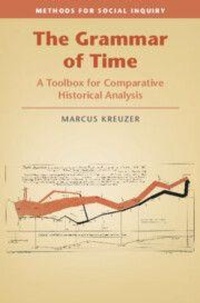
The Grammar of Time
A Toolbox for Comparative Historical Analysis
Erschienen am 25. Mai 2023
Buch
Hardcover
228 Seiten
978-1-108-48378-0 (ISBN)
Beschreibung
Kreuzer offers guidance to scholars looking to comparative historical analysis (CHA) for the tools to analyze macro-historical questions. Like history, CHA uses the past to formulate research questions, describe social transformations, and generate inductive insights. Like social science, CHA compares those patterns to explicate generalizable and testable theories. It operates in two different worlds-one constantly changing and full of cultural particularities and another static and full of orderly uniformities. CHA draws attention to the ontological constructions of these worlds; how scholars background historical and geographic particularities to create a social reality orderly enough for theorizing, while others foreground those particularities to re-complexify it to generate new inductive insights. CHA engages in ontological triage, dialogue between exploration and confirmation, and conversation in how to translate test results into genuine answers. This book is supplemented by online materials including introductory videos, diagnostic quizzes, advanced exercises, and annotated bibliographies.
Rezensionen / Stimmen
'Testing theories with historical data has become increasingly popular among social scientists. Often, however, history is 'used' uncritically, after stripping social and political phenomena of their spatial and temporal context, or by forcing monocausal models on complex and distant realities. Kreuzer's impressive volume offers a very persuasive warning against such strategies and proposes a conceptual apparatus to use history consciously in the social sciences. Written in a very accessible language, this book should be required reading for all graduate students and social scientists who plan to engage with history.' Giovanni Capoccia, Professor of Comparative Politics, University of Oxford 'Kreuzer reminds us that doing history is much more than mining data from a more or less remote past to test our hypotheses or establish some causal effect. He offers us a nuanced and thorough guide for how to go about it and, in doing so, he widens our horizons and improves our research.' Stathis N. Kalyvas, Gladstone Professor of Government, University of OxfordWeitere Details
Reihe
Sprache
Englisch
Verlagsort
Cambridge
Großbritannien
Zielgruppe
Für höhere Schule und Studium
Produkt-Hinweis
Fadenheftung
Gewebe-Einband
Illustrationen
Worked examples or Exercises
Maße
Höhe: 229 mm
Breite: 152 mm
Dicke: 14 mm
Gewicht
476 gr
ISBN-13
978-1-108-48378-0 (9781108483780)
Copyright in bibliographic data and cover images is held by Nielsen Book Services Limited or by the publishers or by their respective licensors: all rights reserved.
Schweitzer Klassifikation
Weitere Ausgaben
Andere Ausgaben
Buch
05/2023
Cambridge University Press
31,50 €
Versand in 15-20 Tagen
E-Book
05/2023
Cambridge University Press
31,49 €
Als Download verfügbar
Person
Marcus Kreuzer is Professor of Political Science Department, Villanova University. His research builds a bridge between the worlds of history and social science methodology. His earlier research focused on the 19th century origins of modern democracy and the role party systems played in the consolidation of interwar and post-communist democracies. His subsequent work on comparative historical methodology has won several best paper awards from American Political Science Association. He also regularly teaches comparative historical analysis at various methods schools.
Inhalt
Introduction: how to study a disorderly world in an orderly fashion; Section I. The Temporal foundations of comparative historical analysis; 1. Historical thinking: stop talking about testing for once!; 2. Varieties of historical time: history is not a dummy variable; 3. Physical time: capturing the rhythms of history; Section II. How to use history to describe patterns; 4. A primer on the origins of electoral systems; 5. Eventful analysis: using dates to explore patterns of (dis-) continuities; 6. Longue Duree analysis: looking for serial patterns; 7. Macro-causal analysis: physical time and the temporal construction of theories; Section III. What about causality?; 8. situating comparative historical analysis: heterodox yet still systematic; 9. Historical explanations: making sense of continuities and discontinuities; 10. Causal process tracing: making testing symmetric; Conclusion: different origins and shared complementarities.