

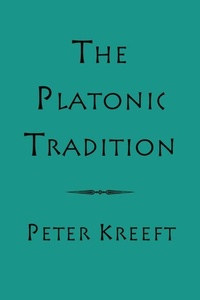
The Platonic Tradition
Erschienen am 15. Juni 2018
Buch
Hardcover
152 Seiten
978-1-58731-650-0 (ISBN)
Beschreibung
The Platonic tradition in Western philosophy is not just one of many equally central traditions. It is so much THE central one that the very existence and survival of Western civilization depends on it. It is like the Confucian tradition in Chinese culture, or the monotheistic tradition in religion, or the human rights tradition in politics.
In the first of his eight lectures, Peter Kreeft defines Platonism and its "Big Idea," the idea of a transcendent reality that the history of philosophy has labeled "Platonic Ideas" or Platonic Forms. In the second lecture, he briefly explores Plato's two basic predecessors or sources, myth and Socrates; and then looks at 12 applications of the Forms in Plato's own dialogues. The third lecture covers the three most important modifications or additions to Plato himself in the Platonic tradition: Aristotle, Plotinus, and Augustine, each of whom gave the Forms a new metaphysical address. The fourth lecture explores six Christian Platonists, three in the New Testament and three philosophers, Justin Martyr, Bonaventure, and Aquinas.
The next three lectures explore the consequences of the modern abandoning of Platonism, beginning with William of Ockham's Nominalism, as the source of nearly all modern philosophical errors, and its results in the Empiricism of Locke and Hume, the so-called Copernican Revolution in philosophy in Kant, the so-called "analytic philosophy," which still dominates English and American philosophy departments. In the sixth essays, Kreeft looks at 13 influential kinds of positivism or reductionism in modern thought: in method, history, metaphysics, epistemology, ethics, sociology, politics, logics, linguistics, sex, psychology, and theology, exemplified by Descartes, Machiavelli, Hobbes, Marx, Kant, Comte, Rousseau, Rawls, Ayer, Derrida, Freud, Skimmer, Nietzsche, and Sartre. Lecture 7 looks at the results of abandoning the Platonic tradition in ethics, the values vacuum, or nihilism, in Ecclesiastes, Pascal, Kierkegaard, Nietzsche, Heidegger, Sartre, Dostoyevsky, Tolstoi, Marcel, and Buber. In the last lecture, Kreeft looks at some experiential evidence for Platonism, doors out of the cave that are still open, signals of transcendence.
In the first of his eight lectures, Peter Kreeft defines Platonism and its "Big Idea," the idea of a transcendent reality that the history of philosophy has labeled "Platonic Ideas" or Platonic Forms. In the second lecture, he briefly explores Plato's two basic predecessors or sources, myth and Socrates; and then looks at 12 applications of the Forms in Plato's own dialogues. The third lecture covers the three most important modifications or additions to Plato himself in the Platonic tradition: Aristotle, Plotinus, and Augustine, each of whom gave the Forms a new metaphysical address. The fourth lecture explores six Christian Platonists, three in the New Testament and three philosophers, Justin Martyr, Bonaventure, and Aquinas.
The next three lectures explore the consequences of the modern abandoning of Platonism, beginning with William of Ockham's Nominalism, as the source of nearly all modern philosophical errors, and its results in the Empiricism of Locke and Hume, the so-called Copernican Revolution in philosophy in Kant, the so-called "analytic philosophy," which still dominates English and American philosophy departments. In the sixth essays, Kreeft looks at 13 influential kinds of positivism or reductionism in modern thought: in method, history, metaphysics, epistemology, ethics, sociology, politics, logics, linguistics, sex, psychology, and theology, exemplified by Descartes, Machiavelli, Hobbes, Marx, Kant, Comte, Rousseau, Rawls, Ayer, Derrida, Freud, Skimmer, Nietzsche, and Sartre. Lecture 7 looks at the results of abandoning the Platonic tradition in ethics, the values vacuum, or nihilism, in Ecclesiastes, Pascal, Kierkegaard, Nietzsche, Heidegger, Sartre, Dostoyevsky, Tolstoi, Marcel, and Buber. In the last lecture, Kreeft looks at some experiential evidence for Platonism, doors out of the cave that are still open, signals of transcendence.
Weitere Details
Sprache
Englisch
Verlagsort
Indiana
USA
Zielgruppe
Für Beruf und Forschung
Produkt-Hinweis
Fadenheftung
Gewebe-Einband
Maße
Höhe: 231 mm
Breite: 150 mm
Dicke: 10 mm
Gewicht
358 gr
ISBN-13
978-1-58731-650-0 (9781587316500)
Copyright in bibliographic data and cover images is held by Nielsen Book Services Limited or by the publishers or by their respective licensors: all rights reserved.
Schweitzer Klassifikation
Weitere Ausgaben
Andere Ausgaben
Kreeft Peter Kreeft
Platonic Tradition
E-Book
05/2020
St Augustine's Press
19,49 €
Als Download verfügbar