

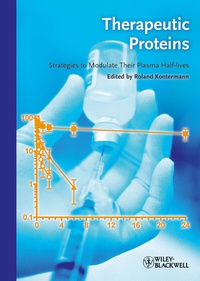
Therapeutic Proteins
Strategies to Modulate Their Plasma Half-lives
1. Auflage
Erschienen am 22. Februar 2012
Buch
Hardcover
XVIII, 354 Seiten
978-3-527-32849-9 (ISBN)
Beschreibung
For this ready reference, the internationally renowned authority in the field, Roland Kontermann, has assembled a team of outstanding contributors from industry and academia to convey the worldwide knowledge on modifying therapeutic proteins in order to optimize their pharmacological potential. The result is a comprehensive work covering all approaches and aspects of the topic in one handy volume, making this indispensable reading for companies and research institutions working on the development of biopharmaceuticals.
Rezensionen / Stimmen
"The majority of future protein therapeutics will be modified in one way or another using techniques and concepts described in this monograph. Therefore it can be safely stated that this is an extremely relevant contribution, which should be on hand for all those who think about or work on protein therapeutics." (Biotechnology Journal, Nov 2012)Weitere Details
Auflage
1. Auflage
Sprache
Englisch
Verlagsort
Berlin
Deutschland
Verlagsgruppe
Wiley-VCH
Zielgruppe
Für Beruf und Forschung
Illustrationen
124
74 s/w Abbildungen, 21 farbige Abbildungen, 29 s/w Tabellen
Maße
Höhe: 24 cm
Breite: 17 cm
Dicke: 2.2 cm
Gewicht
844 gr
ISBN-13
978-3-527-32849-9 (9783527328499)
Schweitzer Klassifikation
Weitere Ausgaben
Andere Ausgaben
E-Book
01/2012
1. Auflage
Wiley-Blackwell
129,99 €
Als Download verfügbar
E-Book
12/2011
1. Auflage
Wiley-Blackwell
129,99 €
Als Download verfügbar
Person
Roland Kontermann obtained his PhD in Molecular Biology from the University of Heidelberg. After working as a postdoc in the laboratory of Sir Gregory Winter at the MRC Centre for Protein Engineering, Cambridge, UK, he was a group leader at the Institute of Molecular Biology and Tumor Biology of the University of Marburg, and subsequently Head of Research at vectron therapeutics AG. Since 2004 he is Professor of Biomedical Engineering at the Institute of Cell Biology and Immunology of the University of Stuttgart. Current research focuses on the development of recombinant bispecific and bifunctional antibody molecules, including half-life extension strategies, and targeted nanoparticulate carrier systems for tumor therapy. He has over 60 scientific publications and co-editor (together with Stefan Dübel) of the Antibody Engineering Lab Manual.
Inhalt
GENERAL INFORMATION
Half-life modulating strategies - an introduction (Roland Kontermann)
Pharmacokinetics and half-life protein of therapeutics (Bernd Meibohm)
HALF-LIFE EXTENSION THROUGH CHEMICAL AND POSTTRANSLATIONAL MODIFICATIONS
Half-life extension through PEGylation (Simona Jevsevar and Menci Kunstelj)
Half-life extension of therapeutic proteins via genetic fusion to recombinant PEG mimetics
(Uli Binder and Arne Skerra)
Half-life extension through O-glyosylation (Fuad Fares)
Polysialic acid and polysialylation to modulate antibody pharmacokinetics (Antony Constantinou, Chen Chen and Mahendra P. Deonarain)
Half-life extension through HESylation (Thomas Hey, Helmut Knoller and Peter Vorstheim)
HALF-LIFE MODULATION INVOLVING RECYCLING BY THE NEONATAL FC RECEPTOR
The biology of FcRn (Jonghan Kim)
Half-life extension by fusion to the Fc region (Jalal A. Jazayeri and Graeme J Carroll)
Monomeric Fc fusion Technology: an approach to create long lasting clotting factors (Jennifer A. Dumont, Xiaomei Jei, Robert T. Peters, Alvin Luk, Glenn F. Pierce and Alan J. Bitonti)
The diverse roles of FcRn: implications for antibody engineering (Sally Ward and Raimund J. Ober)
Half-life extension by fusion to albumin (Hubert J. Metzner, Thomas Weimer and Stefan Schulte)
AlbudAb(TM) technology platform: versatile albumin binding domains for the development of therapeutics with tunable half-lives (Christopher Herring and Oliver Schon)
Half-life extension by binding to albumin through an albumin-binding domain (Fredrik Frejd)
Half-life extension by binding to albumin through small molecules (Sabrina Trüssel, Joerg Scheuermann and Dario Neri)
HALF-LIFE EXTENSION WITH PHARMACEUTICAL FORMULATIONS
Half-life extension with pharmaceutical formulations: liposomes (Astrid Hartung and Gerd Bendas)
Half-life extension with pharmaceutical formulations: nanoparticles (Katharina Landfester)
Half-life modulating strategies - an introduction (Roland Kontermann)
Pharmacokinetics and half-life protein of therapeutics (Bernd Meibohm)
HALF-LIFE EXTENSION THROUGH CHEMICAL AND POSTTRANSLATIONAL MODIFICATIONS
Half-life extension through PEGylation (Simona Jevsevar and Menci Kunstelj)
Half-life extension of therapeutic proteins via genetic fusion to recombinant PEG mimetics
(Uli Binder and Arne Skerra)
Half-life extension through O-glyosylation (Fuad Fares)
Polysialic acid and polysialylation to modulate antibody pharmacokinetics (Antony Constantinou, Chen Chen and Mahendra P. Deonarain)
Half-life extension through HESylation (Thomas Hey, Helmut Knoller and Peter Vorstheim)
HALF-LIFE MODULATION INVOLVING RECYCLING BY THE NEONATAL FC RECEPTOR
The biology of FcRn (Jonghan Kim)
Half-life extension by fusion to the Fc region (Jalal A. Jazayeri and Graeme J Carroll)
Monomeric Fc fusion Technology: an approach to create long lasting clotting factors (Jennifer A. Dumont, Xiaomei Jei, Robert T. Peters, Alvin Luk, Glenn F. Pierce and Alan J. Bitonti)
The diverse roles of FcRn: implications for antibody engineering (Sally Ward and Raimund J. Ober)
Half-life extension by fusion to albumin (Hubert J. Metzner, Thomas Weimer and Stefan Schulte)
AlbudAb(TM) technology platform: versatile albumin binding domains for the development of therapeutics with tunable half-lives (Christopher Herring and Oliver Schon)
Half-life extension by binding to albumin through an albumin-binding domain (Fredrik Frejd)
Half-life extension by binding to albumin through small molecules (Sabrina Trüssel, Joerg Scheuermann and Dario Neri)
HALF-LIFE EXTENSION WITH PHARMACEUTICAL FORMULATIONS
Half-life extension with pharmaceutical formulations: liposomes (Astrid Hartung and Gerd Bendas)
Half-life extension with pharmaceutical formulations: nanoparticles (Katharina Landfester)