

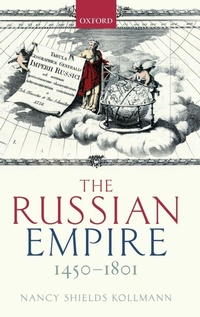
The Russian Empire 1450-1801
Erschienen am 19. Januar 2017
Buch
Hardcover
512 Seiten
978-0-19-928051-3 (ISBN)
Beschreibung
Modern Russian identity and historical experience has been largely shaped by Russia's imperial past: an empire that was founded in the early modern era and endures in large part today. The Russian Empire 1450-1801 surveys how the areas that made up the empire were conquered and how they were governed. It considers the Russian empire a 'Eurasian empire', characterized by a 'politics of difference': the rulers and their elites at the center defined the state's needs minimally - with control over defense, criminal law, taxation, and mobilization of resources - and otherwise tolerated local religions, languages, cultures, elites, and institutions. The center related to communities and religions vertically, according each a modicum of rights and autonomies, but didn't allow horizontal connections across nobilities, townsmen, or other groups potentially with common interests to coalesce. Thus, the Russian empire was multi-ethnic and multi-religious; Nancy Kollmann gives detailed attention to the major ethnic and religious groups, and surveys the government's strategies of governance - centralized bureaucracy, military reform, and a changed judicial system. The volume pays particular attention to the dissemination of a supranational ideology of political legitimacy in a variety of media - written sources and primarily public ritual, painting, and particularly architecture. Beginning with foundational features, such as geography, climate, demography, and geopolitical situation, The Russian Empire 1450-1801 explores the empire's primarily agrarian economy, serfdom, towns and trade, as well as the many religious groups - primarily Orthodoxy, Islam, and Buddhism. It tracks the emergence of an 'Imperial nobility' and a national self-consciousness that was, by the end of the eighteenth century, distinctly imperial, embracing the diversity of the empire's many peoples and cultures.
Rezensionen / Stimmen
Grounded upon an impressive list of renewed books and articles, Nancy Shields Kollmann offers here a wonderful synthesis of her long-standing contribution to the history of early modern Russia ... [an] excellent book * Alessandro Stanziani, Slavic Review * This excellent book provides a fresh, detailed treatment of the construction, operation, and composition of the Russian Empire during the early modern period.[A]n ideal reference work and introduction to early modern Russian history that does justice to the complexity of Russia's vast territory and diverse population, while never losing sight of larger themes... Highly recommended. * CHOICE * this masterpiece will accompany us for years to come. It is a gift given to the entire spectrum of people engaging with Russian history -- from the public to the specialists -- by a scholar most intimately with the sources as well as the scholarship. * Orel Beilinson, Reviews in History *Weitere Details
Reihe
Sprache
Englisch
Verlagsort
Oxford
Großbritannien
Zielgruppe
Für höhere Schule und Studium
Für Beruf und Forschung
Illustrationen
over 50 black and white images and maps
Maße
Höhe: 240 mm
Breite: 161 mm
Dicke: 32 mm
Gewicht
928 gr
ISBN-13
978-0-19-928051-3 (9780199280513)
Copyright in bibliographic data and cover images is held by Nielsen Book Services Limited or by the publishers or by their respective licensors: all rights reserved.
Schweitzer Klassifikation
Weitere Ausgaben
Andere Ausgaben
Nancy Shields Kollmann
The Russian Empire 1450-1801
E-Book
02/2017
1. Auflage
OUP eBook
74,49 €
Als Download verfügbar
Nancy Shields Kollmann
The Russian Empire 1450-1801
E-Book
12/2016
1. Auflage
OUP eBook
80,99 €
Als Download verfügbar
Person
Nancy Kollmann has taught early modern Russian history at Stanford University since 1982. Her research has focused on the problem of how politics worked in an autocratic state; she has studied how the great men of the Moscow court received and enhanced their political positions through marriage and kinship, how the tsar's government supported litigations over personal honor for all social groups as a means of social integration and how criminal law was applied in practice. She has also focused on the image of Russia conveyed to Europeans in contemporary engravings, maps, and books.
Inhalt
PART I: ASSEMBLING THE EMPIRE; PART II: THE MUSCOVITE EMPIRE THROUGH THE SEVENTEENTH CENTURY; PART III: THE CENTURY OF EMPIRE: RUSSIA IN THE EIGHTEENTH CENTURY