

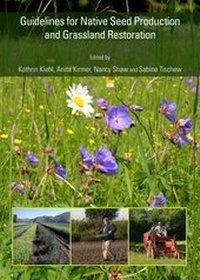
Guidelines for Native Seed Production and Grassland Restoration
Erschienen am 25. Juni 2014
Buch
Hardcover
315 Seiten
978-1-4438-5900-4 (ISBN)
Beschreibung
World-wide, the degradation and destruction of both natural and traditionally used semi-natural ecosystems is drastically increasing. Unfortunately, commercial seed mixtures, consisting of non-native species and genetically uniform cultivars, are widely used in grassland restoration, often with negative effects on biodiversity. Therefore, native species should be used in the ecological restoration of natural and semi-natural vegetation. This book compiles results from recent studies presented at a Special Session "Native seed production and use in restoration projects", which was organised during the 8th European Conference on Ecological Restoration in Ceske Budejovice, Czech Republic.The authors review the ecological and genetic aspects of seed propagation and species introduction both from a European and an American perspective, and discuss implications for the development of seed zones and for native seed production. Examples from different countries focus on native seed production in practice, and suggest different approaches for the certification of seed provenance.Best practice examples from Europe and the United States are used to indicate the advantages of using native seeds for ecological restoration of grasslands, field margins and sagebrush steppe. Finally, this volume also provides guidelines for the successful implementation of restoration projects for local authorities, landscape planners and NGOs in order to bridge gaps between research and practice.
Rezensionen / Stimmen
'The best practice examples from Europe and the United States in the book indicate the advantages of using native plant material of regional provenance for ecological restoration in a variety of ecosystems. Although restoration approaches can be generalized only so far, thewide range of restoration goals and measures together with the guidelines for successful implementation of restoration projects provide a good starting point for those wishing to engage in seed-based restoration.'Conservation Biology 32/4 (2018)Weitere Details
Auflage
Unabridged edition
Sprache
Englisch
Verlagsort
Newcastle upon Tyne
Großbritannien
Zielgruppe
Für höhere Schule und Studium
Für Beruf und Forschung
Editions-Typ
Ungekürzte Ausgabe
Produkt-Hinweis
mit Schutzumschlag
Maße
Höhe: 212 mm
Breite: 148 mm
ISBN-13
978-1-4438-5900-4 (9781443859004)
Copyright in bibliographic data and cover images is held by Nielsen Book Services Limited or by the publishers or by their respective licensors: all rights reserved.
Schweitzer Klassifikation
Weitere Ausgaben
Andere Ausgaben
Kathrin Kiehl | Anita Kirmer | Nancy Shaw
Guidelines for Native Seed Production and Grassland Restoration
E-Book
06/2014
1. Auflage
Cambridge Scholars Publishing
132,59 €
Als Download verfügbar
Personen
Kathrin Kiehl is Professor of Vegetation Ecology at Osnabrueck University of Applied Sciences, Germany. She has studied the effects of species introduction in restoration of different types of grasslands in Europe for more than 15 years.Anita Kirmer is a Senior Researcher and Lecturer at the Anhalt University of Applied Sciences, Germany. She has long-term experience in the ecological restoration of grassland in mined areas, agricultural land and nature conservation sites.Nancy Shaw is a Research Botanist (Emeritus) with the USDA Forest Service, Rocky Mountain Research Station's Grassland Shrubland and Desert Ecosystem Research Program (USA). Her research has focused on the development, propagation, and use of genetically appropriate native plant materials for the Great Basin.Sabine Tischew holds the Chair of Vegetation Science and Landscape Ecology at the Anhalt University of Applied Science in Bernburg, Germany. Together with her working group she developed strategies for near-natural restoration of degraded ecosystems and their practical implementation.All editors are active members of the Society for Ecological Restoration (SER).