

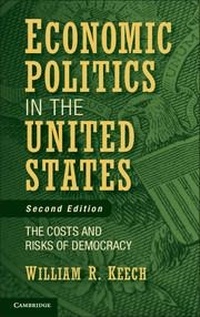
Economic Politics in the United States
The Costs and Risks of Democracy
2. Auflage
Erscheint ca. am 14. Oktober 2013
Buch
Softcover
300 Seiten
978-0-521-17867-9 (ISBN)
Beschreibung
Employing macroeconomic performance as a lens to evaluate democratic institutions, the author uses models of political behavior that allow for opportunism on the part of public officials and shortsightedness on the part of voters to see if democratic institutions lead to inferior macroeconomic performance. We have learned more about how and why democracy can work well or badly in the years since the first edition was published. It was not previously apparent how much the good performance of democracy in the United States was contingent on informal rules and institutions of restraint that are not part of the definition of democracy. Since that first edition, the United States has experienced soaring indebtedness, unintended adverse consequences of housing policy, and massive problems in the financial system. Each of these was permitted or encouraged by the incentives of electoral politics and by limitations on government, the two essential features of democratic institutions.
Rezensionen / Stimmen
'In this important new edition, Bill Keech, one of the first political scientists to apply macroeconomic tools and research to political questions, revisits his prior inquiry on the 'health' of economic politics. But, in doing so, he also extends his discussion to incorporate many new findings in macro political economy. These additional results enhance our understanding of how and how well representative government performs. What is more, this book reflects the author's qualities: clear in exposition and sober in outlook. Very few social scientists have his scholarly breadth to engage the varied literatures from different disciplines - and even fewer could have written a contribution like this.' Jim Granato, University of HoustonWeitere Details
Auflage
2nd Revised edition
Sprache
Englisch
Verlagsort
Cambridge
Großbritannien
Zielgruppe
Für höhere Schule und Studium
Für Beruf und Forschung
Editions-Typ
Überarbeitete Ausgabe
Produkt-Hinweis
Broschur/Paperback
Illustrationen
8 Tables, unspecified; 8 Line drawings, unspecified
Maße
Höhe: 228 mm
Breite: 152 mm
Dicke: 16 mm
Gewicht
420 gr
ISBN-13
978-0-521-17867-9 (9780521178679)
Copyright in bibliographic data and cover images is held by Nielsen Book Services Limited or by the publishers or by their respective licensors: all rights reserved.
Schweitzer Klassifikation
Weitere Ausgaben
Andere Ausgaben
Buch
10/2013
2. Auflage
Cambridge University Press
99,10 €
Versand in 15-20 Tagen
E-Book
09/2013
2. Auflage
Cambridge University Press
32,49 €
Als Download verfügbar
Person
William Keech is Research Professor of Political Economy in the Department of Political Science at Duke University. Keech is the author of numerous books, including the first edition of Economic Politics in the United States (Cambridge University Press, 1995), and his articles have appeared in academic journals such as the American Political Science Review, Public Choice, and the American Economic Review. Most of his academic career has been at the University of North Carolina, Chapel Hill and Carnegie Mellon University. He has been president of the Southern Political Science Association and a member of the Council of the American Political Science Association. He received his PhD from the University of Wisconsin, Madison.
Inhalt
Part I. Introduction: 1. Macroeconomic politics and the costs and risks of democracy; 2. Macroeconomic theories and their political implications; Part II. Models of Macroeconomic Politics: 3. Models of accountability and opportunism: the electoral cycle; 4. Models of choice: partisanship; 5. Unintended consequences, moral hazard, and time consistency; Part III. The Sources and Authority of Macroeconomic Goals: 6. The authority of macroeconomic goals; 7. Voters, elections, accountability, and choice; Part IV. Institutions and Processes: 8. Rules, discretion, and accountability in the monetary policy process; 9. Rules, discretion, and accountability in the fiscal policy process; Part IV. Conclusion: 10. The costs and risks of democracy.