

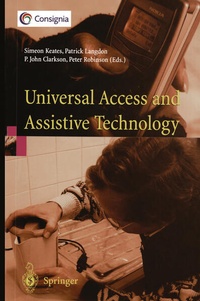
Universal Access and Assistive Technology
Proceedings of the Cambridge Workshop on UA and AT '02
Erschienen am 3. Oktober 2013
Buch
Softcover
XIV, 306 Seiten
978-1-4471-3721-4 (ISBN)
Beschreibung
The first Cambridge Workshop on Universal Access and Assistive Technology (CWUAAT) was held at Trinity Hall, Cambridge, in March 2002. It was inspired by the earlier, highly successful Cambridge Workshops on Rehabilitation Robotics organised by the late Robin Jackson. Robin was the founder of Rehabilitation Research at Cambridge which now continues in the Engineering Design Centre within the Department of Engineering, led by John Clarkson and Simeon Keates, and in the Rainbow Group within the Computer Laboratory led by Peter Robinson. CWUAAT represents the first in a new series of workshops that we are aiming to hold every two years which, reflecting the spirit of recent moves to extend the rights for universal accessibility, will encourage discussion of a broad range of interests. There will be a general focus on product/solution development. Hence it is intended that the principal requirements for the successful design of assistive technology shall be addressed, where these range from the identification and capture of the needs of the users, through to the development and evaluation of truly usable and accessible systems for users with special needs. The best submissions received for the first CWUAAT are contained in this book, where the contributors are all leading researchers in the fields of Universal Access and Assistive Technology and represent a large part of the international research community. They include, though not exclusively, computer scientists, designers, engineers, industrial representatives, ergonomists and sociologists.
Weitere Details
Auflage
Softcover reprint of the original 1st ed. 2002
Sprache
Englisch
Verlagsort
London
Großbritannien
Zielgruppe
Für Beruf und Forschung
Research
Illustrationen
XIV, 306 p.
Maße
Höhe: 229 mm
Breite: 152 mm
Dicke: 18 mm
Gewicht
471 gr
ISBN-13
978-1-4471-3721-4 (9781447137214)
DOI
10.1007/978-1-4471-3719-1
Schweitzer Klassifikation
Weitere Ausgaben
Andere Ausgaben
Simeon Keates | Patrick Langdon | P. John Clarkson
Universal Access and Assistive Technology
Proceedings of the Cambridge Workshop on UA and AT '02
E-Book
06/2013
Springer
149,79 €
Als Download verfügbar

Simeon Keates | Patrick Langdon | P. John Clarkson
Universal Access and Assistive Technology
Proceedings of the Cambridge Workshop on UA and AT '02
Buch
02/2002
Springer
85,59 €
Artikel ist vergriffen; siehe andere Ausgabe
Inhalt
1. Commercial Perspectives on Universal Access and Assistive Technology.- 2. Defining Design Exclusion.- 3. Quantifying Design Exclusion.- 4. Countering Design Exclusion.- 5. Inclusive Design - Developing Theory Through Practice.- 6. A Systematic Basis for Developing Cognitive Assessment Methods for Assistive Technology.- 7. Control of Virtual Environments for People with Intellectual Disabilities.- 8. Why Are Eye Mice Unpopular? - A Detailed Comparison of Head and Eye Controlled Assistive Technology Pointing Devices.- 9. Cursor Characterisation and Haptic Interfaces for Motion-impaired Users.- 10. Web-based Multimodal Graphs for Visually Impaired People.- 11. Automatically Rearranging Structured Data for Customised Special-needs Presentations.- 12. Bridging the Education Divide.- 13. Contextual On-line Help: A Contribution to the Implementation of Universal Access.- 14. 3rd Age Interfaces: A Usability Evaluation of the 'Your Guide' Kiosk Prototype from an Older User's Perspective.- 15. Virtual Environments for the Training of the Visually Impaired.- 16. User Involvement in the Design of a New Multimedia Communication Service.- 17. Issues Surrounding the User-centred Development of a New Interactive Memory Aid.- 18. Games Children with Autism Can Play With Robota, a Humanoid Robotic Doll.- 19. Progress of a Modular Prosthetic Arm.- 20. Development of a Novel Type Rehabilitation Robotic System KARES II.- 21. Improving the Flexibility of an Assistive Robot.- 22. Commercialising Assistive and Therapy Robotics.- 23. Improved Assistive Technology Prescription via Usage Log Analysis.- 24. Virtual Interface Development and Sensor-based Door Navigation for Nonholonomic Vehicles.- 25. An Ergonomic One-handed Wheelchair.- 26. Gathering User Needs in the Development ofthe POWER-HAND Opening Aid - A Successful Consumer Product for the Wider Market.- 27. Locomotion Assistance for the Blind.- 28. 'Keep Taking the Medication': Assistive Technology for Medication Regimes in Care Settings.- 29. "I can't talk now" and Other Design Stories: Four Assistive Technologies for People With and Without Disabilities.- Index of Contributors.