

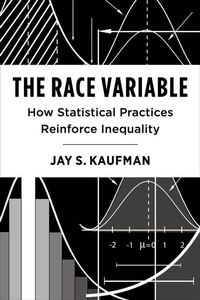
The Race Variable
How Statistical Practices Reinforce Inequality
Erschienen am 9. Dezember 2025
Buch
Softcover
256 Seiten
978-0-231-21363-9 (ISBN)
Beschreibung
From social science and biomedical research to government and media reporting, statistics on racial and ethnic disparities are everywhere. The numbers we typically encounter, however, are not straightforward comparisons. Researchers analyze data using adjustments such as regression models that are intended to address bias and confounding factors. Yet many common statistical practices produce misleading results, and some have flawed assumptions that inadvertently misrepresent the inequalities between groups.
Jay S. Kaufman offers a clear and accessible guide to understanding the use and abuse of statistics on racial and ethnic disparities. Examining dozens of real-world examples spanning medicine, economics, education, and criminal justice, he shows how typical statistical practices-no matter how well-intentioned-have obscured the realities of injustice, with significant consequences for public policy. Kaufman considers how to select and apply statistical adjustments responsibly and systematically, and he proposes ways to improve the explanation and analysis of racial and ethnic inequalities.
Written for readers without a background in statistics, this book provides an essential introduction to quantitative reasoning in terms of social justice. The Race Variable is appropriate for undergraduate and graduate courses across the medical and social sciences-including sociology, demography, public health, epidemiology, medicine, and public policy-that focus on racial and ethnic disparities, and for all readers interested in the statistical foundations of our understanding of inequality.
Jay S. Kaufman offers a clear and accessible guide to understanding the use and abuse of statistics on racial and ethnic disparities. Examining dozens of real-world examples spanning medicine, economics, education, and criminal justice, he shows how typical statistical practices-no matter how well-intentioned-have obscured the realities of injustice, with significant consequences for public policy. Kaufman considers how to select and apply statistical adjustments responsibly and systematically, and he proposes ways to improve the explanation and analysis of racial and ethnic inequalities.
Written for readers without a background in statistics, this book provides an essential introduction to quantitative reasoning in terms of social justice. The Race Variable is appropriate for undergraduate and graduate courses across the medical and social sciences-including sociology, demography, public health, epidemiology, medicine, and public policy-that focus on racial and ethnic disparities, and for all readers interested in the statistical foundations of our understanding of inequality.
Rezensionen / Stimmen
The Race Variable is simultaneously a primer on the use of statistics in the study of health disparities and an advanced master class in quantitative social science. Kaufman has produced a book that will be useful to both a lay audience and to seasoned professionals by meticulously illuminating the pitfalls and hidden assumptions about how we use racial categories. -- Troy Duster, author of <i>Backdoor to Eugenics</i> This book provides an invaluable cautionary tale, describing the many kinds of mistakes that are routinely made by doctors and scientists with regards to race and ethnicity and offering guidance to practitioners and researchers alike. -- David S. Jones, author of <i>Broken Hearts: The Tangled History of Cardiac Care</i>Weitere Details
Reihe
Sprache
Englisch
Verlagsort
New York
USA
Zielgruppe
Für höhere Schule und Studium
Produkt-Hinweis
Broschur/Paperback
Illustrationen
43 b&w illustrations
Maße
Höhe: 227 mm
Breite: 152 mm
Dicke: 17 mm
Gewicht
380 gr
ISBN-13
978-0-231-21363-9 (9780231213639)
Copyright in bibliographic data and cover images is held by Nielsen Book Services Limited or by the publishers or by their respective licensors: all rights reserved.
Schweitzer Klassifikation
Weitere Ausgaben
Andere Ausgaben
E-Book
12/2025
1. Auflage
Columbia University Press
31,49 €
Als Download verfügbar
Person
Jay S. Kaufman is a professor in the Department of Epidemiology, Biostatistics, and Occupational Health at McGill University. A former president of the Society for Epidemiological Research, he is an editor of the journal Epidemiology and coeditor of the textbook Methods in Social Epidemiology (second edition, 2017).
Inhalt
Acknowledgments
Introduction
1. What Is This Thing Called Race?
2. Causality and the Fundamental Challenge of Observed Correlation
3. Making Other Worlds
4. Crude Versus Adjusted Racial and Ethnic Comparisons
5. Conditional Disparities Are the Devil's Playground
6. The Mismeasure of Man
7. Proxies and Predictions
8. Filters and Screens
9. Scales, Values, and Preferences
10. What Explains a Disparity?
11. Nature Versus Nurture
Conclusion
Notes
Index
Introduction
1. What Is This Thing Called Race?
2. Causality and the Fundamental Challenge of Observed Correlation
3. Making Other Worlds
4. Crude Versus Adjusted Racial and Ethnic Comparisons
5. Conditional Disparities Are the Devil's Playground
6. The Mismeasure of Man
7. Proxies and Predictions
8. Filters and Screens
9. Scales, Values, and Preferences
10. What Explains a Disparity?
11. Nature Versus Nurture
Conclusion
Notes
Index