

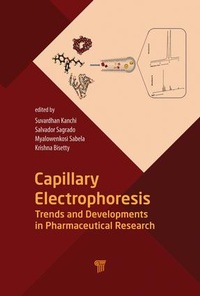
Capillary Electrophoresis
Trends and Developments in Pharmaceutical Research
1. Auflage
Erschienen am 10. August 2017
Buch
Hardcover
396 Seiten
978-981-4774-12-3 (ISBN)
Beschreibung
Capillary electrophoresis (CE) has become an established method with widespread recognition as an analytical technique of choice in numerous analytical laboratories, including industrial and academic sectors. Pharmaceutical and biochemical research and quality control are the most important CE applications. This book provides a comparative assessment of related techniques on mode selection, method development, detection, and quantitative analysis and estimation of pharmacokinetic parameters and broadens the understanding of modern CE applications, developments, and prospects. It introduces the fundamentals of CE and clearly outlines the procedures used to mitigate several barriers, such as detection limits, signal detection, changing capillary environment, resolution separation of analytes, and hyphenation of mass spectrometry with CE, for a range of analytical problems. Each chapter outlines a specific electrophoretic variant with detailed instructions and some standard operating procedures. In this respect, the book meets its desired goal of rendering assistance to lovers of electrophoresis.
Rezensionen / Stimmen
"Decades after its introduction, capillary electrophoresis has evolved into a mature technique, especially in the field of pharmaceutical analysis. This book focuses on a number of fields in which this separation technique has proven its unique usefulness, such as chiral separations and the analysis of protein biopharmaceuticals. It highlights the current state of the art and offers high-quality general chapters and overviews as well as topical chapters. Recommended reading for all those involved in pharmaceutical analysis, albeit academically or industrially!"-Prof. Ann Van Schepdael, University of Leuven, Belgium
Weitere Details
Sprache
Englisch
Verlagsort
Singapore
Singapure
Zielgruppe
Für Beruf und Forschung
Für höhere Schule und Studium
Academic, Postgraduate, and Professional Practice & Development
Illustrationen
60 s/w Abbildungen, 15 farbige Abbildungen, 15 s/w Tabellen
15 Tables, black and white; 15 Illustrations, color; 60 Illustrations, black and white
Maße
Höhe: 229 mm
Breite: 152 mm
Gewicht
818 gr
ISBN-13
978-981-4774-12-3 (9789814774123)
Copyright in bibliographic data and cover images is held by Nielsen Book Services Limited or by the publishers or by their respective licensors: all rights reserved.
Schweitzer Klassifikation
Weitere Ausgaben
Andere Ausgaben
Suvardhan Kanchi | Salvador Sagrado | Myalo I. Sabela
Capillary Electrophoresis
Trends and Developments in Pharmaceutical Research
E-Book
08/2017
1. Auflage
Routledge
125,99 €
Als Download verfügbar
Suvardhan Kanchi | Salvador Sagrado | Myalo I. Sabela
Capillary Electrophoresis
Trends and Developments in Pharmaceutical Research
E-Book
08/2017
1. Auflage
Routledge
125,99 €
Als Download verfügbar
Personen
Suvardhan Kanchi is a research scientist in the Department of Chemistry, Durban University of Technology (DUT), South Africa. His current research involves method development to separate organic and inorganic molecules from environmental samples using CE. He is also interested in fabrication of electrochemical nano-biosensors for high-intensity artificial sweeteners, bisphenols, and dyes.
Salvador Sagrado is full professor in the Department of Analytical Chemistry, Universitat de Valencia (UV), and secretary of the Interuniversity Research Institute for Molecular Recognition and Technological Development (IDM), Universitat Politecnica de Valencia, Spain. His current research focuses on chemometrics and enantioselectivity.
Myalowenkosi Sabela is currently conducting doctoral research at DUT and has been a recipient of the Erasmus Mundus-EUROSA fellowship 2014-2015. His research interest is in pharmacokinetic and enantioselective parameters of pharmaceutical compounds in the presence of biomacromolecules and nanoparticles for applications such as diagnostics and sensors.
Krishna Bisetty is head of the Department of Chemistry at DUT. His current research is largely based on high-performance computing ranging from small organic molecules to bioactive macromolecules including the development of computational models for the design of more effective host-guest systems using state-of-the-art molecular dynamics and docking simulations supported by experimental studies.
Salvador Sagrado is full professor in the Department of Analytical Chemistry, Universitat de Valencia (UV), and secretary of the Interuniversity Research Institute for Molecular Recognition and Technological Development (IDM), Universitat Politecnica de Valencia, Spain. His current research focuses on chemometrics and enantioselectivity.
Myalowenkosi Sabela is currently conducting doctoral research at DUT and has been a recipient of the Erasmus Mundus-EUROSA fellowship 2014-2015. His research interest is in pharmacokinetic and enantioselective parameters of pharmaceutical compounds in the presence of biomacromolecules and nanoparticles for applications such as diagnostics and sensors.
Krishna Bisetty is head of the Department of Chemistry at DUT. His current research is largely based on high-performance computing ranging from small organic molecules to bioactive macromolecules including the development of computational models for the design of more effective host-guest systems using state-of-the-art molecular dynamics and docking simulations supported by experimental studies.
Inhalt
Capillary Electrophoresis: A Versatile Technique in Pharmaceutical Analysis. Recent Applications of Chiral Capillary Electrophoresis in Pharmaceutical Analysis. A Mini-Review on Enantiomeric Separation of Ofloxacin using Capillary Electrophoresis: Pharmaceutical Applications. Nano-Stationary Phases for Capillary Electrophoresis Techniques. Capillary Electrophoresis Coupled to Mass Spectrometry for Enantiomeric Drugs Analysis. Enantioselective Drug-Plasma Protein-Binding Studies by Capillary Electrophoresis. Clinical Use of Capillary Zone Electrophoresis: New Insights into Parkinson's Disease. Electrophoretically Mediated Microanalysis for Evaluation of Enantioselective Drug Metabolism. Capillary Electrophoresis for the Quality Control of Intact Therapeutic Monoclonal Antibodies. Molecular Simulation of Chiral Selector-Enantiomer Interactions through Docking: Antimalarial Drugs as Case Study.