

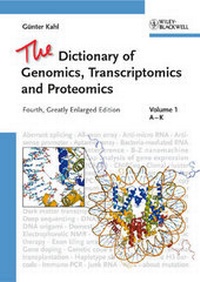
The Dictionary of Genomics, Transcriptomics and Proteomics
4. Auflage
Erschienen am 18. Februar 2009
Buch
Hardcover
LIV, 1862 Seiten
978-3-527-32073-8 (ISBN)
Beschreibung
This fourth edition of a very successful longseller and a leading title is now neatly divided into three volumes, with the text thoroughly updated and expanded by around 30 %. The result is some 12,000 entries providing comprehensive coverage of genomics, transcriptomics and proteomics. Each entry is accompanied by an extensive explanation including a complete listing of synonyms and acronyms and most also contain cross-references to related terms. All the formulas have been professionally redrawn to create a uniform style and most of the figures are custom designed for the dictionary.
Die vierte Auflage dieses seit Langem überaus erfolgreichen Lexikons umfasst nun drei Bände, wurde sorgfältig aktualisiert und um etwa 30 % erweitert. Rund 12.000 Einträge bieten umfassende Erläuterungen zur Genomik, Transkriptomik und Proteomik.
Die vierte Auflage dieses seit Langem überaus erfolgreichen Lexikons umfasst nun drei Bände, wurde sorgfältig aktualisiert und um etwa 30 % erweitert. Rund 12.000 Einträge bieten umfassende Erläuterungen zur Genomik, Transkriptomik und Proteomik.
Rezensionen / Stimmen
"...this book should be available within hand's reach for everyone who is enthusiastically involved with molecular biology and gene technology."Angewandte Chemie
"This book is much more than what its concise title implies - it is more than a mere dictionary, in the sense of a collection of terms and acronyms, but rather a self-sufficient research tool, an illuminating read, and in fact an entire encyclopedia for the post-genomic era." Trends in Molecular Medicine
" This precious piece cannot be missed in any library or laboratory, nor on any desk!" BioTec
"Physically the book is beautifully presented on high quality paper and one aspect that I particulary like is the plethora of illustrations. ... this book would make a useful addition to any academic library."
School of Biosciences, Univ. of Birmingham, ISSX newsletter
"...essential for students, faculty, and researchers in genetics, biochemistry, biotechnology, and microbiology..."
CHOICE
"In summary, this is a useful resource that many institutions, academic departments, and laboratories may consider having on their reference shelves."
Clinical Chemistry
Weitere Details
Auflage
4. stark erweiterte Auflage
Sprache
Englisch
Verlagsort
Berlin
Deutschland
Verlagsgruppe
Wiley-VCH
Zielgruppe
Für Beruf und Forschung
Illustrationen
474
24 s/w Tabellen, 14 farbige Abbildungen, 474 s/w Abbildungen
Maße
Höhe: 24 cm
Breite: 17 cm
Dicke: 11 cm
Gewicht
4068 gr
ISBN-13
978-3-527-32073-8 (9783527320738)
Schweitzer Klassifikation
Weitere Ausgaben
Nachauflagen

Buch
04/2015
5. Auflage
Wiley-Blackwell
730,00 €
Artikel ist vergriffen; siehe andere Ausgabe
Vorauflage
Buch
06/2004
3. Auflage
Wiley-VCH
325,00 €
Artikel ist vergriffen; siehe Neuauflage
Person
Günter Kahl is Professor of Plant Molecular Biology at Johann Wolfgang Goethe University, Frankfurt am Main, Germany. After gaining his Ph.D. in plant biochemistry, he spent two postdoctoral years at Michigan State University, East Lansing, USA, joining Professor Joe Varner and Professor James Bonner at the California Institute of Technology, Pasadena. His main research interests focus on
- Gene technology, in particular the genetic and physical mapping as well as the isolation and characterization of plant defence genes and their promoters, and the use of in vitro modified defence genes for the improvement of plant crops via gene transfer.
- Plant genome analysis, in particular the development of molecular marker technologies and informative DNA markers for genomic fingerprinting, the establishment of genetic maps, the use of BAC libraries and physical mapping, and the map-based cloning of agronomically important genes.
- Expression profiling of plant tissues with expression microarrays and high-throughput techniques such as SAGE.
Due to the international nature of this work, Professor Kahl collaborates with a series of research institutions throughout Europe, in Japan, the USA, Syria, India, and South America. In addition, he is currently organizing a series of molecular marker courses in Austria, South America, Asia, Africa and the Middle East. He has also served in expert missions for IAEA, FAO and UNESCO in these and many other countries.
Professor Kahl is the author of more than 250 scientific publications, and is currently CSO at GenXPro, a company specializing in novel technologies in genomics and transcriptomics, located at the Frankfurt Innovation Center for Biotechnology (FIZ), Frankfurt am Main, Germany.
- Gene technology, in particular the genetic and physical mapping as well as the isolation and characterization of plant defence genes and their promoters, and the use of in vitro modified defence genes for the improvement of plant crops via gene transfer.
- Plant genome analysis, in particular the development of molecular marker technologies and informative DNA markers for genomic fingerprinting, the establishment of genetic maps, the use of BAC libraries and physical mapping, and the map-based cloning of agronomically important genes.
- Expression profiling of plant tissues with expression microarrays and high-throughput techniques such as SAGE.
Due to the international nature of this work, Professor Kahl collaborates with a series of research institutions throughout Europe, in Japan, the USA, Syria, India, and South America. In addition, he is currently organizing a series of molecular marker courses in Austria, South America, Asia, Africa and the Middle East. He has also served in expert missions for IAEA, FAO and UNESCO in these and many other countries.
Professor Kahl is the author of more than 250 scientific publications, and is currently CSO at GenXPro, a company specializing in novel technologies in genomics and transcriptomics, located at the Frankfurt Innovation Center for Biotechnology (FIZ), Frankfurt am Main, Germany.
Inhalt
Instructions for Users. A to Z.
Appendix 1 Units and Conversion Factors.
Appendix 2 Restriction Endonucleases.
Appendix 3 Databases.
Appendix 4 Scientifi c Journals.
Appendix 5 Acknowledgements.
Appendix 1 Units and Conversion Factors.
Appendix 2 Restriction Endonucleases.
Appendix 3 Databases.
Appendix 4 Scientifi c Journals.
Appendix 5 Acknowledgements.