

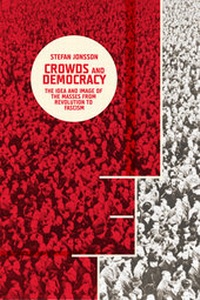
Crowds and Democracy
The Idea and Image of the Masses from Revolution to Fascism
Erscheint ca. am 1. Oktober 2013
Buch
Hardcover
336 Seiten
978-0-231-16478-8 (ISBN)
Beschreibung
Between 1918 and 1933, the masses became a decisive preoccupation of European culture, fueling modernist movements in art, literature, architecture, theater, and cinema, as well as the rise of communism and fascism and experiments in radical democracy. Spanning aesthetics, cultural studies, intellectual history, and political theory, this volume unpacks the significance of the shadow agent known as "the mass" during a critical period in European history. It follows its evolution into the preferred conceptual tool for social scientists, the ideal slogan for politicians, and the chosen image for artists and writers trying to capture a society in flux and a people in upheaval. This volume is the second installment in Stefan Jonsson's epic study of the crowd and the mass in modern Europe, building on his work in A Brief History of the Masses, which focused on monumental artworks produced in 1789, 1889, and 1989.
Rezensionen / Stimmen
In his demonstrable command of the cross-disciplinary fund of available literatures and their respective knowledges, Jonsson's treatments effectively dissolve any meaningful boundary among literary criticism, philosophical explication, and intellectual and cultural history. -- Geoff Eley, University of Michigan In his strikingly choreographed and beautifully written study, Jonsson traverses an extensive archive, delving into novels and artworks, philosophy, historiography, and psychoanalysis. From this remarkable interdisciplinary bricolage emerges a profound set of insights into the shifting notions of the masses during the interwar years. -- Kerstin Barndt, University of Michigan A magnificent sociocultural analysis, written with the erudition of the intellectual historian and the vision of a photographer in the captivating prose of the experienced journalist. -- Goran Therborn, University of Cambridge Stefan Jonsson's book analyzes in depth, but also with wit and elegance, the centrality of the 'masses' as a problematic category in the troubled trajectories of Germany and Austria in the interwar period. Reading discourses and images that range from sociology to theater and photography, with Simmel and Freud as core theorists of the new regime of the collective passions and expressionism and modernism as extreme forms of its aesthetic representation, Jonsson convincingly argues that what was at stake and made democracy unstable was not only the violence of political movements but also the aporia of the modern individuality. This offers fascinating insights into our own contemporary cultural crisis. -- Etienne Balibar, author of We, the People of Europe? Reflections on Transnational CitizenshipWeitere Details
Reihe
Sprache
Englisch
Verlagsort
New York
USA
Zielgruppe
Für Beruf und Forschung
Produkt-Hinweis
Standardbindung
Illustrationen
33 Illustrations
Maße
Höhe: 229 mm
Breite: 152 mm
Gewicht
595 gr
ISBN-13
978-0-231-16478-8 (9780231164788)
Copyright in bibliographic data and cover images is held by Nielsen Book Services Limited or by the publishers or by their respective licensors: all rights reserved.
Schweitzer Klassifikation
Weitere Ausgaben
Andere Ausgaben
E-Book
08/2015
1. Auflage
De Gruyter
ab
56,95 €
Als Download verfügbar
Person
Stefan Jonsson is a writer and critic based in Sweden and professor of ethnic studies at Linkoping University. His previous books include A Brief History of the Masses: Three Revolutions and Subject Without Nation: Robert Musil and the History of Modern Identity.
Inhalt
List of Illustrations Preface 1. Introducing the Masses: Vienna 2. Authority Versus Anarchy: Allegories of the Mass in Sociology and Literature 3. The Revolving Nature of the Social: Primal Hordes and Crowds Without Qualities 4. Collective Vision: A Matrix for New Art and Politics 5. Coda: Remnants of Weimar Notes Index
Read an excerpt from the chapter, "Introducing the Masses":