

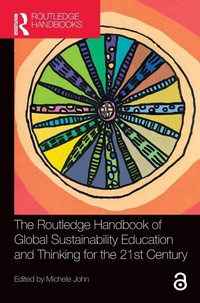
The Routledge Handbook of Global Sustainability Education and Thinking for the 21st Century
1. Auflage
Erschienen am 20. Februar 2025
Buch
Hardcover
952 Seiten
978-0-367-76065-6 (ISBN)
Beschreibung
This Handbook emerges as a pivotal resource in underscoring the important role of sustainability education in catalysing a global shift toward sustainable development. It articulates the need for a profound transformation within institutional leadership and educational frameworks to support the critical global sustainability transition.
This Handbook explores sustainability thinking as a critical paradigm shift in confronting the multifaceted challenges of sustainable development. It presents an urgent case for a systemic overhaul in our approach to education in the 21st century, advocating for multidisciplinary education and holistic systems thinking in order to more successfully navigate the complexities of sustainable development.
The text discusses the foundational elements of modern sustainability thought and management, including the significance of values, ethics, governance, and the pressing issues of environmental degradation and climate change. It offers an extensive trans-disciplinary overview of sustainability discourse, spanning a broad array of perspectives on sustainability management and education.
It provides a comprehensive introduction to the language of sustainability and a detailed examination of sustainability issues, highlighting their implications for education, training, and management development. It addresses urgent global issues such as decarbonisation, resource scarcity, population dynamics, pollution, and land degradation, emphasising the crucial role of educational initiatives in helping to mitigate these challenges.
This seminal work has been developed for a diverse audience, including academics, policymakers, students, and educators, serving as a valuable tool for those wanting to comprehend complex global sustainability challenges and the paramount importance of education in supporting global sustainability in the 21st century.
This Handbook explores sustainability thinking as a critical paradigm shift in confronting the multifaceted challenges of sustainable development. It presents an urgent case for a systemic overhaul in our approach to education in the 21st century, advocating for multidisciplinary education and holistic systems thinking in order to more successfully navigate the complexities of sustainable development.
The text discusses the foundational elements of modern sustainability thought and management, including the significance of values, ethics, governance, and the pressing issues of environmental degradation and climate change. It offers an extensive trans-disciplinary overview of sustainability discourse, spanning a broad array of perspectives on sustainability management and education.
It provides a comprehensive introduction to the language of sustainability and a detailed examination of sustainability issues, highlighting their implications for education, training, and management development. It addresses urgent global issues such as decarbonisation, resource scarcity, population dynamics, pollution, and land degradation, emphasising the crucial role of educational initiatives in helping to mitigate these challenges.
This seminal work has been developed for a diverse audience, including academics, policymakers, students, and educators, serving as a valuable tool for those wanting to comprehend complex global sustainability challenges and the paramount importance of education in supporting global sustainability in the 21st century.
Rezensionen / Stimmen
"As a resource for those seeking to foster a culture of humility, and an ethic of restraint and creativity to match our fraught moment in history, this Handbook may prove invaluable."Tim Winton AO, Australian author
"The Routledge Handbook of Global Sustainability Education and Thinking for the 21st Century takes on big topics like climate change, mass extinctions, food production, forests, population, energy, and waste, while speaking the language of higher education: faculty support and training, leadership, governance, pedagogies, competencies. May this handbook be the positive tipping point that transforms colleges and universities everywhere into the Noble endeavours we urgently need them to be."
Krista Hiser, PhD Professor and Senior Lead and Advisor for Sustainability Education; Global Council for Science and the Environment, Washington, D.C.
"A comprehensive international guide to the big issues facing humankind and what educators can do. A vitally important and timely book for teachers at all levels. Highly recommended."
David W. Orr, Professor of Practice, Arizona State University and Editor: Democracy in a Hotter Time (2023)
"Education is the single most important investment that any society makes - and this timely collection of essays underscores the fact that sustainability education must now be our #1 priority if we are to make sense of the emerging market and political dynamics of the Anthropocene epoch in which we now find ourselves."
John Elkington, Co-founder of Environmental Data Services (ENDS), SustainAbility and Volans, Author: Green Swans: The Coming Boom in Regenerative Capitalism (2020)
"The current development trajectory is not sustainable. It is no exaggeration to say that our civilisation can only survive if we are educated about the principles of sustainable futures. This Handbook gives educators the tools and examples to fulfill their responsibility to future generations, helping us all to live sustainably."
Ian Lowe, Emeritus Professor and Author: Australia on the Brink: Avoiding Environmental Ruin (2023)
"Progress toward sustainable development will require the reconceptualization and reorganization of our colleges and universities. Toward an essential transformation of sustainability education, this timely volume provides invaluable insights and practical guidance. The need to link knowledge with action is self-evident, and toward this end, the contributors provide a wide-ranging overview of the prospects for academic culture to contribute to shaping more sustainable futures."
Michael M. Crow, President, Arizona State University
Weitere Details
Sprache
Englisch
Verlagsort
London
Großbritannien
Verlagsgruppe
Taylor & Francis Ltd
Zielgruppe
Für höhere Schule und Studium
Für Beruf und Forschung
Postgraduate
Illustrationen
125 s/w Photographien bzw. Rasterbilder, 3 s/w Zeichnungen, 55 s/w Tabellen, 128 s/w Abbildungen
55 Tables, black and white; 3 Line drawings, black and white; 125 Halftones, black and white; 128 Illustrations, black and white
Maße
Höhe: 250 mm
Breite: 175 mm
Dicke: 57 mm
Gewicht
1840 gr
ISBN-13
978-0-367-76065-6 (9780367760656)
Copyright in bibliographic data and cover images is held by Nielsen Book Services Limited or by the publishers or by their respective licensors: all rights reserved.
Schweitzer Klassifikation
Weitere Ausgaben
Person
Michele John is Professor of Sustainability and Director of the Sustainable Engineering Group (SEG), Curtin University, Perth, Western Australia, Australia. Michele has been involved in sustainability education development for the past two decades. This Handbook was developed to fill an urgent need for a comprehensive resource in 21st-century sustainability knowledge and thinking for both education and management.
Inhalt
Section I Introduction. 1. Education for a changing world 2. Climate change - the Elephant in the Room 3. Ethics and Values as Guiding Principles in Sustainability 4. The Role of Governance in Sustainability Management and Accountability 5. Critical Context in Sustainability Education Section II: Sustainability Understanding and Knowledge 6 Critical Concepts in Sustainability Education 7. Key Competencies in Sustainability Education 8. Environmental Focus in Sustainability Education Section III: Sustainability Teaching and Learning 9. Pedagogy and Strategies for Teaching Sustainability Education Section IV: Sustainability Education leadership 10. Institutional Leadership in Sustainability Education and Sustainable Development 11. Educating the Educators in Sustainability 12 Conclusions 13 Profile of contributing academics- name, institution, sustainability philosophy, favourite sustainability books, biggest sustainability concern