

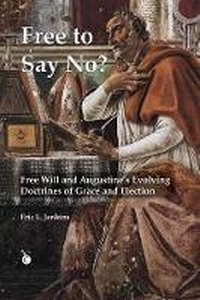
Free To Say No
Free Will and Augustine's Evolving Doctrines of Grace and Election
Erschienen am 26. September 2013
Buch
Softcover
146 Seiten
978-0-227-17423-4 (ISBN)
Beschreibung
For centuries Augustine's theory of free will has been used to explain why God is not the author of evil and humans are morally responsible for sin. Yet, when he embraced the doctrines of unconditional election and operative grace, Augustine began modifying his theory of free will. His final works claim his evolved notion of free will remained consistent with his early view, but this claim has provoked significant debate. Some scholars take him at his word, interpreting his teachings on free will in light of his later predestination teachings. Others reject his claim of continuity and warn of great inconsistencies between his early and later works. Few have undertaken a thorough study of Augustine's works to compare his early notion of free will with his later theory of predestination. Free To Say No? is a detailed study of Augustine's work that presents clear evidence in Augustine's own words for a significant discontinuity between his early and later theories - especially the disappearance of the will's freedom to say "No" - and offers some fascinating insights as to why Augustine proposed such drastic changes.
Rezensionen / Stimmen
"Eric Jenkins has served the church well with this new and detailed study of Augustine's theology [...] The work is well written and attractively presented, and for further research a comprehensive bibliography and extensive footnotes are provided."-Dr. S. Westcott, British Church Newspaper, No. 270, 29 November 2013
"Overall, a useful work."
-Rev. E. T. Kirkland, English Churchman, April, 2014
"This is a fascinating study of a very important set of issues and, whether we agree with Augustine at every point or not, we have to take his arguments with great seriousness and listen to them as he actually formulated them."
-David McKay, Reformed Theological Journal, 2014
"...I like this straightforward and unassuming book and recommend it."
John Rist, Studies in Christian Ethics, 28.3, August 2015
"The strength of Jenkin's well documented study is the fact that he is dealing with Augustine's work in a chronological perspective so that it is possible to see the development in the theology of the great African."
-Bernhard Kaiser, Journal of Reformed Theology, 10, 2016
"...[Jenkins] approaches Augustine with a personal as well as an intellectual interest, and with a desire to make Augustine's teachings more accesible and more widely understood. This is certainly an accesible book, requiring no previous knowledge either of the early Church, or of systematic theology."
-Rownea Pailing, Modern Believing, Vol. 57 Iss. 3, August 2016
"This is a good book for understanding Augustine's thought on free will and the doctrines of grace and election, with a strong bibliography of ancient and modern authors."
-Hans Herrin, Theological Book Review, Vol. 26 No. 2, 2016
Weitere Details
Sprache
Englisch
Verlagsort
Cambridge
Großbritannien
Zielgruppe
Für höhere Schule und Studium
Maße
Höhe: 229 mm
Breite: 153 mm
Gewicht
230 gr
ISBN-13
978-0-227-17423-4 (9780227174234)
Copyright in bibliographic data and cover images is held by Nielsen Book Services Limited or by the publishers or by their respective licensors: all rights reserved.
Schweitzer Klassifikation
Weitere Ausgaben
Andere Ausgaben
E-Book
09/2013
James Clarke & Co Ltd
16,99 €
Als Download verfügbar
Person
Eric L. Jenkins (MPhil, London School of Theology) has been a missionary for twenty years, including serving as the Director of a Bible School in Algeria - the land of Augustine.
Inhalt
Acknowledgments
Introduction
1 Defending Free Will in the Early Works
Before Free Will
Free Will
After Free Will
2 Defining Free Will in the Middle Works
Before To Simplician
To Simplician
Confessions to Punishment and Forgiveness of Sins
Spirit and the Letter
3 Denying Free Will in the Later Works
Nature and Grace
Perfection of Human Righteousness and Deeds of Pelagius
Grace of Christ and Original Sin
Letter 194 and Answer to the Two Letters of the Pelagians
Answer to Julian, Enchiridion, and City of God
Grace and Free Choice, Letter 217, and Rebuke and Grace
Predestination of the Saints and The Gift of Perseverance
Unfinished Work in Answer to Julian
4 Evaluation of the Doctrines of Grace, Election, and the Will
Identifying the Changes in Augustine's View of the Will
Affirming God's Just, Merciful, and Loving Nature
Final Thoughts
Bibliography
Introduction
1 Defending Free Will in the Early Works
Before Free Will
Free Will
After Free Will
2 Defining Free Will in the Middle Works
Before To Simplician
To Simplician
Confessions to Punishment and Forgiveness of Sins
Spirit and the Letter
3 Denying Free Will in the Later Works
Nature and Grace
Perfection of Human Righteousness and Deeds of Pelagius
Grace of Christ and Original Sin
Letter 194 and Answer to the Two Letters of the Pelagians
Answer to Julian, Enchiridion, and City of God
Grace and Free Choice, Letter 217, and Rebuke and Grace
Predestination of the Saints and The Gift of Perseverance
Unfinished Work in Answer to Julian
4 Evaluation of the Doctrines of Grace, Election, and the Will
Identifying the Changes in Augustine's View of the Will
Affirming God's Just, Merciful, and Loving Nature
Final Thoughts
Bibliography