

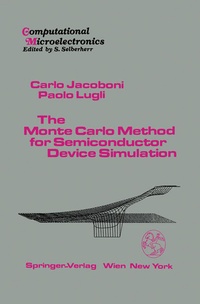
The Monte Carlo Method for Semiconductor Device Simulation
Erschienen am 30. Oktober 1989
Buch
Hardcover
X, 359 Seiten
978-3-211-82110-7 (ISBN)
Beschreibung
The application of the Monte Carlo method to the simulation of semiconductor devices is presented. A review of the physics of transport in semiconductors is given, followed by an introduction to the physics of semiconductor devices. The Monte Carlo algorithm is discussed in great details, and specific applications to the modelling of semiconductor devices are given. A comparison with traditional simulators is also presented.
Weitere Details
Reihe
Auflage
1989 ed.
Sprache
Englisch
Verlagsort
Vienna
Österreich
Verlagsgruppe
Springer Wien
Zielgruppe
Für Beruf und Forschung
Research
Illustrationen
X, 359 p.
Maße
Höhe: 241 mm
Breite: 160 mm
Dicke: 25 mm
Gewicht
729 gr
ISBN-13
978-3-211-82110-7 (9783211821107)
DOI
10.1007/978-3-7091-6963-6
Schweitzer Klassifikation
Weitere Ausgaben
Andere Ausgaben
Carlo Jacoboni | Paolo Lugli
The Monte Carlo Method for Semiconductor Device Simulation
E-Book
12/2012
Springer
149,79 €
Als Download verfügbar
Carlo Jacoboni | Paolo Lugli
The Monte Carlo Method for Semiconductor Device Simulation
Buch
10/2011
Springer
160,49 €
Versand in 10-15 Tagen
Inhalt
1 Introduction.- References.- 2 Charge Transport in Semiconductors.- 2.1 Electron Dynamics.- 2.2 Energy Bands.- 2.3 Scattering Mechanisms.- 2.4 Scattering Probabilities.- 2.5 Transport Equation.- 2.6 Linear Response and the Relaxation Time Approximation.- 2.7 Diffusion, Noise, and Velocity Autocorrelation Function.- 2.8 Hot Electrons.- 2.9 Transient Transport.- 2.10 The Two-dimensional Electron Gas.- References.- 3 The Monte Carlo Simulation.- 3.1 Fundamentals.- 3.2 Definition of the Physical System.- 3.3 Initial Conditions.- 3.4 The Free Flight, Self Scattering.- 3.5 The Scattering Process.- 3.6 The Choice of the State After Scattering.- 3.7 Collection of Results for Steady-State Phenomena.- 3.8 The Ensemble Monte Carlo (EMC).- 3.9 Many Particle Effects.- 3.10 Monte Carlo Simulation of the 2DEG.- 3.11 Special Topics.- 3.12 Variance-reducing Techniques.- 3.13 Comparison with Other Techniques.- References.- 4 Review of Semiconductor Devices.- 4.1 Introduction.- 4.2 Historical Evolution of Semiconductor Devices.- 4.3 Physical Basis of Semiconductor Devices.- 4.4 Comparison of Semiconductor Devices.- References.- 5 Monte Carlo Simulation of Semiconductor Devices.- 5.1 Introduction.- 5.2 Geometry of the System.- 5.3 Particle-Mesh Force Calculation.- 5.4 Poisson Solver and Field Distribution.- 5.5 The Monte Carlo Simulation of Semiconductor Devices.- References.- 6 Applications.- 6.1 Introduction.- 6.2 Diodes.- 6.3 MESFET.- 6.4 HEMT and Heterojunction Real Space Transfer Devices.- 6.5 Bipolar Transistor.- 6.6 HBT.- 6.7 MOSFET and MISFET.- 6.8 Hot Electron Transistors.- 6.9 Permeable Base Transistor.- 6.10 Comparison with Traditional Simulators.- References.- Appendix A. Numerical Evaluation of Some Integrals of Interest.- References.- Appendix B. Generation of Random Numbers.- References.