

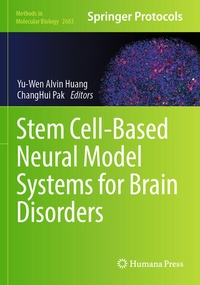
Stem Cell-Based Neural Model Systems for Brain Disorders
Erschienen am 11. Juni 2023
Buch
Softcover
XIII, 292 Seiten
978-1-0716-3289-5 (ISBN)
Beschreibung
This detailed volume presents validated and well-adapted procedures involving humanized and/or stem cell-based neural model systems that have proven helpful in better understanding the essential brain functions involved in the pathogenesis of brain disorders. The book explores the generation of multiple neural cell types in 2D and 3D as well as cutting-edge techniques to assay neural function. Written for the highly successful
Methods in Molecular Biology
series, chapters include introductions to their respective topics, lists of the necessary materials and reagents, step-by-step and readily reproducible laboratory protocols, and tips on troubleshooting and avoiding known pitfalls.
Authoritative and practical, Stem Cell-Based Neural Model Systems for Brain Disorders serves as an essential resource for researchers and students in neuroscience, stem cell biology, and related fields.
Authoritative and practical, Stem Cell-Based Neural Model Systems for Brain Disorders serves as an essential resource for researchers and students in neuroscience, stem cell biology, and related fields.
Weitere Details
Reihe
Auflage
2023 ed.
Sprache
Englisch
Verlagsort
New York
USA
Verlagsgruppe
Springer-Verlag New York Inc.
Zielgruppe
Für Beruf und Forschung
Illustrationen
1 s/w Abbildung
XIII, 292 p. 1 illus.
Maße
Höhe: 254 mm
Breite: 178 mm
Dicke: 17 mm
Gewicht
583 gr
ISBN-13
978-1-0716-3289-5 (9781071632895)
DOI
10.1007/978-1-0716-3287-1
Schweitzer Klassifikation
Weitere Ausgaben
Andere Ausgaben
Yu-Wen Alvin Huang | ChangHui Pak
Stem Cell-Based Neural Model Systems for Brain Disorders
Buch
06/2023
Humana
235,39 €
Versand in 15-20 Tagen
Inhalt
Generation of Cerebral Cortical Neurons from Human Pluripotent Stem Cells in 3D Culture.- Generation of Homogeneous Populations of Cortical Interneurons from Human Pluripotent Stem Cells.- Generation and Co-Culture of Cortical Glutamatergic and GABAergic Induced Neuronal Cells.- Transcription Factor-Directed Dopaminergic Neuron Differentiation from Human Pluripotent Stem Cells.- Directed Differentiation of Human iPSCs into Microglia-Like Cells Using Defined Transcription Factors.- The Generation and Functional Characterization of Human Microglia-Like Cells Derived from iPS and Embryonic Stem Cells.- Modeling Cellular Crosstalk of Neuroinflammation Axis by Tri-Cultures of iPSC-Derived Human Microglia, Astrocytes, and Neurons.- Generation of Oligodendrocytes from Human Pluripotent and Embryonic Stem Cells.- Characterizing the Neuron-Glial Interactions by the Co-Cultures of Human iPSC-Derived Oligodendroglia and Neurons.- Defined Differentiation of Human Pluripotent Stem Cells to Brain Microvascular Endothelial-Like Cells for Modeling the Blood-Brain Barrier.- Modeling the Blood-Brain Barrier Using Human Induced Pluripotent Stem Cells.- A Three-Dimensional Primary Cortical Culture System Compatible with Transgenic Disease Models, Virally-Mediated Fluorescence, and Live Microscopy.- Method to Generate Dorsal Forebrain Brain Organoids from Human Pluripotent Stem Cells.- A 3D Bioengineered Neural Tissue Model Generated from Human iPSC-Derived Neural Precursor Cells.- FACS-Based Sequencing Approach to Evaluate Cell Type to Genotype Associations Using Cerebral Organoids.- Dynamic Measurement of Endosome-Lysosome Fusion in Neurons Using High-Content Imaging.- Live-Imaging Detection of Multivesicular Body-Plasma Membrane Fusion and Exosome Release in Cultured Primary Neurons.- Assays of Monitoring and Measuring Autophagic Flux for iPSC-Derived Human Neurons and Other Brain Cell Types.- Measuring Neuronal Network Activity Using Human Induced Neuronal Cells.- A Simple Ca
2+
-Imaging Approach of Network-Activity Analyses for Human Neurons.- Whole Cell Patch Clamp Electrophysiology in Human Neuronal Cells.- Assaying Chemical Long-Term Potentiation in Human iPSC-Derived Neuronal Networks.