

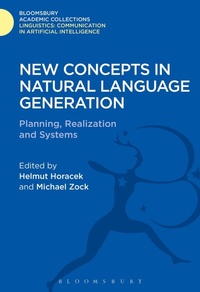
New Concepts in Natural Language Generation
Planning, Realization and Systems
Erschienen am 17. Dezember 2015
Buch
Hardcover
336 Seiten
978-1-4742-4641-5 (ISBN)
Beschreibung
This book aims to inform researchers with an interest in natural language generation about advances in the field. It is organised around four topics - system architectures, content planning, discourse planning and realisation in linguistic form - and it presents some of the most important works in this area of research.
Weitere Details
Reihe
Sprache
Englisch
Verlagsort
London
Großbritannien
Verlagsgruppe
Bloomsbury Publishing PLC
Zielgruppe
Für höhere Schule und Studium
Maße
Höhe: 240 mm
Breite: 161 mm
Dicke: 23 mm
Gewicht
672 gr
ISBN-13
978-1-4742-4641-5 (9781474246415)
Copyright in bibliographic data and cover images is held by Nielsen Book Services Limited or by the publishers or by their respective licensors: all rights reserved.
Schweitzer Klassifikation
Weitere Ausgaben
Andere Ausgaben
E-Book
12/2015
1. Auflage
Bloomsbury Academic
155,99 €
Als Download verfügbar
Person
Helmut Horacek works for the German Research Center for Artificial Intelligence and taught at Saarland University, Germany.
Michael Zock is Emeritus Research Director of the French National Centre for Scientific Research, Aix-Marseille University, France.
Michael Zock is Emeritus Research Director of the French National Centre for Scientific Research, Aix-Marseille University, France.
Inhalt
Introduction Helmut Horacek and Michael Zock
Part I. Content Planning
1. Content Determination and Text Structuring: Two Interrelated Processes Denis Carcagno And Lidija Iordanskaja
2. Explanation Strategies for KADS-Based Expert Systems Michael Sprenger
Part II. Text Planning
3. From Interclausal Relations To Discourse Structure - A Long Way Behind, A Long Way Ahead Eduard Hovy
4. Organising Discourse Structure Relations Using Metafunctions Elisabeth Maier and Eduard Hovy
5. From Constituent Planning To Text Planning Zuzana Krifka-Dobei and Hans-Joachim Novak
Part III. Realization
6. How a Systemic Functional Grammar Works: The Role of Realization in Realization Robin P. Fawcett, Gordon H. Tucker and Yuen Q. Lin
7. Head-Driven Bottom-Up Generation and Government and Binding: A Unified Perspective Fabio Pianesi
Part IV. Systems
8. Decision Making Throughout the Generation Process in The Systems WISBER And DIAMOD
Helmut Horacek
9. A Revision-Based Generation Architecture for Reporting Facts in Their Historical Context Jacques Robin
Part V. Selected Topics
10. The Initial Specifications for Generation
Introduction: Helmut Horacek
A. The Initial Specifications for Generation: Robert Dale
B. 'Does Natural Language Generation Start From A Specification?': David D. McDonald
C. Notes on 'The Initial Specifications for Generation': Dietmar Rosner
D. On the Generator Input of the Future: Eduard Hovy
11. Lexicalization
Introduction: Ernst Buchberger
A. Is Content Generation A One-Shot Process Or A Cyclical Activity Of Gradual Refinement? The Case of Lexical Choice: Michael Zock
B. Lexical Choice and Lexical Preferences: Ehud Reiter
C. A Holistic View of Lexical Choice: Stephan Busemann
D. Ontology and Lexical Choice: Hans-Joachim Novak
Index
Part I. Content Planning
1. Content Determination and Text Structuring: Two Interrelated Processes Denis Carcagno And Lidija Iordanskaja
2. Explanation Strategies for KADS-Based Expert Systems Michael Sprenger
Part II. Text Planning
3. From Interclausal Relations To Discourse Structure - A Long Way Behind, A Long Way Ahead Eduard Hovy
4. Organising Discourse Structure Relations Using Metafunctions Elisabeth Maier and Eduard Hovy
5. From Constituent Planning To Text Planning Zuzana Krifka-Dobei and Hans-Joachim Novak
Part III. Realization
6. How a Systemic Functional Grammar Works: The Role of Realization in Realization Robin P. Fawcett, Gordon H. Tucker and Yuen Q. Lin
7. Head-Driven Bottom-Up Generation and Government and Binding: A Unified Perspective Fabio Pianesi
Part IV. Systems
8. Decision Making Throughout the Generation Process in The Systems WISBER And DIAMOD
Helmut Horacek
9. A Revision-Based Generation Architecture for Reporting Facts in Their Historical Context Jacques Robin
Part V. Selected Topics
10. The Initial Specifications for Generation
Introduction: Helmut Horacek
A. The Initial Specifications for Generation: Robert Dale
B. 'Does Natural Language Generation Start From A Specification?': David D. McDonald
C. Notes on 'The Initial Specifications for Generation': Dietmar Rosner
D. On the Generator Input of the Future: Eduard Hovy
11. Lexicalization
Introduction: Ernst Buchberger
A. Is Content Generation A One-Shot Process Or A Cyclical Activity Of Gradual Refinement? The Case of Lexical Choice: Michael Zock
B. Lexical Choice and Lexical Preferences: Ehud Reiter
C. A Holistic View of Lexical Choice: Stephan Busemann
D. Ontology and Lexical Choice: Hans-Joachim Novak
Index