

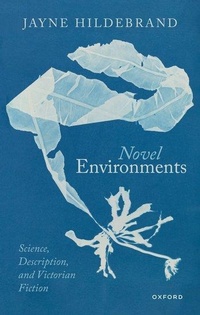
Novel Environments
Science, Description, and Victorian Fiction
Erschienen am 7. Juli 2023
Buch
Hardcover
224 Seiten
978-0-19-288847-1 (ISBN)
Beschreibung
The environment concept has shaped humanity's relationship to the natural world and has drawn attention to the effects of human actions on our natural surroundings. But when did we learn that we live in an environment? While scholars have often located the emergence of the environment concept in twentieth-century ecological and political thought, Novel Environments: Science, Description, and Victorian Fiction reconstructs a longer-and a specifically literary-history. It was in the descriptive worldmaking of the Victorian novel that the environment was first transformed from an abstraction into a vivid object of imagination and feeling. Engaging the scientific theories of their contemporaries, Mary Russell Mitford, George Eliot, Thomas Hardy, and Robert Louis Stevenson turned to detailed description-from gardens and landscapes to weather and atmospheres-to model interactions between life and its surroundings. Far from merely furnishing static background, the descriptive apparatus of the Victorian novel imagined the nonhuman environment as dynamically involved with human action, feeling, and development.
In making this argument, Novel Environments recovers the scientific vocabulary the Victorians used to name the surroundings of living organisms. The word "environment" dominates our own way of speaking about the nonhuman world, but nineteenth-century scientific writers and novelists availed themselves of a richer conceptual lexicon, which included "environment" along with less familiar concepts such as "milieu," "medium," and "circumstance." Jayne Hildebrand traces the development of Victorian environmental thought from the earliest theorization of physical surroundings as a dynamic influence in the life sciences, through the idea of a singular "medium" in mid-century organicism, to the conception of the planet as an environmental system at the fin-de-siecle. By showing how novelistic description helped to produce the modern environment concept, Hildebrand sheds new light on the relationship between Victorian literature and the life sciences, and reveals how literary form has shaped the ecological ideas through which we apprehend the nonhuman world.
In making this argument, Novel Environments recovers the scientific vocabulary the Victorians used to name the surroundings of living organisms. The word "environment" dominates our own way of speaking about the nonhuman world, but nineteenth-century scientific writers and novelists availed themselves of a richer conceptual lexicon, which included "environment" along with less familiar concepts such as "milieu," "medium," and "circumstance." Jayne Hildebrand traces the development of Victorian environmental thought from the earliest theorization of physical surroundings as a dynamic influence in the life sciences, through the idea of a singular "medium" in mid-century organicism, to the conception of the planet as an environmental system at the fin-de-siecle. By showing how novelistic description helped to produce the modern environment concept, Hildebrand sheds new light on the relationship between Victorian literature and the life sciences, and reveals how literary form has shaped the ecological ideas through which we apprehend the nonhuman world.
Weitere Details
Sprache
Englisch
Verlagsort
Oxford
Großbritannien
Zielgruppe
Für Beruf und Forschung
Produkt-Hinweis
Fadenheftung
Gewebe-Einband
Maße
Höhe: 222 mm
Breite: 148 mm
Dicke: 18 mm
Gewicht
386 gr
ISBN-13
978-0-19-288847-1 (9780192888471)
Copyright in bibliographic data and cover images is held by Nielsen Book Services Limited or by the publishers or by their respective licensors: all rights reserved.
Schweitzer Klassifikation
Weitere Ausgaben
Andere Ausgaben
E-Book
06/2023
1. Auflage
OUP eBook
64,49 €
Als Download verfügbar
E-Book
05/2023
1. Auflage
OUP eBook
64,49 €
Als Download verfügbar
Person
Jayne Hildebrand is Assistant Professor of English at Barnard College, where she specializes in nineteenth-century British literature with a focus on the Victorian novel and the history of science. Her other research and teaching interests include nineteenth-century poetry, science fiction, and environmental humanities. She has also published articles on William Morris and Victorian psychology, early Victorian working-class poetry, and eighteenth-century georgic poetry.
Inhalt
Acknowledgments
Introduction
1: The Habitats of Mary Russell Mitford's Our Village
2: George Eliot's Biological Media
3: Thomas Hardy's Virtual Environments
4: Stevenson's Islands and the Poetry of Circumstance
Coda: Immersed in the Environment
Bibliography
Index
Introduction
1: The Habitats of Mary Russell Mitford's Our Village
2: George Eliot's Biological Media
3: Thomas Hardy's Virtual Environments
4: Stevenson's Islands and the Poetry of Circumstance
Coda: Immersed in the Environment
Bibliography
Index