

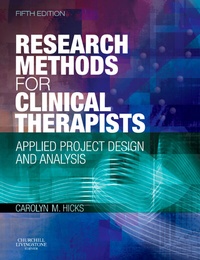
Research Methods for Clinical Therapists
Applied Project Design and Analysis
5. Auflage
Erschienen am 7. August 2009
Buch
Softcover
420 Seiten
978-0-7020-2998-1 (ISBN)
Beschreibung
Struggling to do a project or dissertation, evaluate published research or conduct your own research? Help is at hand with this 5th edition of Research Methods for Clinical Therapists, which explains, in a clear and simple manner, how to evaluate existing research and how to conduct your own research.
Aimed at undergraduate and postgraduate students, as well as the practising health care professional, the focus of the text is the design and analysis of experimental studies. These are vital to the effectiveness studies that are central to the work of the healthcare professional. Specific examples from different areas of healthcare are used to explain the core research concepts and relate them to clinical situations. Statistical theory and jargon are kept to a minimum.
'Key concept' boxes to explain technical research terms
Activities and exercises (with answers provided in an appendix) to reinforce learning
Sample critique of a published research article
Comprehensive coverage of the key components of a robust research study
Explanation of basic mathematical concepts
Extended section on calculating sample sizes
Guidelines on the preparation of posters
Calculation of Inter-rater reliability measures, including Cohen's Kappa, ICC (interclass correlation) and Bland-Altman graphs of inter-rater agreement
Introduction to Receiver Operating Characteristics, for use in screening and diagnostic testing against gold-standards
The Thurstone Paired Comparison Technique, valuable in capturing the user voice on a variety of service planning, design and development issues
Undertaking Systematic Reviews
Relevant further reading for each chapter to support readers in their work.
Aimed at undergraduate and postgraduate students, as well as the practising health care professional, the focus of the text is the design and analysis of experimental studies. These are vital to the effectiveness studies that are central to the work of the healthcare professional. Specific examples from different areas of healthcare are used to explain the core research concepts and relate them to clinical situations. Statistical theory and jargon are kept to a minimum.
'Key concept' boxes to explain technical research terms
Activities and exercises (with answers provided in an appendix) to reinforce learning
Sample critique of a published research article
Comprehensive coverage of the key components of a robust research study
Explanation of basic mathematical concepts
Extended section on calculating sample sizes
Guidelines on the preparation of posters
Calculation of Inter-rater reliability measures, including Cohen's Kappa, ICC (interclass correlation) and Bland-Altman graphs of inter-rater agreement
Introduction to Receiver Operating Characteristics, for use in screening and diagnostic testing against gold-standards
The Thurstone Paired Comparison Technique, valuable in capturing the user voice on a variety of service planning, design and development issues
Undertaking Systematic Reviews
Relevant further reading for each chapter to support readers in their work.
Weitere Details
Auflage
5th edition
Sprache
Englisch
Verlagsort
London
Großbritannien
Verlagsgruppe
Elsevier Health Sciences
Zielgruppe
Für höhere Schule und Studium
Für Beruf und Forschung
Maße
Höhe: 246 mm
Breite: 189 mm
Gewicht
810 gr
ISBN-13
978-0-7020-2998-1 (9780702029981)
Copyright in bibliographic data and cover images is held by Nielsen Book Services Limited or by the publishers or by their respective licensors: all rights reserved.
Schweitzer Klassifikation
Weitere Ausgaben
Andere Ausgaben
E-Book
08/2009
5. Auflage
Churchill Livingstone
43,99 €
Als Download verfügbar
Vorauflage

Buch
02/2004
4. Auflage
Churchill Livingstone
44,43 €
Artikel ist vergriffen; siehe Neuauflage
Person
Inhalt
SECTION 1 Basic principles of research
1. Introduction
2. Research design and statistics: some basic concepts
3. Questionnaires, surveys and sampling
4. The nature of the data
5. Techniques of descriptive statistics
6. Testing hypotheses
7. Designing your study
8. Sources of error in research
9. Matching the research design to the statistical test
10.Putting the theory into practice
11.Writing up the research for publication
12.Reading published research critically
SECTION 2 Statistical tests
13.Non-parametric tests for same- and matched-subject designs
14.Parametric tests for same- and matched-subject designs
15. Non-parametric tests for different- (unrelated-) subject designs
16.Parametric tests for different- (unrelated-) subject designs
17.Non-parametric and parametric tests for correlational designs
18.Estimation
SECTION 3 Research applications
19.Attitude scales
20.Repertory grid analysis
21.Using statistics in diagnostic and screening tests: receiver operating characteristics
22.Capturing expert opinion: the Delphi technique
23.Capturing the user voice: Thurstone's paired comparison technique
24.Capturing the clinician's view: reliability measures
25.Undertaking systematic reviews
Appendices
Appendix 1 Basic mathematical principles
Appendix 2 Statistical probability tables
Appendix 3 Answers to activities
Appendix 4 A sample critique of a published article
Glossary
References, further reading and information sources
Index
1. Introduction
2. Research design and statistics: some basic concepts
3. Questionnaires, surveys and sampling
4. The nature of the data
5. Techniques of descriptive statistics
6. Testing hypotheses
7. Designing your study
8. Sources of error in research
9. Matching the research design to the statistical test
10.Putting the theory into practice
11.Writing up the research for publication
12.Reading published research critically
SECTION 2 Statistical tests
13.Non-parametric tests for same- and matched-subject designs
14.Parametric tests for same- and matched-subject designs
15. Non-parametric tests for different- (unrelated-) subject designs
16.Parametric tests for different- (unrelated-) subject designs
17.Non-parametric and parametric tests for correlational designs
18.Estimation
SECTION 3 Research applications
19.Attitude scales
20.Repertory grid analysis
21.Using statistics in diagnostic and screening tests: receiver operating characteristics
22.Capturing expert opinion: the Delphi technique
23.Capturing the user voice: Thurstone's paired comparison technique
24.Capturing the clinician's view: reliability measures
25.Undertaking systematic reviews
Appendices
Appendix 1 Basic mathematical principles
Appendix 2 Statistical probability tables
Appendix 3 Answers to activities
Appendix 4 A sample critique of a published article
Glossary
References, further reading and information sources
Index