

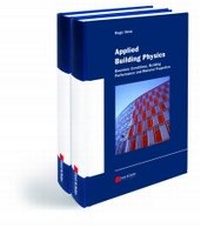
Package: Building Physics and Applied Building Physics
Building Physics: Heat, Air and Moisture; Fundamentals and Engineering Methods with Examples and Exercises + Applied Building Physics; Boundary Conditions, Building Performance and Material Properties
2. Auflage
Erschienen am 8. August 2012
Buch
Softcover
XXX, 538 Seiten
978-3-433-03031-8 (ISBN)
Beschreibung
Bad experiences with construction quality, the energy crises of 1973 and 1979, complaints about 'sick buildings', thermal, acoustical, visual and olfactory discomfort, the move towards more sustainability, have all accelerated the development of a field, which until 35 years ago was hardly more than an academic exercise: building physics. The societal pressure to diminish energy consumption in buildings without impairing usability acted as a trigger to activate the whole notion of performance based design and construction.
Through the application of existing physical knowledge and the combination with information coming from other disciplines, the field helps to understand the physical performance of building parts, buildings and the built environment, and translates it into correct design and construction.
As with all engineering sciences, Building Physics is oriented towards application, which is why, after a first book on fundamentals a second volume examines performance rationale and performance requirements. Outdoor and indoor climate conditions are described and calculation values are discussed, the performance concept is specified at the building level and at the building envelope level, and heat-air-moisture material properties are defined.
Die Energiekrise der 1970er Jahre, häufig auftretende Feuchteprobleme, Klagen über das Sick-Building-Syndrom, mangelnder Komfort hinsichtlich Raumklima und Behaglichkeit und nicht zuletzt das Bemühen um Nachhaltigkeit haben die Bauphysik zu einem Innovationsmotor auf dem Gebäudesektor gemacht. Dabei war die gesellschaftliche Forderung nach Energieeinsparung in Gebäuden ohne Einschränkungen im Gebrauch auch der Auslöser für die ganzheitliche Planung.
Die Anwendung der physikalischen Grundlagen und ihre Zusammenführung mit den Erkenntnissen aus anderen Disziplinen fördert das Verständnis über das physikalische Verhalten von Bauteilen, Gebäudehüllen, Gebäuden bis hin zur gebauten Umwelt, was sich in der Stadtbauphysik widerspiegelt. Bauphysikalische Planung hat einen unmittelbaren Einfluss auf die Gebrauchstauglichkeit und Energieeffizienz von Gebäuden.
Wie alle Ingenieurwissenschaften ist auch die Bauphysik anwendungsorientiert, weshalb sich nach einem ersten Band über die Grundlagen ein zweiter Band mit den Hintergründen der Gebrauchstauglichkeit und den Anforderungen an Energieeffizienz von Gebäuden befasst. Außenklimabedingungen und Berechnungen für Innenräume werden diskutiert, Energieverluste und -gewinne werden für Gebäude und Gebäudehülle untersucht. Die wichtigen physikalischen Eigenschaften für den Wärme- und Feuchtetransport durch Baukonstruktionen werden für zahlreiche Materialien aufgeführt.
Through the application of existing physical knowledge and the combination with information coming from other disciplines, the field helps to understand the physical performance of building parts, buildings and the built environment, and translates it into correct design and construction.
As with all engineering sciences, Building Physics is oriented towards application, which is why, after a first book on fundamentals a second volume examines performance rationale and performance requirements. Outdoor and indoor climate conditions are described and calculation values are discussed, the performance concept is specified at the building level and at the building envelope level, and heat-air-moisture material properties are defined.
Die Energiekrise der 1970er Jahre, häufig auftretende Feuchteprobleme, Klagen über das Sick-Building-Syndrom, mangelnder Komfort hinsichtlich Raumklima und Behaglichkeit und nicht zuletzt das Bemühen um Nachhaltigkeit haben die Bauphysik zu einem Innovationsmotor auf dem Gebäudesektor gemacht. Dabei war die gesellschaftliche Forderung nach Energieeinsparung in Gebäuden ohne Einschränkungen im Gebrauch auch der Auslöser für die ganzheitliche Planung.
Die Anwendung der physikalischen Grundlagen und ihre Zusammenführung mit den Erkenntnissen aus anderen Disziplinen fördert das Verständnis über das physikalische Verhalten von Bauteilen, Gebäudehüllen, Gebäuden bis hin zur gebauten Umwelt, was sich in der Stadtbauphysik widerspiegelt. Bauphysikalische Planung hat einen unmittelbaren Einfluss auf die Gebrauchstauglichkeit und Energieeffizienz von Gebäuden.
Wie alle Ingenieurwissenschaften ist auch die Bauphysik anwendungsorientiert, weshalb sich nach einem ersten Band über die Grundlagen ein zweiter Band mit den Hintergründen der Gebrauchstauglichkeit und den Anforderungen an Energieeffizienz von Gebäuden befasst. Außenklimabedingungen und Berechnungen für Innenräume werden diskutiert, Energieverluste und -gewinne werden für Gebäude und Gebäudehülle untersucht. Die wichtigen physikalischen Eigenschaften für den Wärme- und Feuchtetransport durch Baukonstruktionen werden für zahlreiche Materialien aufgeführt.
Weitere Details
Weitere Ausgaben
Nachauflagen
Buch
04/2016
3. Auflage
Ernst & Sohn
99,00 €
Artikel ist vergriffen; siehe Neuauflage
Vorauflage
Hugo S. L. C. Hens
Package: Building Physics and Applied Building Physics
Buch
10/2010
1. Auflage
Ernst & Sohn
99,90 €
Artikel ist vergriffen; siehe Neuauflage
Person
Dr. Ir. Hugo S.L.C. Hens is an emeritus professor at the University of Leuven (KU Leuven), Belgium. Till 1972, he worked as a structural engineer and site supervisor at a mid-sized architectural office. In 1975, after defending his PhD-thesis, he started the research unit Building Physics within the Faculty of Engineering of the university. He taught Building Physics from 1975 till 2003, Performance Based Building Design from 1975 till 2005 and Building Services from 1975 till 1977 and 1990 till 2008.
He authored and co-authored some 70 peer reviewed journal and 170 conference papers about the research done at the unit, helped man-aging hundreds of building damage cases and acted as coordinator of the CIB W40 working group on Heat and Mass Transfer in Buildings from 1983 till 1993. Between 1986 and 2008, he was operating agent of the Annexes 14, 24, 32 and 41 of the International Energy Agency`s EXCO on Energy in Buildings and Communities. He is a fellow of the American Society of Heating, Refrigeration and Air Conditioning Engineers (ASHRAE).
Prof. em. Dr.-Ing. Hugo S. L. C. Hens, Universität Leuven (K.U. Leuven/Belgien) lehrte Bauphysik von 1975 bis 2003, Gebäudeplanung von 1970 bis 2005 und Technische Gebäudeausrüstung von 1975 bis 1977 sowie von 1990 bis 2008. Bis 1972 war er als Tragwerksplaner für Wohnhäuser, Büro- und Geschossbauten in einem Architekturbüro tätig. Er hat als Autor bzw. Koautor über 150 Artikel und Tagungsbeiträge veröffentlicht und hunderte Schadensgutachten erstellt. Während zehn Jahren koordinierte er die internationale Arbeitsgruppe CIB W40 "Heat and Mass Transfer in Buildings". Von 1986 bis 2008 war er im Rahmen des Forschungsprogramms "Energy Conservation in Buildings and Community Systems" der Internationalen Energieagentur IEA für die Erarbeitung von Annex 14, Annex 24, Annex 32 und Annex 41 verantwortlich. Er ist Mitglied der American Society of Heating, Refrigeration and Air Conditioning Engineers (ASHRAE).
He authored and co-authored some 70 peer reviewed journal and 170 conference papers about the research done at the unit, helped man-aging hundreds of building damage cases and acted as coordinator of the CIB W40 working group on Heat and Mass Transfer in Buildings from 1983 till 1993. Between 1986 and 2008, he was operating agent of the Annexes 14, 24, 32 and 41 of the International Energy Agency`s EXCO on Energy in Buildings and Communities. He is a fellow of the American Society of Heating, Refrigeration and Air Conditioning Engineers (ASHRAE).
Prof. em. Dr.-Ing. Hugo S. L. C. Hens, Universität Leuven (K.U. Leuven/Belgien) lehrte Bauphysik von 1975 bis 2003, Gebäudeplanung von 1970 bis 2005 und Technische Gebäudeausrüstung von 1975 bis 1977 sowie von 1990 bis 2008. Bis 1972 war er als Tragwerksplaner für Wohnhäuser, Büro- und Geschossbauten in einem Architekturbüro tätig. Er hat als Autor bzw. Koautor über 150 Artikel und Tagungsbeiträge veröffentlicht und hunderte Schadensgutachten erstellt. Während zehn Jahren koordinierte er die internationale Arbeitsgruppe CIB W40 "Heat and Mass Transfer in Buildings". Von 1986 bis 2008 war er im Rahmen des Forschungsprogramms "Energy Conservation in Buildings and Community Systems" der Internationalen Energieagentur IEA für die Erarbeitung von Annex 14, Annex 24, Annex 32 und Annex 41 verantwortlich. Er ist Mitglied der American Society of Heating, Refrigeration and Air Conditioning Engineers (ASHRAE).
Inhalt
Buidling Phyiscs
Preface
0 Introduction
1 Heat Transfer
2 Mass Transfer
3 Combined Heat, Air, Moisture Transfer
4 Postscript
5 Problems, Solutions
Applied Buidling Physics
PREFACE
INTRODUCTION
OUTDOOR AND INDOOR CONDITIONS
PERFORMANCE METRICS AND ARRAYS
FUNCTIONAL REQUIREMENTS AND PERFORMANCES AT THE BUILDING LEVEL
HEAT-AIR-MOISTURE PERFORMANCES AT THE ENVELOPE LEVEL
HEAT-AIR-MOISTURE MATERIAL PROPERTIES
APPENDIX
Preface
0 Introduction
1 Heat Transfer
2 Mass Transfer
3 Combined Heat, Air, Moisture Transfer
4 Postscript
5 Problems, Solutions
Applied Buidling Physics
PREFACE
INTRODUCTION
OUTDOOR AND INDOOR CONDITIONS
PERFORMANCE METRICS AND ARRAYS
FUNCTIONAL REQUIREMENTS AND PERFORMANCES AT THE BUILDING LEVEL
HEAT-AIR-MOISTURE PERFORMANCES AT THE ENVELOPE LEVEL
HEAT-AIR-MOISTURE MATERIAL PROPERTIES
APPENDIX