

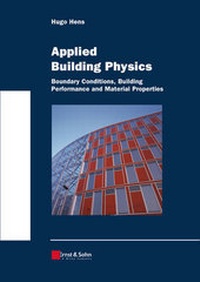
Package: Building Physics and Applied Building Physics / Applied Building Physics
Boundary Conditions, Building Performance and Material Properties
Erschienen am 20. Oktober 2010
Buch
Softcover
XIV, 308 Seiten
978-3-433-02962-6 (ISBN)
Beschreibung
The energy crises of the 1970s, persisting moisture problems, complaints about sick buildings, thermal, visual and olfactory discomfort, and the move towards more sustainability in building construction have pushed Building Physics to the forefront of building innovation. The societal pressure to diminish energy consumption in buildings without impairing usability acted as a trigger to activate the whole notion of performance based design and construction. As with all engineering sciences, Building Physics is oriented towards application, which is why, after a first book on fundamentals this second volume examines performance rationale and performance requirements. Outdoor and indoor climate conditions are described and calculation values are discussed, the performance concept is specified at the building level and at the building envelope level, and heat-air-moisture material properties are defined.
The book incorporates 35 years of teaching Building Physics to architectural, building and civil engineers, bolstered by 40 years of experience, research and consultancy.
Weitere Details
Weitere Ausgaben
Nachauflagen
Hugo Hens
Package: Building Physics and Applied Building Physics / Applied Building Physics
Ambient Conditions, Building Performance and Material Properties
Buch
03/2016
2. Auflage
Ernst & Sohn
69,00 €
Artikel ist vergriffen; siehe Neuauflage
Andere Ausgaben
E-Book
01/2012
1. Auflage
Ernst & Sohn
52,99 €
Als Download verfügbar
E-Book
01/2012
1. Auflage
Ernst & Sohn
52,99 €
Als Download verfügbar
Person
Prof. Em. Dr. IR. Hugo S.L.C Hens, Katholieke Universiteit Leuven (Belgium), taught Building Physics from 1975 to 2003, Performance Based Building Design from 1970 to 2005 and Building Services from 1975 to 1977 and 1990 to 2008. He has authored and co-authored over 150 articles and conference papers, and written hundreds of reports on building damage cases and their solution. He has been coordinating the international working group CIB W40 on Heat and Mass Transfer in Buildings for ten years. Between 1986 and 2008, he was operating agent of 4 Annexes, initiated by the International Energy Agency's EXCO on Energy Conservation in Buildings and Community Systems: Annex 14, Annex 24, Annex 32 and Annex 41. He is a fellow of the American Society of Heating, Refrigeration and Air Conditioning Engineers (ASHRAE).
Inhalt
PREFACE
INTRODUCTION
OUTDOOR AND INDOOR CONDITIONS
Overview
Outdoor Conditions
Dry bulb (or air) temperature
Solar radiation
Long wave radiation
Relative humidity and (partial water) vapour pressure
Wind
Precipitation and wind-driven rain
Standardized outside climate values
Indoor conditions
Dry bulb (or air) temperature
Relative humidity and (partial water) vapour pressure
Water vapour release indoors
Indoor climate classes
Indoor/outdoor air pressure differentials
PERFORMANCE METRICS AND ARRAYS
Definitions
Functional demands
Performance requirements
Some history
Performance arrays
FUNCTIONAL REQUIREMENTS AND PERFORMANCES AT THE BUILDING LEVEL
Thermal comfort
Health and indoor environmental quality
Energy efficiency
Durability
Life cycle costs
Sustainability
HEAT-AIR-MOISTURE PERFORMANCES AT THE ENVELOPE LEVEL
Introduction
Air-tightness
Thermal transmittance (U)
Transient thermal response
Moisture tolerance
Thermal bridges
Contact coefficients
Hygrothermal stress and strain
Example of performance control: timber-framed walls
HEAT-AIR-MOISTURE MATERIAL PROPERTIES
Introduction
Dry air and water
Building and insulation materials
APPENDIX