

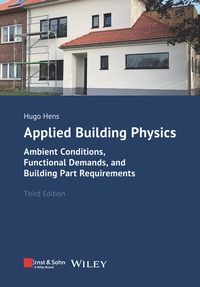
Applied Building Physics
Ambient Conditions, Functional Demands, and Building Part Requirements
3. Auflage
Erschienen am 13. September 2023
Buch
Softcover
XXII, 346 Seiten
978-3-433-03423-1 (ISBN)
Beschreibung
While a first book on building physics refreshes the physics behind the heat, air, moisture behaviour of buildings, and building components, this second book on applied building physics focuses on the question of what a well-balanced building performance consists of.
First, the environmental loads on buildings are explained - i.e. all those parameters that describe the external and internal environmental conditions, with an emphasis on practical implementation. Then follows a comprehensive presentation of those performance requirements that are important at the whole-building level, mainly considering thermal, acoustic, visual and olfactory comfort, indoor air quality, energy consumption, durability, economy and sustainability. This is followed by an in-depth discussion of the requirements regarding thermal, air and moisture behaviour as well as the measured variables at the level of the building construction and components.
The analyses and calculations described in this book result in sustainable buildings made of functional and durable building constructions, with comfortable and healthy indoor climate.
Compared to the second edition, the whole text, included the figures, for the third edition has been reorganised, corrected, revised and expanded where appropriate. Chapter 3 saw the discussion on comfort not only limited to the thermal but extended to the acoustic, visual and olfactory comfort. Also, the indoor air quality part is expanded as is the part on sustainability. Chapter 4 got under interstitial condensation an example from practice added. The last chapter on material properties has been moved to the book on building physics and is replaced by an appendix for quick reference, only containing standard values, for which standard lists are missing.
First, the environmental loads on buildings are explained - i.e. all those parameters that describe the external and internal environmental conditions, with an emphasis on practical implementation. Then follows a comprehensive presentation of those performance requirements that are important at the whole-building level, mainly considering thermal, acoustic, visual and olfactory comfort, indoor air quality, energy consumption, durability, economy and sustainability. This is followed by an in-depth discussion of the requirements regarding thermal, air and moisture behaviour as well as the measured variables at the level of the building construction and components.
The analyses and calculations described in this book result in sustainable buildings made of functional and durable building constructions, with comfortable and healthy indoor climate.
Compared to the second edition, the whole text, included the figures, for the third edition has been reorganised, corrected, revised and expanded where appropriate. Chapter 3 saw the discussion on comfort not only limited to the thermal but extended to the acoustic, visual and olfactory comfort. Also, the indoor air quality part is expanded as is the part on sustainability. Chapter 4 got under interstitial condensation an example from practice added. The last chapter on material properties has been moved to the book on building physics and is replaced by an appendix for quick reference, only containing standard values, for which standard lists are missing.
Weitere Details
Auflage
3. überarbeitete Auflage
Sprache
Englisch
Verlagsort
Berlin
Deutschland
Zielgruppe
Für Beruf und Forschung
Illustrationen
282
142 farbige Abbildungen, 95 s/w Tabellen, 45 s/w Abbildungen
Maße
Höhe: 24.4 cm
Breite: 17 cm
Dicke: 2.6 cm
Gewicht
708 gr
ISBN-13
978-3-433-03423-1 (9783433034231)
Schweitzer Klassifikation
Weitere Ausgaben
Andere Ausgaben
Hugo Hens
Applied Building Physics
Ambient Conditions, Functional Demands and Building Part Requirements
E-Book
08/2023
3. Auflage
Ernst & Sohn
61,99 €
Als Download verfügbar
Hugo Hens
Applied Building Physics
Ambient Conditions, Functional Demands and Building Part Requirements
E-Book
08/2023
3. Auflage
Ernst & Sohn
61,99 €
Als Download verfügbar
Gesamtwerk / Teilwerk
Buch
10/2023
5. Auflage
Ernst & Sohn
119,00 €
Versand in 5-7 Tagen
Vorauflage
Hugo Hens
Package: Building Physics and Applied Building Physics / Applied Building Physics
Ambient Conditions, Building Performance and Material Properties
Buch
03/2016
2. Auflage
Ernst & Sohn
69,00 €
Artikel ist vergriffen; siehe Neuauflage
Person
Dr. Ir. Hugo S.L.C. Hens is an emeritus professor of the University of Leuven (KU Leuven), Belgium. Until 1972, he worked as a structural engineer and site supervisor at a mid-sized architectural office. After the sudden death of his predecessor and promotor Professor A. de Grave in 1975 and after defending his PhD thesis, he stepwise built up the Department of Building Physics at the Department of Civil Engineering.
He taught Building Physics from 1975 to 2003, performance based building design from 1975 to 2005 and building services from 1975 to 1977 and 1990 to 2008. He authored and co-authored 68 peer reviewed journal papers and 174 conference papers about the research done, has helped to manage hundreds of building damage cases and acted as coordinator of the CIB W40 working group on Heat and Mass Transfer in Buildings from 1983 to 1993. Between 1986 and 2008, he was operating agent of the Annexes 14, 24, 32 and 41 of the IEA ExCo on Energy in Buildings and Communities. He is a fellow of the American Society of Heating, Refrigeration and Air Conditioning Engineers (ASHRAE).
He taught Building Physics from 1975 to 2003, performance based building design from 1975 to 2005 and building services from 1975 to 1977 and 1990 to 2008. He authored and co-authored 68 peer reviewed journal papers and 174 conference papers about the research done, has helped to manage hundreds of building damage cases and acted as coordinator of the CIB W40 working group on Heat and Mass Transfer in Buildings from 1983 to 1993. Between 1986 and 2008, he was operating agent of the Annexes 14, 24, 32 and 41 of the IEA ExCo on Energy in Buildings and Communities. He is a fellow of the American Society of Heating, Refrigeration and Air Conditioning Engineers (ASHRAE).
Inhalt
Preface
Units and Symbols
Introduction, Historical Review
1 Ambient Conditions Out- and Indoors
1.1 Overview
1.2 Outdoors
1.3 Indoors
Further Reading
2 Performance Metrics and Arrays
2.1 Definitions
2.2 Functional Demands
2.3 Performance Requirements
2.4 A short history
2.5 Performance arrays
Further Reading
3 Functional Demands at the Whole Building Level
3.1 In brief
3.2 Thermal, acoustical, visual and olfactory comfort
3.3 Health and Indoor environmental quality (IEQ)
3.4 Energy Efficiency
3.5 Durability
3.6 Economics
3.7 Sustainability
3.8 High performance buildings
Further Reading
4 Heat, Air, Moisture Metrics at the Building Assembly Level
4.1 Introduction
4.2 Air-tightness
4.3 Thermal transmittance
4.4 Transient thermal response
4.5 Moisture tolerance
4.6 Thermal bridging
4.7 Contact coefficient
4.8 Hygrothermal stress and strain
4.9 Transparent parts: solar transmittance
Further Reading
5 The Envelope Parts HAM Performances Applied to Timber-Frame
5.1 In general
5.2 Assembly
5.3 Performance evaluation
Further Reading
Appendix: Heat, Air, Moisture Material Properties
Index
Units and Symbols
Introduction, Historical Review
1 Ambient Conditions Out- and Indoors
1.1 Overview
1.2 Outdoors
1.3 Indoors
Further Reading
2 Performance Metrics and Arrays
2.1 Definitions
2.2 Functional Demands
2.3 Performance Requirements
2.4 A short history
2.5 Performance arrays
Further Reading
3 Functional Demands at the Whole Building Level
3.1 In brief
3.2 Thermal, acoustical, visual and olfactory comfort
3.3 Health and Indoor environmental quality (IEQ)
3.4 Energy Efficiency
3.5 Durability
3.6 Economics
3.7 Sustainability
3.8 High performance buildings
Further Reading
4 Heat, Air, Moisture Metrics at the Building Assembly Level
4.1 Introduction
4.2 Air-tightness
4.3 Thermal transmittance
4.4 Transient thermal response
4.5 Moisture tolerance
4.6 Thermal bridging
4.7 Contact coefficient
4.8 Hygrothermal stress and strain
4.9 Transparent parts: solar transmittance
Further Reading
5 The Envelope Parts HAM Performances Applied to Timber-Frame
5.1 In general
5.2 Assembly
5.3 Performance evaluation
Further Reading
Appendix: Heat, Air, Moisture Material Properties
Index