

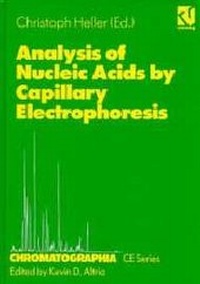
Analysis of Nucleic Acids by Capillary Electrophoresis
Erschienen am 26. Juni 1997
Buch
Hardcover
X, 314 Seiten
978-3-528-06871-4 (ISBN)
Beschreibung
Die Kapillarelektrophorese (CE) ist heute in biochemischen Laboratorien noch nicht als Routinemethode zur DNA-Trennung etabliert, obwohl sie diverse Vorzüge gegenüber den derzeitigen Methoden besitzt.
In diesem Band stellen verschiedene Wissenschaftler die theoretischen Aspekte der Trennung von Oligonucleinsäuren mit der CE, die instrumentellen Grundlagen und deren Grenzen und schließlich die praktische Anwendung in der Biochemie und Molekularbiologie vor.
This book on capillary electrophoresis is unique in its focus on the separation of nucleic acids. The importance of electrophoretic separation in every molecular biology laboratory justifies this specialization, which is also reflected in the development of instrumentation.
This book is aimed to help to implement this rather new and promising technology in the biological laboratories and to help to overcome typical problems that can occur when starting with a new technique. It should also trigger further development in the field. It covers the theoretical background as well as practical examples of usual applications.
The authors are all experts in their field, having many years of experience with capillary electrophoresis and their application to nucleic acids.
In diesem Band stellen verschiedene Wissenschaftler die theoretischen Aspekte der Trennung von Oligonucleinsäuren mit der CE, die instrumentellen Grundlagen und deren Grenzen und schließlich die praktische Anwendung in der Biochemie und Molekularbiologie vor.
This book on capillary electrophoresis is unique in its focus on the separation of nucleic acids. The importance of electrophoretic separation in every molecular biology laboratory justifies this specialization, which is also reflected in the development of instrumentation.
This book is aimed to help to implement this rather new and promising technology in the biological laboratories and to help to overcome typical problems that can occur when starting with a new technique. It should also trigger further development in the field. It covers the theoretical background as well as practical examples of usual applications.
The authors are all experts in their field, having many years of experience with capillary electrophoresis and their application to nucleic acids.
Weitere Details
Reihe
Auflage
1997
Sprache
Englisch
Verlagsort
Wiesbaden
Deutschland
Verlagsgruppe
Vieweg & Teubner
Zielgruppe
Für höhere Schule und Studium
Für Beruf und Forschung
Professional/practitioner
Illustrationen
biography
Maße
Höhe: 24 cm
Breite: 17 cm
Gewicht
658 gr
ISBN-13
978-3-528-06871-4 (9783528068714)
DOI
10.1007/978-3-322-91015-8
Schweitzer Klassifikation
Weitere Ausgaben
Andere Ausgaben
Christoph Heller
Analysis of Nucleic Acids by Capillary Electrophoresis
E-Book
06/2013
Vieweg+Teubner Verlag
96,29 €
Als Download verfügbar
Christoph Heller
Analysis of Nucleic Acids by Capillary Electrophoresis
Buch
01/2013
Vieweg+Teubner Verlag
106,99 €
Versand in 10-15 Tagen
Personen
Dr. Christoph Heller ist Wissenschaftler am Max-Planck-Institut für molekulare Genetik in Berlin.
The editor, Dr. Christoph Heller, is currently working at the Max-Planck-Institute for Molecular Genetics in Berlin-Dahlem, Germany. Since 1985 he is working in the field of DNA separation, both in conventional gels and - since five years - also in capillaries.
The editor, Dr. Christoph Heller, is currently working at the Max-Planck-Institute for Molecular Genetics in Berlin-Dahlem, Germany. Since 1985 he is working in the field of DNA separation, both in conventional gels and - since five years - also in capillaries.
Inhalt
Part 1: Basic Concepts
Separation Matrix - Electrophoresis theories - Microscopic studies
Part 2: Factors affecting the separation
Electric field and polymer concentration - Sample matrix and injection - Agglomeration
Part 3: Development in instrumentation
Pulsed field CE - New type of separation matrix - Blotting - DNA separation
Part 4: Applications
Separation of restriction fragments - Analysis of oligonucleotides - DNA sequencing - Antisense DNA - Mutational analysis
Separation Matrix - Electrophoresis theories - Microscopic studies
Part 2: Factors affecting the separation
Electric field and polymer concentration - Sample matrix and injection - Agglomeration
Part 3: Development in instrumentation
Pulsed field CE - New type of separation matrix - Blotting - DNA separation
Part 4: Applications
Separation of restriction fragments - Analysis of oligonucleotides - DNA sequencing - Antisense DNA - Mutational analysis