

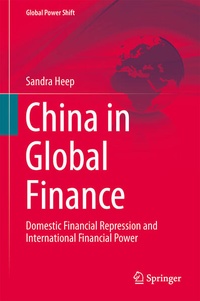
China in Global Finance
Domestic Financial Repression and International Financial Power
Erschienen am 11. Februar 2014
Buch
Hardcover
XVI, 157 Seiten
978-3-319-02465-3 (ISBN)
Beschreibung
Against the backdrop of China's increasingly influential role in the international financial architecture, this book seeks to characterize and evaluate China's financial power potential. It does so by analyzing the relationship between domestic financial repression and international financial power in the context of the political economy of the developmental state. On the basis of a novel theoretical framework for the analysis of the financial power potential of developmental states, the book provides an in-depth analysis of China's approach to currency internationalization, its creditor status and its policies towards the Bretton Woods institutions while contrasting the country's present role in global finance with the position of the Japanese developmental state in the 1980s and 1990s.
Weitere Details
Reihe
Auflage
2014 ed.
Sprache
Englisch
Verlagsort
Cham
Schweiz
Verlagsgruppe
Springer International Publishing
Zielgruppe
Für Beruf und Forschung
Illustrationen
17 s/w Abbildungen
XVI, 157 p. 17 illus.
Maße
Höhe: 241 mm
Breite: 160 mm
Dicke: 16 mm
Gewicht
436 gr
ISBN-13
978-3-319-02465-3 (9783319024653)
DOI
10.1007/978-3-319-02466-0
Schweitzer Klassifikation
Weitere Ausgaben
Andere Ausgaben
Buch
08/2016
Springer
106,99 €
Versand in 10-15 Tagen
E-Book
01/2014
1. Auflage
Springer
96,29 €
Als Download verfügbar
Person
Sandra Heep is a lecturer at the Institute of Chinese Studies at Freiburg University. Her research focuses on the political economy of Chinese economic reforms and China's role in global finance.
Inhalt
1 Introduction.- 2 Financial Power and the Developmental State.- 3 Financial Repression and Structural Financial Power.- 4 Financial Repression and Currency Internationalization.- 5 Financial Repression and Relational Financial Power.- 6 Developmental States in the Bretton Woods Institutions.- 7 Conclusion.