

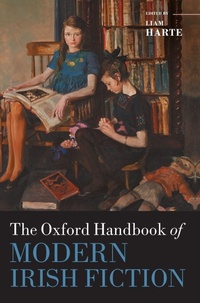
The Oxford Handbook of Modern Irish Fiction
Erschienen am 15. Oktober 2020
Buch
Hardcover
698 Seiten
978-0-19-875489-3 (ISBN)
Beschreibung
The Oxford Handbook of Modern Irish Fiction presents authoritative essays by thirty-five leading scholars of Irish fiction. They provide in-depth assessments of the breadth and achievement of novelists and short story writers whose collective contribution to the evolution and modification of these unique art forms has been far out of proportion to Ireland's small size. The volume brings a variety of critical perspectives to bear on the development of modern Irish fiction, situating authors, texts, and genres in their social, intellectual, and literary historical contexts.
The Handbook's coverage encompasses an expansive range of topics, including the recalcitrant atavisms of Irish Gothic fiction; nineteenth-century Irish women's fiction and its influence on emergent modernism and cultural nationalism; the diverse modes of irony, fabulism, and social realism that characterize the fiction of the Irish Literary Revival; the fearless aesthetic radicalism of James Joyce; the jolting narratological experiments of Samuel Beckett, Flann O'Brien, and Mairtin O Cadhain; the fate of the realist and modernist traditions in the work of Elizabeth Bowen, Frank O'Connor, Sean O'Faolain, and Mary Lavin, and in that of their ambivalent heirs, Edna O'Brien, John McGahern, and John Banville; the subversive treatment of sexuality and gender in Northern Irish women's fiction written during and after the Troubles; the often neglected genres of Irish crime fiction, science fiction, and fiction for children; the many-hued novelistic responses to the experiences of famine, revolution, and emigration; and the variety and vibrancy of post-millennial fiction from both parts of Ireland. Readably written and employing a wealth of original research, The Oxford Handbook of Modern Irish Fiction illuminates a distinguished literary tradition that has altered the shape of world literature.
The Handbook's coverage encompasses an expansive range of topics, including the recalcitrant atavisms of Irish Gothic fiction; nineteenth-century Irish women's fiction and its influence on emergent modernism and cultural nationalism; the diverse modes of irony, fabulism, and social realism that characterize the fiction of the Irish Literary Revival; the fearless aesthetic radicalism of James Joyce; the jolting narratological experiments of Samuel Beckett, Flann O'Brien, and Mairtin O Cadhain; the fate of the realist and modernist traditions in the work of Elizabeth Bowen, Frank O'Connor, Sean O'Faolain, and Mary Lavin, and in that of their ambivalent heirs, Edna O'Brien, John McGahern, and John Banville; the subversive treatment of sexuality and gender in Northern Irish women's fiction written during and after the Troubles; the often neglected genres of Irish crime fiction, science fiction, and fiction for children; the many-hued novelistic responses to the experiences of famine, revolution, and emigration; and the variety and vibrancy of post-millennial fiction from both parts of Ireland. Readably written and employing a wealth of original research, The Oxford Handbook of Modern Irish Fiction illuminates a distinguished literary tradition that has altered the shape of world literature.
Rezensionen / Stimmen
Harte's collection succeeds admirably. Gothic, romanticism, the historical novel, magic naturalism, social realism, modernism, hard-boiled noir, children's lit, film, political thrillers, police procedurals, the domestic novel, fiction in Irish, the Bildungsroman, post-modern experimentation - it's all here. If you teach modern literature, you will love this book. If you teach Irish literature, you will need it. * Michael Gleason, James Joyce Literary Supplement *Weitere Details
Reihe
Sprache
Englisch
Verlagsort
Oxford
Großbritannien
Zielgruppe
Für Beruf und Forschung
Maße
Höhe: 250 mm
Breite: 175 mm
Dicke: 42 mm
Gewicht
1363 gr
ISBN-13
978-0-19-875489-3 (9780198754893)
Copyright in bibliographic data and cover images is held by Nielsen Book Services Limited or by the publishers or by their respective licensors: all rights reserved.
Schweitzer Klassifikation
Weitere Ausgaben
Person
Liam Harte is Professor of Irish Literature at the University of Manchester. His publications include A History of Irish Autobiography (Cambridge University Press, 2018), Reading the Contemporary Irish Novel 1987-2007 (Wiley Blackwell, 2014), The Literature of the Irish in Britain: Autobiography and Memoir, 1725-2001 (Palgrave Macmillan, 2009), Modern Irish Autobiography: Self, Nation and Society (Palgrave Macmillan, 2007), and Contemporary Irish Fiction: Themes, Tropes, Theories (Macmillan, 2000; co-edited with Michael Parker).
Inhalt
Part I: Introduction
1: Liam Harte: Modern Irish Fiction: Renewing the Art of the New
Part II: Nineteenth-Century Contexts and Legacies
2: Jarlath Killeen: Irish Gothic Fiction
3: Gerardine Meaney: Nation, Gender, and Genre: Nineteenth-Century Women's Writing and the Development of Irish Fiction
4: James H. Murphy: Shame is the Spur: Novels by Irish Catholics, 1873-1922
Part III: Irish Revivalism and Irish Modernism
5: Elizabeth Grubgeld: George Moore: Gender, Place, and Narrative
6: Gregory Castle: Revival Fiction: Proclaiming the Future
7: Gregory Dobbins: The Materialist Fabulist Dialectic: James Stephens, Eimar O'Duffy, and Magic Naturalism
8: Sam Slote: Epic Modernism: Ulysses and Finnegans Wake
9: Brian O Conchubhair: The Parallax of Irish-Language Modernism, 1900-1940
Part IV: After the Revival, In Joyce's Wake
10: Louis de Paor: Lethal in Two Languages: Narrative Form and Cultural Politics in the Fiction of Flann O'Brien and Mairtin O Cadhain
11: Sinead Mooney: Effing the Ineffable: Samuel Beckett's Narrators
12: Allan Hepburn: Obliquities: Elizabeth Bowen and the Modern Short Story
13: Gerry Smyth: The Role and Representation of Betrayal in the Irish Short Story Since Dubliners
14: Heather Ingman: Arrows in Flight: Success and Failure in Mid-Twentieth-Century Irish Fiction
15: Norman Vance: 'Proud of Our Wee Ulster'?: Writing Region and Identity in Ulster Fiction
Part V: Fiction in the Modernizing Republic and the Troubled North
16: Jane Elizabeth Dougherty: Edna O'Brien and the Politics of Belatedness
17: Frank Shovlin: 'Half-Arsed Modern': John McGahern and the Failed State
18: Neil Murphy: John Banville's Fictions of Art
19: Caroline Magennis: Intimacy, Sex, and Violence in Northern Irish Women's Fiction
Part VI: Irish Genre Fiction
20: Ian Campbell Ross: Irish Crime Fiction
21: Jack Fennell: Irish Science Fiction
22: Padraic Whyte: House, Land, and Family Life: Children's Fiction and Irish Homes
Part VII: Fact into Fiction, Fiction into Film
23: Melissa Fegan: The Great Famine in Fiction, 1901-2015
24: Laura O'Connor: Fictions of 1916 in the Story of Ireland
25: Kevin Rockett: Irish Literary Cinema
Part VIII: Crossings and Crosscurrents
26: Tony Murray: The Fiction of the Irish in England
27: Stefanie Lehner: Devolutionary States: Crosscurrents in Contemporary Irish and Scottish Fiction
28: Sally Barr Ebest: Sex, Violence, and Religion in the Irish-American Domestic Novel
29: Sinead Moynihan: 'A Sly, Mid-Atlantic Appropriation': Ireland, the United States, and Transnational Fictions of Spain
Part IX: Contemporary Irish Fiction
30: Derek Hand: Dublin in the Rare New Times
31: Fiona McCann: Northern Irish Fiction After the Troubles
32: Michael G. Cronin: 'Our Nameless Desires': The Erotics of Time and Space in Contemporary Irish Lesbian and Gay Fiction
33: Padraig O Siadhail: Contemporary Irish-Language Fiction
34: Susan Cahill: Post-Millennial Irish Fiction
Part X: Critical Evaluations
35: Eve Patten: The Irish Novelist as Critic and Anthologist
1: Liam Harte: Modern Irish Fiction: Renewing the Art of the New
Part II: Nineteenth-Century Contexts and Legacies
2: Jarlath Killeen: Irish Gothic Fiction
3: Gerardine Meaney: Nation, Gender, and Genre: Nineteenth-Century Women's Writing and the Development of Irish Fiction
4: James H. Murphy: Shame is the Spur: Novels by Irish Catholics, 1873-1922
Part III: Irish Revivalism and Irish Modernism
5: Elizabeth Grubgeld: George Moore: Gender, Place, and Narrative
6: Gregory Castle: Revival Fiction: Proclaiming the Future
7: Gregory Dobbins: The Materialist Fabulist Dialectic: James Stephens, Eimar O'Duffy, and Magic Naturalism
8: Sam Slote: Epic Modernism: Ulysses and Finnegans Wake
9: Brian O Conchubhair: The Parallax of Irish-Language Modernism, 1900-1940
Part IV: After the Revival, In Joyce's Wake
10: Louis de Paor: Lethal in Two Languages: Narrative Form and Cultural Politics in the Fiction of Flann O'Brien and Mairtin O Cadhain
11: Sinead Mooney: Effing the Ineffable: Samuel Beckett's Narrators
12: Allan Hepburn: Obliquities: Elizabeth Bowen and the Modern Short Story
13: Gerry Smyth: The Role and Representation of Betrayal in the Irish Short Story Since Dubliners
14: Heather Ingman: Arrows in Flight: Success and Failure in Mid-Twentieth-Century Irish Fiction
15: Norman Vance: 'Proud of Our Wee Ulster'?: Writing Region and Identity in Ulster Fiction
Part V: Fiction in the Modernizing Republic and the Troubled North
16: Jane Elizabeth Dougherty: Edna O'Brien and the Politics of Belatedness
17: Frank Shovlin: 'Half-Arsed Modern': John McGahern and the Failed State
18: Neil Murphy: John Banville's Fictions of Art
19: Caroline Magennis: Intimacy, Sex, and Violence in Northern Irish Women's Fiction
Part VI: Irish Genre Fiction
20: Ian Campbell Ross: Irish Crime Fiction
21: Jack Fennell: Irish Science Fiction
22: Padraic Whyte: House, Land, and Family Life: Children's Fiction and Irish Homes
Part VII: Fact into Fiction, Fiction into Film
23: Melissa Fegan: The Great Famine in Fiction, 1901-2015
24: Laura O'Connor: Fictions of 1916 in the Story of Ireland
25: Kevin Rockett: Irish Literary Cinema
Part VIII: Crossings and Crosscurrents
26: Tony Murray: The Fiction of the Irish in England
27: Stefanie Lehner: Devolutionary States: Crosscurrents in Contemporary Irish and Scottish Fiction
28: Sally Barr Ebest: Sex, Violence, and Religion in the Irish-American Domestic Novel
29: Sinead Moynihan: 'A Sly, Mid-Atlantic Appropriation': Ireland, the United States, and Transnational Fictions of Spain
Part IX: Contemporary Irish Fiction
30: Derek Hand: Dublin in the Rare New Times
31: Fiona McCann: Northern Irish Fiction After the Troubles
32: Michael G. Cronin: 'Our Nameless Desires': The Erotics of Time and Space in Contemporary Irish Lesbian and Gay Fiction
33: Padraig O Siadhail: Contemporary Irish-Language Fiction
34: Susan Cahill: Post-Millennial Irish Fiction
Part X: Critical Evaluations
35: Eve Patten: The Irish Novelist as Critic and Anthologist