

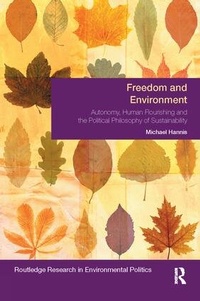
Freedom and Environment
Autonomy, Human Flourishing and the Political Philosophy of Sustainability
1. Auflage
Erschienen am 13. April 2017
Buch
Softcover
202 Seiten
978-1-138-06620-5 (ISBN)
Beschreibung
Must freedom be sacrificed to achieve ecological sustainability - or vice versa? Can we be genuinely free and live in sustainable societies? This book argues that we can, if we recognise and celebrate our ecological embeddedness, rather than seeking to transcend it.
But this does not mean freedom can simply be redefined to fit within ecological limits. Addressing current unsustainability will involve significant restrictions, and hence will require political justification, not just scientific evidence.
Drawing on material from perfectionist liberalism, capabilities approaches, human rights, relational ethics and virtue theory, Michael Hannis explores the relationship between freedom and sustainability, considering how each contributes to human flourishing. He argues that a substantive and ecologically literate conception of human flourishing can underpin both capability-based environmental rights and a eudaimonist ecological virtue ethics. With such a foundation in place, public authorities can act both to facilitate ecological virtue, and to remove structural incentives to ecological vice.
Freedom and Environment is a lucid addition to existing literature in environmental politics and virtue ethics, and will be an excellent resource to those studying debates about freedom with debates about ecological sustainability.
But this does not mean freedom can simply be redefined to fit within ecological limits. Addressing current unsustainability will involve significant restrictions, and hence will require political justification, not just scientific evidence.
Drawing on material from perfectionist liberalism, capabilities approaches, human rights, relational ethics and virtue theory, Michael Hannis explores the relationship between freedom and sustainability, considering how each contributes to human flourishing. He argues that a substantive and ecologically literate conception of human flourishing can underpin both capability-based environmental rights and a eudaimonist ecological virtue ethics. With such a foundation in place, public authorities can act both to facilitate ecological virtue, and to remove structural incentives to ecological vice.
Freedom and Environment is a lucid addition to existing literature in environmental politics and virtue ethics, and will be an excellent resource to those studying debates about freedom with debates about ecological sustainability.
Rezensionen / Stimmen
'Michael Hannis' new book represents a valuable addition to the literatures on capabilities and justice, on the one hand, and environmental virtue ethics, on the other. In addition, it provides a sustained and penetrating account of the relationship between human freedom and ecological sustainability-two sometimes conflicting goals that must be reconciled if humanity is to have a decent future on Earth.'-Philip Cafaro, Colorado State University'This book aptly examines how ecological sustainability and freedom - both required for the possibility of human flourishing - can be understood as mutually compatible. Employing theoretic resources from the capabilities approach and environmental virtue ethics, Hannis presents an important, compelling, and pragmatic conception of the political change, institutional reorientation, and ethical adaptation called for as we enter the Anthropocene.'-Allen Thompson, Oregon State University
'Imagine we didn't face the most serious environmental crisis in our history: wouldn't we still want to live in a human society characterised by respect for human freedom and where acting as a virtuous citizen was rewarded? Those resisting effective action to address unsustainability often claim to be protecting the sacred cow of freedom. Mike Hannis offers a detailed, life-affirming and much-needed rebuttal of such claims, revealing them to be conceptually as well as practically incoherent. He demonstrates that the aims of saving the planet and creating a free and flourishing human society are not only compatible but mutually reinforcing.'-Molly Scott Cato, Professor of Green Economics, Roehampton University; Green MEP for South West England, UK
'This is a book that covers a lot of ground very intelligently, and advances an unusually well integrated set of arguments to pull together several current areas of environmental scholarship in a stimulating, cohesive way.'-Piers H.G. Stephen, The White Horse Press
Weitere Details
Reihe
Sprache
Englisch
Verlagsort
London
Großbritannien
Verlagsgruppe
Taylor & Francis Ltd
Zielgruppe
Für höhere Schule und Studium
Postgraduate and Undergraduate
Illustrationen
2 s/w Abbildungen, 2 s/w Zeichnungen
2 Line drawings, black and white; 2 Illustrations, black and white
Maße
Höhe: 229 mm
Breite: 152 mm
Gewicht
294 gr
ISBN-13
978-1-138-06620-5 (9781138066205)
Copyright in bibliographic data and cover images is held by Nielsen Book Services Limited or by the publishers or by their respective licensors: all rights reserved.
Schweitzer Klassifikation
Weitere Ausgaben
Andere Ausgaben
Michael Hannis
Freedom and Environment
Autonomy, Human Flourishing and the Political Philosophy of Sustainability
Buch
10/2015
1. Auflage
Routledge
231,50 €
Versand in 10-20 Tagen
Michael Hannis
Freedom and Environment
Autonomy, Human Flourishing and the Political Philosophy of Sustainability
E-Book
10/2015
Routledge
61,99 €
Als Download verfügbar
Michael Hannis
Freedom and Environment
Autonomy, Human Flourishing and the Political Philosophy of Sustainability
E-Book
10/2015
Routledge
61,99 €
Als Download verfügbar
Person
Mike Hannis is Lecturer in Environmental Humanities at Bath Spa University, UK. He works at the intersection of ethics, politics and philosophy, exploring conceptions of sustainability, land use issues and environmental virtue ethics.
Inhalt
Selected Contents: Introduction Chapter 1: Sustainability of What? Chapter 2: Neutrality or Sustainability? Chapter 3: Freedom and Flourishing Chapter 4: Capabilities, Consumption and Environmental Rights Chapter 5: Autonomy, Interdependence and Virtue Chapter 6: The Virtues of Acknowledged Ecological Dependence Chapter 7: Facilitating Ecological Virtue Index