

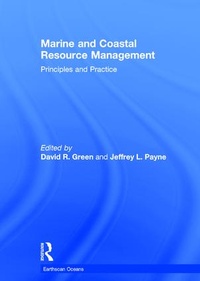
Marine and Coastal Resource Management
Principles and Practice
1. Auflage
Erschienen am 26. September 2017
Buch
Hardcover
328 Seiten
978-1-84971-289-7 (ISBN)
Beschreibung
In this new and highly original textbook for a range of interdisciplinary courses and degree programmes focusing on marine and coastal resource management, readers are offered an introduction to the subject matter, a broad perspective and understanding, case study applications, and a reference source. Each chapter is written by an international authority and expert in the respective field, providing perspectives from physical and human geography, marine biology and fisheries, planning and surveying, law, technology, environmental change, engineering, and tourism.
In addition to an overview of the theory and practice of its subject area, many chapters include detailed case studies to illustrate the applications, including relationships to decision-making requirements at local, regional, and national levels. Each chapter also includes a list of references for further reading, with a selection of key journal papers and URLs. Overall, this volume provides a key textbook for undergraduate and postgraduate courses and for the coastal or marine practitioner, as well as a long-term reference for students.
In addition to an overview of the theory and practice of its subject area, many chapters include detailed case studies to illustrate the applications, including relationships to decision-making requirements at local, regional, and national levels. Each chapter also includes a list of references for further reading, with a selection of key journal papers and URLs. Overall, this volume provides a key textbook for undergraduate and postgraduate courses and for the coastal or marine practitioner, as well as a long-term reference for students.
Rezensionen / Stimmen
"Since publication this book has been an invaluable source of reference and inspiration for my students - notably my postgraduate classes have used the book for a wide variety of assignments and seminar presentations as it provides an accessible and comprehensive overview of the subject base. It provides in-depth conceptual and academic content coupled with real world case studies that have really helped develop and broaden student knowledge and engagement. A must have book for students and academic staff alike." - Jonathan Potts, Principal Lecturer and Course Director for MSc Coastal and Marine Resource Management, University of Portsmouth, UKWeitere Details
Reihe
Sprache
Englisch
Verlagsort
London
Großbritannien
Verlagsgruppe
Taylor & Francis Ltd
Zielgruppe
Für höhere Schule und Studium
Für Beruf und Forschung
Illustrationen
24 s/w Zeichnungen, 15 s/w Tabellen, 93 s/w Abbildungen, 54 s/w Photographien bzw. Rasterbilder
15 Tables, black and white; 24 Line drawings, black and white; 54 Halftones, black and white; 93 Illustrations, black and white
Maße
Höhe: 246 mm
Breite: 174 mm
Gewicht
870 gr
ISBN-13
978-1-84971-289-7 (9781849712897)
Copyright in bibliographic data and cover images is held by Nielsen Book Services Limited or by the publishers or by their respective licensors: all rights reserved.
Schweitzer Klassifikation
Weitere Ausgaben
Andere Ausgaben
E-Book
09/2017
Routledge
78,99 €
Als Download verfügbar
E-Book
09/2017
Routledge
78,99 €
Als Download verfügbar
Buch
09/2017
1. Auflage
Earthscan Ltd
74,50 €
Versand in 3-4 Wochen
Personen
David R. Green is a specialist in the application of geospatial technologies to coastal and marine environments. He is director of the Aberdeen Institute for Coastal Science and Management (AICSM) and the UAV/UAS Centre for Environmental Monitoring and Mapping (UCEMM) in the Department of Geography and Environment, School of Geosciences, at the University of Aberdeen in Scotland, UK; director and vice-chair of the East Grampian Coastal Partnership (EGCP Ltd) in Aberdeen; and editor-in-chief of the Journal of Coastal Conservation, Management and Planning (Springer). He is also the editor of a number of books on coastal zone management.
Jeffrey L. Payne is director of the US National Oceanic and Atmospheric Administration's Office for Coastal Management. Under his leadership, the nation's coastal management activities are coordinated to address the significant challenges affecting our coastal communities, with a focus on customer needs and a commitment to partnerships. He brings 30 years of experience in environmental policy, natural resources management, community resilience, climate adaptation, oceanographic research, and organizational development. He has held previous positions as the NOAA deputy chief of staff and deputy of the NOAA policy office, as the budget examiner for NOAA programs in the White House Office of Management and Budget, and as legislative staff on Capitol Hill as a Congressional Science and Engineering Fellow. Among his current interagency appointments, he serves as the NOAA representative to the Federal Interagency Floodplain Management Task Force, the Recovery Support Function Leadership Group, the Mitigation Framework Leadership Group, and the U.S. Subcommittee on Ocean Science and Technology.
Jeffrey L. Payne is director of the US National Oceanic and Atmospheric Administration's Office for Coastal Management. Under his leadership, the nation's coastal management activities are coordinated to address the significant challenges affecting our coastal communities, with a focus on customer needs and a commitment to partnerships. He brings 30 years of experience in environmental policy, natural resources management, community resilience, climate adaptation, oceanographic research, and organizational development. He has held previous positions as the NOAA deputy chief of staff and deputy of the NOAA policy office, as the budget examiner for NOAA programs in the White House Office of Management and Budget, and as legislative staff on Capitol Hill as a Congressional Science and Engineering Fellow. Among his current interagency appointments, he serves as the NOAA representative to the Federal Interagency Floodplain Management Task Force, the Recovery Support Function Leadership Group, the Mitigation Framework Leadership Group, and the U.S. Subcommittee on Ocean Science and Technology.
Inhalt
1. Introduction Part I: Fundamentals 2. Integrated Coastal Zone Management 3. Beach Management 4. Marine Law and Designations 5. Marine Spatial Planning 6. Shoreline Management Planning and Coastal Engineering Part II: Mapping, Monitoring and Modelling 7. Coastal Data Collection: Applying Geospatial Technologies to Coastal Studies 8. Basic Prediction Methods in Marine Sciences 9. Information Management and Electronic Coastal Atlases 10. Hydrographic Surveying Part III: Current and Emerging Sectors and Issues 11. Coastal Ecology, Conservation, Sustainability and Management 12. Management of Marine Ecosystems 13. Public Participation, Coastal Management and Climate Change Adaptation 14. Offshore Energy 15. Marine and Coastal Tourism 16. Surf Science and Multi-Purpose Reefs 17. Epilogue: Current and Future Developments