

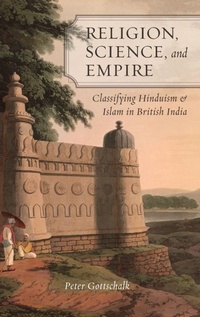
Religion, Science, and Empire
Classifying Hinduism and Islam in British India
Erschienen am 20. Dezember 2012
Buch
Hardcover
448 Seiten
978-0-19-539301-9 (ISBN)
Beschreibung
Peter Gottschalk offers a compelling study of how, through the British implementation of scientific taxonomy in the subcontinent, Britons and Indians identified an inherent divide between mutually antagonistic religious communities.
England's ascent to power coincided with the rise of empirical science as an authoritative way of knowing not only the natural world, but the human one as well. The British scientific passion for classification, combined with the Christian impulse to differentiate people according to religion, led to a designation of Indians as either Hindu or Muslim according to rigidly defined criteria that paralleled classification in botanical and zoological taxonomies.
Through an historical and ethnographic study of the north Indian village of Chainpur, Gottschalk shows that the Britons' presumed categories did not necessarily reflect the Indians' concepts of their own identities, though many Indians came to embrace this scientism and gradually accepted the categories the British instituted through projects like the Census of India, the Archaeological Survey of India, and the India Museum. Today's propogators of Hindu-Muslim violence often cite scientistic formulations of difference that descend directly from the categories introduced by imperial Britain.
Religion, Science, and Empire will be a valuable resource to anyone interested in the colonial and postcolonial history of religion in India.
England's ascent to power coincided with the rise of empirical science as an authoritative way of knowing not only the natural world, but the human one as well. The British scientific passion for classification, combined with the Christian impulse to differentiate people according to religion, led to a designation of Indians as either Hindu or Muslim according to rigidly defined criteria that paralleled classification in botanical and zoological taxonomies.
Through an historical and ethnographic study of the north Indian village of Chainpur, Gottschalk shows that the Britons' presumed categories did not necessarily reflect the Indians' concepts of their own identities, though many Indians came to embrace this scientism and gradually accepted the categories the British instituted through projects like the Census of India, the Archaeological Survey of India, and the India Museum. Today's propogators of Hindu-Muslim violence often cite scientistic formulations of difference that descend directly from the categories introduced by imperial Britain.
Religion, Science, and Empire will be a valuable resource to anyone interested in the colonial and postcolonial history of religion in India.
Rezensionen / Stimmen
This is a remarkable book which greatly expands our knowledge of the processes which went into making British representations of India. It is a formidable achievement. * Francis Robinson, The Times Literary Supplement *Weitere Details
Sprache
Englisch
Verlagsort
New York
USA
Zielgruppe
Für höhere Schule und Studium
Für Beruf und Forschung
Illustrationen
18 black and white halftones
Maße
Höhe: 240 mm
Breite: 161 mm
Dicke: 30 mm
Gewicht
906 gr
ISBN-13
978-0-19-539301-9 (9780195393019)
Copyright in bibliographic data and cover images is held by Nielsen Book Services Limited or by the publishers or by their respective licensors: all rights reserved.
Schweitzer Klassifikation
Weitere Ausgaben
Andere Ausgaben
E-Book
11/2012
1. Auflage
OUP eBook
53,49 €
Als Download verfügbar
Person
Professor and Chair, Department of Religion, Wesleyan University.
Inhalt
Acknowledgements ; List of Illustrations ; Glossaries ; Note on Transliteration ; Foreword by Peter Lake ; Introduction ; Chapter One: Religion, Science, and Scientism ; Chapter Two: Cartography, the Ideal of Science, and the Place of Religion ; First Interlude: The Dynamics of Comparison and Classification ; Chapter Three: Christocentric Travel Writing: Dynamics of Comparison and Classification ; Second Interlude: The Five Modes of Comparison ; Chapter Four: Humanist Travel Writing: Ascent of Empiricism and the On the Spot ; Third Interlude: Classification in the Natural Sciences ; Chapter Five: Categories to Count On: Religion and Caste in the Census ; Chapter Six: A Raja, a Ghost, and a Tribe: Studies in Ethnology, Folklore, and Religion ; Chapter Seven: Popularizing Chainpur's Past: Archaeology in Place and in Museums ; Chapter Eight: Chainpur Today ; Conclusion ; Appendices ; Notes ; Index