

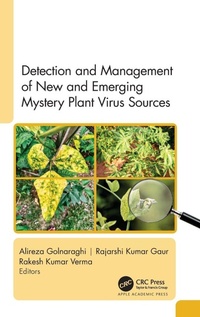
Detection and Management of New and Emerging Mystery Plant Virus Sources
1. Auflage
Erschienen am 22. November 2024
Buch
Hardcover
320 Seiten
978-1-77491-662-9 (ISBN)
Beschreibung
Plant virus infections are estimated to cost billions of dollars in economic losses. Despite intensive efforts to manage and prevent plant viruses and their potential vectors in crop production processes, the threat posed by newly emerging or re-emerging viruses is becoming more common and poses potential threats even in previously uninfected areas. In this new volume, the editors review the progress made and the challenges ahead to address the hidden world of plant viruses, their impact on agriculture and food security, and the need for new detection systems and management strategies.
Weitere Details
Sprache
Englisch
Verlagsort
Oakville
Kanada
Zielgruppe
Für höhere Schule und Studium
Für Beruf und Forschung
Academic and Postgraduate
Illustrationen
40 s/w Abbildungen, 7 s/w Photographien bzw. Rasterbilder, 33 s/w Zeichnungen, 23 s/w Tabellen
23 Tables, black and white; 33 Line drawings, black and white; 7 Halftones, black and white; 40 Illustrations, black and white
Maße
Höhe: 240 mm
Breite: 161 mm
Dicke: 23 mm
Gewicht
669 gr
ISBN-13
978-1-77491-662-9 (9781774916629)
Copyright in bibliographic data and cover images is held by Nielsen Book Services Limited or by the publishers or by their respective licensors: all rights reserved.
Schweitzer Klassifikation
Weitere Ausgaben
Andere Ausgaben
Alireza Golnaraghi | Rajarshi Kumar Gaur | Rakesh Kumar Verma
Detection and Management of New and Emerging Mystery Plant Virus Sources
E-Book
11/2024
1. Auflage
Apple Academic Press Inc.
224,99 €
Als Download verfügbar
Alireza Golnaraghi | Rajarshi Kumar Gaur | Rakesh Kumar Verma
Detection and Management of New and Emerging Mystery Plant Virus Sources
E-Book
11/2024
1. Auflage
Apple Academic Press Inc.
224,99 €
Als Download verfügbar
Personen
Alireza Golnaraghi, PhD, is Assistant Professor of Plant Protection at the Science and Research Branch of Islamic Azad University. He is also a researcher in the Department of Earth, Ocean and Atmospheric Sciences, University of British Columbia and in the Department of Biodiversity,BoomZista Institute, both in Canada. Dr. Golnaraghi has made significant contributions in the area of viruses and endophytic microbes. He has published over 50 journal papers, several books, and book chapters and has presented many conference papers. With the help of international researchers and students, he established the not-for-profit BoomZista Institute in Canada in 2020, with the objective of saving the planet through research, publication, education, and dissemination of science.
Rajarshi Kumar Gaur, PhD, is Professor of Biotechnology at Deen Dayal Upadhyaya Gorakhpur University, Uttar Pradesh, India. He has made significant contributions in the field of sugarcane viruses. He has published many papers and edited books and has presented over 50 papers at national and international conferences. He is a fellow of several professional associations, including Linnean Society and the Royal Society of Biology, among others. He has visited several laboratories around the world and is involved in managing international grants and collaborative projects related to plant viruses and disease management.
Rakesh Kumar Verma, PhD, is Assistant Professor of Biosciences at Mody University of Science and Technology, Rajasthan, India. He made significant contributions to the diagnosis, management, and phylogeny of potyviruses and begomoviruses by using molecular and bioinformatic tools. He is now working on the molecular characterization of endophytes isolated from Thar Desert and their plant growth promotion potential under abiotic and biotic stress conditions and is handling two projects on endophytes and their involvement in biotic and abiotic stress management. He has published book chapters and research papers and presented many papers at international and national conferences.
Rajarshi Kumar Gaur, PhD, is Professor of Biotechnology at Deen Dayal Upadhyaya Gorakhpur University, Uttar Pradesh, India. He has made significant contributions in the field of sugarcane viruses. He has published many papers and edited books and has presented over 50 papers at national and international conferences. He is a fellow of several professional associations, including Linnean Society and the Royal Society of Biology, among others. He has visited several laboratories around the world and is involved in managing international grants and collaborative projects related to plant viruses and disease management.
Rakesh Kumar Verma, PhD, is Assistant Professor of Biosciences at Mody University of Science and Technology, Rajasthan, India. He made significant contributions to the diagnosis, management, and phylogeny of potyviruses and begomoviruses by using molecular and bioinformatic tools. He is now working on the molecular characterization of endophytes isolated from Thar Desert and their plant growth promotion potential under abiotic and biotic stress conditions and is handling two projects on endophytes and their involvement in biotic and abiotic stress management. He has published book chapters and research papers and presented many papers at international and national conferences.
Inhalt
PART 1: RECENT APPROACHES FOR PLANT VIRUS DETECTION 1. Advancement in Detection and Diagnostics of Plant Viruses 2. Recent Trends in Diagnostic Methods for Detection of Plant Viruses 3. Efficient, Rapid, and Sensitive Detection of Plant Viruses with Next-Generation CRISPR-Based Diagnostic Methods 4. Identification and Diagnosis of Plant Viruses Using Different Strategies 5. Current Approaches and Prospective Strategies for Plant Virus Management PART 2: RECENT TRENDS IN VIRAL DISEASE CONTROL 6. Plant Virus Management: An Account of Conventional and Next-Generation Approaches 7. Detection of Plant Viruses and Their Management Strategies 8. Plant Virus Disease Management Strategies: Conventional Versus Modern Techniques 9. CRISPR/Cas System-Mediated Adaptive Immunity: A Revolutionary Tool for Controlling Plant Viruses 10. Biological and Anthropogenic Risk Factors Favoring Persistence and Spread of Harmful Plant Viruses