

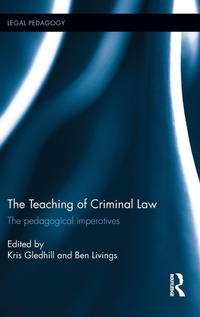
The Teaching of Criminal Law
The pedagogical imperatives
1. Auflage
Erschienen am 8. September 2016
Buch
Hardcover
222 Seiten
978-1-138-84199-4 (ISBN)
Beschreibung
The Teaching of Criminal Law provides the first considered discussion of the pedagogy that should inform the teaching of criminal law. It originates from a survey of criminal law courses in different parts of the English-speaking world which showed significant similarity across countries and over time. It also showed that many aspects of substantive law are neglected. This prompted the question of whether any real consideration had been given to criminal law course design. This book seeks to provide a critical mass of thought on how to secure an understanding of substantive criminal law, by examining the course content that best illustrates the thought process of a criminal lawyer, by presenting innovative approaches for securing active learning by students, and by demonstrating how criminal law can secure other worthwhile graduate attributes by introducing wider contexts.
This edited collection brings together contributions from academic teachers of criminal law from Australia, New Zealand, the United Kingdom, and Ireland who have considered issues of course design and often implemented them. Together, they examine several innovative approaches to the teaching of criminal law that have been adopted in a number of law schools around the world, both in teaching methodology and substantive content. The authors offer numerous suggestions for the design of a criminal law course that will ensure students gain useful insights into criminal law and its role in society.
This book helps fill the gap in research into criminal law pedagogy and demonstrates that there are alternative ways of delivering this core part of the law degree. As such, this book will be of key interest to researchers, academics and lecturers in the fields of criminal law, pedagogy and teaching methods.
This edited collection brings together contributions from academic teachers of criminal law from Australia, New Zealand, the United Kingdom, and Ireland who have considered issues of course design and often implemented them. Together, they examine several innovative approaches to the teaching of criminal law that have been adopted in a number of law schools around the world, both in teaching methodology and substantive content. The authors offer numerous suggestions for the design of a criminal law course that will ensure students gain useful insights into criminal law and its role in society.
This book helps fill the gap in research into criminal law pedagogy and demonstrates that there are alternative ways of delivering this core part of the law degree. As such, this book will be of key interest to researchers, academics and lecturers in the fields of criminal law, pedagogy and teaching methods.
Rezensionen / Stimmen
'We can lament the lingering influence of 'old school' doctrine-focused criminal law teaching or we can articulate better ways to teach and study criminal law. The contributors to this fine collection are to be congratulated for taking the latter more constructive path. Developing curricula that extend beyond the traditional 'general principles + homicide + theft' formula, refusing to artificially extract criminal law rules from the practical and procedures by which they are operationalised, taking historical, cultural, political, economic and other contextual factors seriously, valuing Indigenous and feminist perspectives and insights, employing problem-based learning - it is heartening to read that these and other exciting approaches are well on the way to becoming the 'new normal' in criminal law teaching.'Luke McNamara, Professor, Faculty of Law, UNSW & co-author of D Brown et al, Criminal Laws: Materials and Commentary on Criminal Law and Process of New South Wales (Federation Press, 6th ed, 2015)
"Gledhill and Livings' collection provides criminal law teachers with a uniquely useful resource to aid pedagogical self-reflection and future conversations with various stakeholders. It serves as an important catalyst to take the legal pedagogy agenda forward."
Daniel Pascoe, 'Criminal Law Pedagogy', Legal Quarterly Vol. 72 No. 2 (2021) 406-410, DOI: 10.53386/nilq.v72i2.729
"This publication is a useful, timely, innovative, and aspirational contribution to a small body of literature on subject-specific teaching and learning methods used in law schools. It is a worthwhile addition to any criminal law library and serves as a catalogue of new ideas and useful reminders for anyone involved in the teaching of criminal law. The many diverse and well-developed chapters of this book offer great insight into the ways in which criminal law is, has been, and ought to be taught at university."
Andreas Schloenhardt, Professor of Criminal law, The University of Queensland, Australia.
Weitere Details
Reihe
Sprache
Englisch
Verlagsort
London
Großbritannien
Verlagsgruppe
Taylor & Francis Ltd
Zielgruppe
Für höhere Schule und Studium
Für Beruf und Forschung
Postgraduate and Professional
Illustrationen
2 s/w Zeichnungen, 5 s/w Tabellen
5 Tables, black and white; 2 Line drawings, black and white
Maße
Höhe: 240 mm
Breite: 161 mm
Dicke: 17 mm
Gewicht
505 gr
ISBN-13
978-1-138-84199-4 (9781138841994)
Copyright in bibliographic data and cover images is held by Nielsen Book Services Limited or by the publishers or by their respective licensors: all rights reserved.
Schweitzer Klassifikation
Weitere Ausgaben
Andere Ausgaben
Buch
03/2018
1. Auflage
Routledge
72,30 €
Versand in 10-20 Tagen
E-Book
08/2016
Routledge
65,99 €
Als Download verfügbar
E-Book
08/2016
1. Auflage
Routledge
65,99 €
Als Download verfügbar
Personen
Kris Gledhill is Associate Professor at AUT Law School, Auckland, New Zealand.
Ben Livings is Senior Lecturer at the Law School of the University of New England in New South Wales, Australia.
Ben Livings is Senior Lecturer at the Law School of the University of New England in New South Wales, Australia.
Inhalt
1. Introduction 2. Building Block or Stumbling Block? Teaching Actus Reus and Mens Rea in Criminal Law 3. Teaching the Elements of Crimes 4. Enhancing Interactivity in the Teaching of Criminal Law: Using Response Technology in the Lecture Theatre 5. Using Problem-Based Learning to Enhance the Study of Criminal Law 6. Turning Criminal Law Upside Down 7. Criminal Law Pedagogy and the Australian State Codes 8. Teaching Criminal Law as Statutory Interpretation 9. Shaking the Foundations: Criminal Law as a Means of Critiquing the Assumptions of the Centrality of Doctrine in Law 10. The Challenges and Benefits of Integrating Criminal Law, Litigation and Evidence 11. 'Crime and the Criminal Process': Challenging Traditions, Breaking Boundaries 12. Context and Connection 13. Teaching and Learning Criminal Law 'in Context': Taking 'Context' Seriously 14. Teaching Indigenous and Minority Students and Perspectives in Criminal Law 15. Introducing Feminist Legal Jurisprudence through the Teaching of Criminal Law 16. Choice 17. The Absence of Regulatory Crime from the Criminal Law Curriculum 18. Conclusion: Looking to the future