

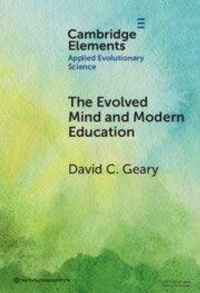
The Evolved Mind and Modern Education
Status of Evolutionary Educational Psychology
Erschienen am 23. Mai 2024
Buch
Hardcover
98 Seiten
978-1-009-45484-1 (ISBN)
Beschreibung
Humans have an extraordinary ability to create evolutionarily novel knowledge, such as writing systems and mathematics. This accumulated knowledge over several millennia supports large, dynamic societies that now require children to learn this novel knowledge in educational settings. This Element provides a framework for understanding the evolution of the brain systems that enable innovation and novel learning and how these systems can act on human cognitive universals, such as language, to create evolutionarily novel abilities, such as reading and writing. Critical features of these networks include the top-down control of attention, which is central to the formation of evolutionarily novel abilities, as well as self-awareness and mental time travel that support academic self-concepts and the generation of long-term educational goals. The basics of this framework are reviewed and updated here, as are implications for instructional practices.
Weitere Details
Reihe
Sprache
Englisch
Verlagsort
Cambridge
Großbritannien
Produkt-Hinweis
Fadenheftung
Gewebe-Einband
Illustrationen
Worked examples or Exercises
Maße
Höhe: 229 mm
Breite: 152 mm
Dicke: 6 mm
Gewicht
304 gr
ISBN-13
978-1-009-45484-1 (9781009454841)
Copyright in bibliographic data and cover images is held by Nielsen Book Services Limited or by the publishers or by their respective licensors: all rights reserved.
Schweitzer Klassifikation
Weitere Ausgaben
Andere Ausgaben
Buch
05/2024
Cambridge University Press
23,50 €
Versand in 15-20 Tagen
E-Book
05/2024
Cambridge University Press
20,99 €
Als Download verfügbar
E-Book
03/2024
Cambridge University Press
20,99 €
Als Download verfügbar
Person
Inhalt
1. Introduction; 2. Brain and cognitive evolution; 3. Cumulative cultural evolution and academic learning; 4. Noncognitive processes and educational outcomes; 5. Instruction implications and research; 6. Conclusion; References.