

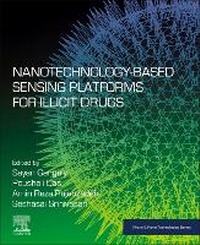
Nanotechnology-Based Sensing Platforms for Illicit Drugs
Erschienen am 2. Juni 2025
Buch
Softcover
400 Seiten
978-0-443-23740-9 (ISBN)
Beschreibung
Nanotechnology-Based Sensing Platforms for Illicit Drugs reviews different types of sensors that detect illicit drugs, with a special focus on the advantages provided by incorporating nanotechnology in their design. The book starts with the fundamentals, classification, progress, the current state of research on nanotechnology-based sensors, and an overview of materials commonly used. Subsequent chapters focus on the chemical interactive behaviors of drugs and their detection methods. It includes a thorough discussion on the design, fabrication, and characterization of sensors for illicit drug detection. Final sections provide an overall outlook on recent technological advances in drug detection devices and future research.
This book is a valuable resource for researchers, scientists, and professionals interested in biosensors, nanotechnology, and their applications in illicit drug detection.
This book is a valuable resource for researchers, scientists, and professionals interested in biosensors, nanotechnology, and their applications in illicit drug detection.
Weitere Details
Reihe
Sprache
Englisch
Verlagsort
Philadelphia
USA
Zielgruppe
Für Beruf und Forschung
Für höhere Schule und Studium
Maße
Höhe: 235 mm
Breite: 191 mm
Gewicht
820 gr
ISBN-13
978-0-443-23740-9 (9780443237409)
Copyright in bibliographic data and cover images is held by Nielsen Book Services Limited or by the publishers or by their respective licensors: all rights reserved.
Schweitzer Klassifikation
Weitere Ausgaben
Personen
Sayan Ganguly is a Senior Researcher at the University of Waterloo, Canada. His primary research interests include superabsorbent hydrogels, composite hydrogels, polymer-graphene nanocomposites, MXene-polymer systems, polymer composites for EMI shielding, and conducting polymer composites. Poushali Das is a Senior Research Scientist in the Faculty of Engineering at McMaster University, Canada. Her research interests include MXenes, multifunctional luminescent quantum dots, and applications in sensors, healthcare, smart nanocomposites, hydrogels, and 3D printing. Dr. Amin Reza Rajabzadeh is an Associate Professor and former Chair of the Biotechnology Program at the School of Engineering Practice and Technology, McMaster University, Canada. Dr. Rajabzadeh specializes in the field of biochemical engineering with a focus on biosensors, bioseparation and purification, bioprocess monitoring and control, bioreactor design, and environmental engineering. Dr. Rajabzadeh is a Professional Engineer of Ontario and is a member of the Canadian Engineering Education Association and the American Society for Engineering Education. Dr. Rajab Zadeh was a MacPherson Leadership in Teaching and Learning (LTL) Fellow from 2017 to 2019. Dr. Seshasai Srinivasan is an Associate Professor in McMaster University's Faculty of Engineering. Prior to this, he has held a Research Scientist and a part-time instructor position in the Department of Mechanical and Industrial Engineering of Ryerson University, a postdoctoral position at the Laboratory of Food Process Engineering of the Swiss Federal Institute of Technology (ETH-Zurich) in Switzerland and a Research Associate position in the Engine Research Center of the University of Wisconsin-Madison.
Inhalt
1. General Introduction to nanotechnology based sensors
2. Classical materials for sensors
3. Chemical interactive behaviors of drugs
4. Drug detection methods
5. Design, and fabrication strategies of drug sensors
6. Characterization of various sensors
7. Electrochemical detection of illicit drugs
8. Colorimetric sensors for illicit drugs detection
9. Fluorescence based sensors for detection of illicit drugs
10. Surface-enhanced Raman spectroscopy for detection of illicit drugs
11. Chromatography for detection of illicit drugs
12. Devices for detection of illicit drugs
13. Rapid detection of illicit drugs in saliva
14. Advantages of point-of-care detections
15. Commercially adoptable Nanotechnology platform for illicit drug sensing
2. Classical materials for sensors
3. Chemical interactive behaviors of drugs
4. Drug detection methods
5. Design, and fabrication strategies of drug sensors
6. Characterization of various sensors
7. Electrochemical detection of illicit drugs
8. Colorimetric sensors for illicit drugs detection
9. Fluorescence based sensors for detection of illicit drugs
10. Surface-enhanced Raman spectroscopy for detection of illicit drugs
11. Chromatography for detection of illicit drugs
12. Devices for detection of illicit drugs
13. Rapid detection of illicit drugs in saliva
14. Advantages of point-of-care detections
15. Commercially adoptable Nanotechnology platform for illicit drug sensing