

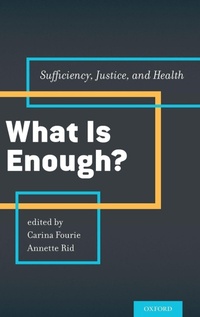
What is Enough?
Sufficiency, Justice, and Health
Erschienen am 24. November 2016
Buch
Hardcover
352 Seiten
978-0-19-938526-3 (ISBN)
Beschreibung
What is a just way of spending public resources for health and health care? Several significant answers to this question are under debate. Public spending could aim to promote greater equality in health, for example, or maximize the health of the population, or provide the worst off with the best possible health. Another approach is to aim for each person to have "enough" so that her health or access to health care does not fall under a critical level. This latter approach is called sufficientarian.
Sufficientarian approaches to distributive justice are intuitively appealing, but require further analysis and assessment. What exactly is sufficiency? Why do we need it? What does it imply for the just distribution of health or healthcare? This volume offers fresh perspectives on these critical questions. Philosophers, bioethicists, health policy-makers, and health economists investigate sufficiency and its application to health and health care in fifteen original contributions.
Sufficientarian approaches to distributive justice are intuitively appealing, but require further analysis and assessment. What exactly is sufficiency? Why do we need it? What does it imply for the just distribution of health or healthcare? This volume offers fresh perspectives on these critical questions. Philosophers, bioethicists, health policy-makers, and health economists investigate sufficiency and its application to health and health care in fifteen original contributions.
Rezensionen / Stimmen
"Health care allocation and sufficientarianism, the distributive view according to which what matters is to lift individuals above a certain threshold of needs, are two of the more hotly contested topics in moral and political philosophy. Somehow, however, they have rarely been linked. This book is the first of its kind to weave these two important questions together. It is therefore a very welcome addition to the literature on health care ethics. Not only isit likely to generate a lot of interest among political philosophers and bioethicists, but it will also, in all likelihood, become a key reference point for any future debates about sufficiency in
health."-Shlomi Segall, The Hebrew University of Jerusalem
"The idea that justice requires us to provide citizens with sufficient health care is plausible and attractive to many, across the political spectrum. Making the principle more precise, however, especially when it comes to specifying what counts as sufficient, is difficult. This book contains many excellent papers across a wide range, and is a major step forward in our understanding of the ethics of allocating scarce health care resources."-Roger Crisp,
Professor of Moral Philosophy, University of Oxford
"How should a country decide how much it should spend on health? Considerations of need, efficiency and justice will be paramount. Yet it is also vital to keep in mind how else those same resources could be spent. These questions often take second-place to political grandstanding, in which medical care becomes an ideologically-charged electoral issue. This excellent collection should help redress the balance, containing bold and highly original contributions
from leading health economists, political philosophers, policy makers and bioethicists. The volume concentrates especially on the idea of health sufficiency and its role in health policy. What is
'sufficient health' and does justice require that governments supply it? These papers will bring much needed clarity to the general debate about health justice and show the importance of approaching the topic with health sufficiency at the forefront of discussion."-Jonathan Wolff, Blavatnik Chair in Public Policy, University of Oxford
Weitere Details
Sprache
Englisch
Verlagsort
New York
USA
Zielgruppe
Für höhere Schule und Studium
Für Beruf und Forschung
Maße
Höhe: 240 mm
Breite: 161 mm
Dicke: 24 mm
Gewicht
696 gr
ISBN-13
978-0-19-938526-3 (9780199385263)
Copyright in bibliographic data and cover images is held by Nielsen Book Services Limited or by the publishers or by their respective licensors: all rights reserved.
Schweitzer Klassifikation
Weitere Ausgaben
Andere Ausgaben

E-Book
09/2016
1. Auflage
OUP eBook
52,49 €
Als Download verfügbar

E-Book
09/2016
1. Auflage
OUP eBook
52,49 €
Als Download verfügbar
Personen
Carina Fourie is the Benjamin Rabinowitz Assistant Professor of Medical Ethics at the University of Washington, Seattle. Previously she worked as a Postdoctoral Fellow at the Ethics Centre of the University of Zurich, and she has a PhD in Philosophy from University College London. Her central research interests include social justice and equality, and their application to health and health care policy. She has published widely in philosophy, medical ethics and health policy journals, including Res Publica, Bioethics and Health Policy, and is the co-editor of a collected volume on social equality, published by Oxford University Press.
Annette Rid is Senior Lecturer in Bioethics and Society at the Department of Social Science, Health & Medicine at King's College London. Trained in medicine, philosophy and bioethics in Germany, Switzerland and the US, Annette's research interests span research ethics, clinical ethics and justice in health and health care. Annette has published widely in medical journals (e.g. Lancet, JAMA) and bioethics journals (e.g. Journal of Medical Ethics, Hastings Center Report). She has served as an advisor, among others, for the World Health Organization, the World Medical Association and the Council of International Organizations of Medical Sciences. At King's, Annette has lead the new MA in Bioethics & Society as one of its inaugural co-directors. More information at annetterid.org.
Annette Rid is Senior Lecturer in Bioethics and Society at the Department of Social Science, Health & Medicine at King's College London. Trained in medicine, philosophy and bioethics in Germany, Switzerland and the US, Annette's research interests span research ethics, clinical ethics and justice in health and health care. Annette has published widely in medical journals (e.g. Lancet, JAMA) and bioethics journals (e.g. Journal of Medical Ethics, Hastings Center Report). She has served as an advisor, among others, for the World Health Organization, the World Medical Association and the Council of International Organizations of Medical Sciences. At King's, Annette has lead the new MA in Bioethics & Society as one of its inaugural co-directors. More information at annetterid.org.
Herausgeber*in
Benjamin Rabinowitz Assistant Professor of Medical EthicsBenjamin Rabinowitz Assistant Professor of Medical Ethics, University of Washington, Seattle
Senior Lecturer in Bioethics and SocietySenior Lecturer in Bioethics and Society, Department of Social Science, Health and Medicine, King's College London
Inhalt
Acknowledgments
Contributors
Introduction
Carina Fourie and Annette Rid
Part 1 - Groundwork
1. The Sufficiency View: A Primer
Carina Fourie
2. Sufficiency, Health and Health Care Justice: The State of the Debate
Annette Rid
Part 2 - The Sufficiency View
3. Axiological Sufficientarianism
Iwao Hirose
4. Sufficiency, Priority, and Aggregation
Robert Huseby
5. Some Questions (and Answers) for Sufficientarians
Liam Shields
6. Essentially Enough: Elements of a Plausible Account of Sufficientarianism
David V. Axelsen and Lasse Nielsen
Part 3 - Sufficiency, health and health care justice
7. Intergenerational Justice, Sufficiency and Health
Axel Gosseries
8. Basic Human Functional Capabilities as the Currency of Sufficientarian Distribution in Healthcare
Efrat Ram-Tiktin
9. Disability, Disease, and Health Sufficiency
Sean Aas and David Wasserman
10. Sufficiency of Capabilities, Social Equality and Two-Tiered Health Care Systems
Carina Fourie
11. Determining a Basic Minimum of Accessible Health Care: A Comparative Assessment of the Well-being Sufficiency Approach
Paul T. Menzel
12. Just Caring: The Insufficiency of the Sufficiency Principle in Health Care
Leonard M. Fleck
Part 4 - Implementing Sufficiency in Health Care Policy and Economics
13. Defining Health Care Benefit Packages: How Sufficientarian is Current Practice?
Dimitra Panteli and Ewout van Ginneken
14. Sufficiency, Comprehensiveness of Healthcare Coverage and Cost-Sharing Arrangements in the Realpolitik of Health Policy
Govind Persad and Harald Schmidt
15. Applying the Capability Approach in Health Economic Evaluations: A Sufficient Solution
Paul Mark Mitchell, Tracy E. Roberts, Pelham M. Barton and Joanna Coast
Index
Bibliography
Contributors
Introduction
Carina Fourie and Annette Rid
Part 1 - Groundwork
1. The Sufficiency View: A Primer
Carina Fourie
2. Sufficiency, Health and Health Care Justice: The State of the Debate
Annette Rid
Part 2 - The Sufficiency View
3. Axiological Sufficientarianism
Iwao Hirose
4. Sufficiency, Priority, and Aggregation
Robert Huseby
5. Some Questions (and Answers) for Sufficientarians
Liam Shields
6. Essentially Enough: Elements of a Plausible Account of Sufficientarianism
David V. Axelsen and Lasse Nielsen
Part 3 - Sufficiency, health and health care justice
7. Intergenerational Justice, Sufficiency and Health
Axel Gosseries
8. Basic Human Functional Capabilities as the Currency of Sufficientarian Distribution in Healthcare
Efrat Ram-Tiktin
9. Disability, Disease, and Health Sufficiency
Sean Aas and David Wasserman
10. Sufficiency of Capabilities, Social Equality and Two-Tiered Health Care Systems
Carina Fourie
11. Determining a Basic Minimum of Accessible Health Care: A Comparative Assessment of the Well-being Sufficiency Approach
Paul T. Menzel
12. Just Caring: The Insufficiency of the Sufficiency Principle in Health Care
Leonard M. Fleck
Part 4 - Implementing Sufficiency in Health Care Policy and Economics
13. Defining Health Care Benefit Packages: How Sufficientarian is Current Practice?
Dimitra Panteli and Ewout van Ginneken
14. Sufficiency, Comprehensiveness of Healthcare Coverage and Cost-Sharing Arrangements in the Realpolitik of Health Policy
Govind Persad and Harald Schmidt
15. Applying the Capability Approach in Health Economic Evaluations: A Sufficient Solution
Paul Mark Mitchell, Tracy E. Roberts, Pelham M. Barton and Joanna Coast
Index
Bibliography