

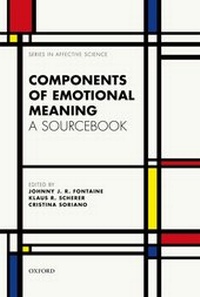
Components of emotional meaning
A sourcebook
Erschienen am 1. August 2013
Buch
Hardcover
672 Seiten
978-0-19-959274-6 (ISBN)
Beschreibung
Publications on emotion (and the affective sciences in general) have exploded in the last decade. Numerous research teams and individual scholars from many different disciplines have published research papers or books about many different aspects of emotions and their role in behaviour and society. However, One aspect of emotional research that has been somewhat neglected, is the way in which emotional terms translate into other languages. When using terms like anger, sadness, fear, disgust, and joy for so-called basic emotions, as well as terms like shame, guilt, pride, regret and contempt for more complex emotions, it is naturally assumed that the emotion terms used for research in the native language of the researchers and translated into English are completely equivalent in meaning. However, this is not generally the case. In many cases there is no direct one to one relationship between an English term and a term in an alternative language. In fact, there can be significant differences in the way that these seemingly similar emotional terms can be applied across various languages, with important implications for how we review and appraise this work.
This book presents an extensive cross-cultural and cross-linguistic review of the meaning of emotion words, adopting a novel methodological approach. Based on the Component Process Model, the authors developed a new instrument to assess the meaning of emotion terms. This instrument, the GRID questionnaire, consists of a grid of 24 emotion terms spanning the emotion domain and 142 emotion features that operationalize five emotion components (Appraisals, Bodily reactions, Expressions, Action tendencies, and Feelings). For the operationalization of these five emotion components, very different emotion models from the Western and the cultural-comparative emotion literature were taken into account.
'Components of Emotional Meaning' includes contributions from psychological, cultural-comparative, and linguistic perspectives demonstrating how this new instrument can be used to empirically study very different research questions on the meaning of emotion terms. The implications of the results for major theoretical debates on emotion are also discussed.
For all researchers in the affective sciences, this book is an important new reference work.
This book presents an extensive cross-cultural and cross-linguistic review of the meaning of emotion words, adopting a novel methodological approach. Based on the Component Process Model, the authors developed a new instrument to assess the meaning of emotion terms. This instrument, the GRID questionnaire, consists of a grid of 24 emotion terms spanning the emotion domain and 142 emotion features that operationalize five emotion components (Appraisals, Bodily reactions, Expressions, Action tendencies, and Feelings). For the operationalization of these five emotion components, very different emotion models from the Western and the cultural-comparative emotion literature were taken into account.
'Components of Emotional Meaning' includes contributions from psychological, cultural-comparative, and linguistic perspectives demonstrating how this new instrument can be used to empirically study very different research questions on the meaning of emotion terms. The implications of the results for major theoretical debates on emotion are also discussed.
For all researchers in the affective sciences, this book is an important new reference work.
Weitere Details
Sprache
Englisch
Verlagsort
Oxford
Großbritannien
Zielgruppe
Für höhere Schule und Studium
Für Beruf und Forschung
Researchers in psychology, linguistics, anthropology, and other social sciences and humanities as well as graduate students
Maße
Höhe: 254 mm
Breite: 178 mm
Dicke: 42 mm
Gewicht
1228 gr
ISBN-13
978-0-19-959274-6 (9780199592746)
Copyright in bibliographic data and cover images is held by Nielsen Book Services Limited or by the publishers or by their respective licensors: all rights reserved.
Schweitzer Klassifikation
Weitere Ausgaben
Andere Ausgaben
Klaus R. Scherer Cristina Soriano Johnny R. J. Fontaine
Components of emotional meaning: A sourcebook
A sourcebook
E-Book
08/2013
1. Auflage
OUP Oxford
126,49 €
Als Download verfügbar
Klaus R. Scherer Cristina Soriano Johnny R. J. Fontaine
Components of emotional meaning: A sourcebook
A sourcebook
E-Book
08/2013
1. Auflage
OUP Oxford
126,49 €
Als Download verfügbar
Personen
Johnny Fontaine made his PhD on the cross-cultural comparability of the Schwartz Value Survey at the University of Leuven (KU Leuven) in Belgium. He currently teaches psychological assessment and cross-cultural psychology at Ghent University in Belgium. Ever since his PhD he has worked from an assessment approach, with a particular focus on bias and equivalence in cross-cultural research. He is currently president-elect of the European Association for Psychological Assessment. He studies values, religiosity, acculturation, intelligence, and especially emotions from a cultural comparative perspective. His emotion research focuses on the structural representation of the emotion domain across cultural groups, on cross-cultural similarities and differences in self-conscious emotions, and on the assessment of emotional competence across cultural groups.
Klaus Scherer, born in 1943, studied economics and social sciences at the University of Cologne and the London School of Economics. Following his postgraduate studies in psychology, he obtained a Ph.D. from Harvard University in 1970. After teaching at the University of Pennsylvania, Philadelphia, and the University of Kiel, Germany, he was appointed, in 1973, full professor of social psychology at the University of Giessen, Germany. From 1985 to 2008, Klaus Scherer has been a full professor of psychology at the University of Geneva, Switzerland, and director of the Human Assessment Centre (Laboratoire dA?Evaluation Psychologique). Since 2004 he is the Director of the Swiss Center for Affective Sciences at the University of Geneva. Apart from extensive theoretical work (Component Process Model), Scherer's research activities focus on different aspects of emotion and other affective states, in particular emotional expression and induction of emotion by music.
Cristina Soriano studied English philology at the University of Murcia (Spain), from which she also obtained a PhD in Linguistics. She further studied at the University of California, Berkeley and Hamburg University, where she specialized in cognitive linguistics. Since 2007 she has worked at the Swiss Center for Affective Sciences of the University of Geneva (Switzerland) as senior researcher on language and emotion. She conducts interdisciplinary research on cross-cultural emotion semantics, the metaphorical representation of concepts, the psycholinguistic investigation of conceptual metaphor, and the affective meaning of color. She is the executive officer of the GRID project and main researcher in a number of other studies on the linguistic representation of emotion concepts across cultures, with a special focus on conflict emotions.
Klaus Scherer, born in 1943, studied economics and social sciences at the University of Cologne and the London School of Economics. Following his postgraduate studies in psychology, he obtained a Ph.D. from Harvard University in 1970. After teaching at the University of Pennsylvania, Philadelphia, and the University of Kiel, Germany, he was appointed, in 1973, full professor of social psychology at the University of Giessen, Germany. From 1985 to 2008, Klaus Scherer has been a full professor of psychology at the University of Geneva, Switzerland, and director of the Human Assessment Centre (Laboratoire dA?Evaluation Psychologique). Since 2004 he is the Director of the Swiss Center for Affective Sciences at the University of Geneva. Apart from extensive theoretical work (Component Process Model), Scherer's research activities focus on different aspects of emotion and other affective states, in particular emotional expression and induction of emotion by music.
Cristina Soriano studied English philology at the University of Murcia (Spain), from which she also obtained a PhD in Linguistics. She further studied at the University of California, Berkeley and Hamburg University, where she specialized in cognitive linguistics. Since 2007 she has worked at the Swiss Center for Affective Sciences of the University of Geneva (Switzerland) as senior researcher on language and emotion. She conducts interdisciplinary research on cross-cultural emotion semantics, the metaphorical representation of concepts, the psycholinguistic investigation of conceptual metaphor, and the affective meaning of color. She is the executive officer of the GRID project and main researcher in a number of other studies on the linguistic representation of emotion concepts across cultures, with a special focus on conflict emotions.
Inhalt
PART I. DISCIPLINARY PERSPECTIVES AND THEORETICAL APPROACHES TO THE MEANING OF EMOTION WORDS ; PART II. THE GRID INSTRUMENT: HYPOTHESES, OPERATIONALIZATION, DATA, AND OVERALL STRUCTURE ; PART III. DECOMPOSING THE MEANING OF EMOTION TERMS: ANALYSIS BY EMOTION COMPONENT ; PART IV: PSYCHOLOGICAL PERSPECTIVES ; PART V: CULTURAL-COMPARATIVE PERSPECTIVES ; PART VI: LINGUISTIC PERSPECTIVES ; PART VII: SPECIAL TOPICS ; PART VIII: TAKING STOCK AND FURTHER DEVELOPMENT OF THE GRID PARADIGM