

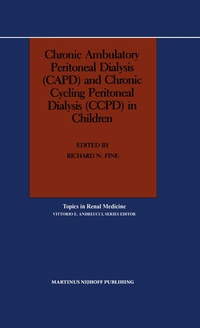
Chronic Ambulatory Peritoneal Dialysis (CAPD) and Chronic Cycling Peritoneal Dialysis (CCPD) in Children
Erschienen am 14. Oktober 2011
Buch
Softcover
XVIII, 346 Seiten
978-1-4612-9217-3 (ISBN)
Beschreibung
During the past decade, there has been a renaissance of interest in the use of peritoneal dialysis as a primary dialytic modality for the treatment of children with end stage renal disease (ESRD). The development of the technique of continuous ambulatory peritoneal dialysis (CAPD) and continuous cycling peritoneal dialysis (CCPD) has markedly changed the approach to children requiring dialytic therapy. The availability of these techniques has facilitated prolonged dialysis in infants and has for the first time given pediatric nephro logists in many areas of the world an opportunity to consider dialysis in chil dren afflicted with ESRD. I have enlisted the collaboration of colleagues from Europe, South America, Canada, and the United States in compiling this multidisciplinary text, which hopefully contains the most up-to-date, comprehensive information regarding the use of CAPD/CCPD in children. It is my hope that every nephrologist (pediatric and adult); nephrology nurse (pediatric and adult); nephrology tech nician, or allied health professional dealing with children who require these therapeutic modalities will be able to resolve immediately any confounding clinical or technical issues that arise by using the information contained in this text. Demographic data on the use of CAPD/CCPD in children in Europe is provided from the EDTA Registry and in the United States from the National Peritoneal Dialysis Registry. The particular problems encountered in the use xiii xiv Preface of CAPD in children in developing countries is detailed by Dr. Grunberg and his colleagues in Uruguay.
Weitere Details
Reihe
Auflage
Softcover reprint of the original 1st ed. 1987
Sprache
Englisch
Verlagsort
New York
USA
Zielgruppe
Für Beruf und Forschung
Research
Illustrationen
XVIII, 346 p.
Maße
Höhe: 235 mm
Breite: 155 mm
Dicke: 20 mm
Gewicht
557 gr
ISBN-13
978-1-4612-9217-3 (9781461292173)
DOI
10.1007/978-1-4613-2047-0
Schweitzer Klassifikation
Weitere Ausgaben
Andere Ausgaben
Richard N. Fine
Chronic Ambulatory Peritoneal Dialysis (CAPD) and Chronic Cycling Peritoneal Dialysis (CCPD) in Children
E-Book
12/2012
Springer
149,79 €
Als Download verfügbar
Richard N. Fine
Chronic Ambulatory Peritoneal Dialysis (CAPD) and Chronic Cycling Peritoneal Dialysis (CCPD) in Children
Buch
07/1987
Kluwer Academic Publishers
160,49 €
Versand in 3-4 Wochen
Inhalt
1. The use of peritoneal dialysis in Europe for treatment of children with end stage renal disease-EDTA registry data.- 2. Demographic data on the use of CAPD/CCPD as a primary dialytic therapy in children in the United States.- 3. Pediatric CAPD in developing countries.- 4. Developmental aspects of peritoneal dialysis kinetics.- 5. Peritoneal dialysis kinetics in children.- 6. Kinetics of CCPD in children.- 7. CAPD in infants.- 8. Technical aspects of CAPD/CCPD.- 9. Peritoneal catheter: technique, logevity, complications.- 10. Continuous ambulatory peritoneal dialysis in children; biochemical control of uremia, anemia, hypertension, lipid metabolism, glucose tolerance, and endocrine abnormalities.- 11. The role of the nurse in CAPD/CCPD training.- 12. Complications of CAPD/CCPD in pediatric patients.- 13. Peritonitis in infants and children on CAPD/CCPD.- 14. Loss of ultrafiltration and sclerosing encapsulating peritonitis in children undergoing CAPD/CCPD.- 15. Long-term function of the peritoneal membrane.- 16. Nutritional recommendations for children treated with CAPD/CCPD.- 17. The role of the dietitian in the management of children undergoing CAPD/CCPD.- 18. Supplemental (NG) feedings of infants undergoing continuous peritoneal dialysis.- 19. Protein losses during CAPD in children: the role of dialysates containing amino acids.- 20. Control of renal bone disease by high-dose calcitriol and the use of calcium carbonate as a phosphate-binding agent in children on CAPD/ CCPD.- 21. Growth in children on CAPD.- 22. Comparison of CAPD and hemodialysis in children.- 23. Comparison of CAPD and CCPD in children.- 24. Transplantation in children undergoing CAPD and CCPD.- 25. Promoting psychosocial adaptation to continuous ambulatory peritoneal dialysis/continuous cylcingperitoneal Dialysis in Children and Adolescents.