

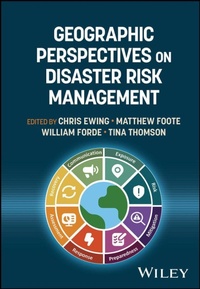
Geographic Perspectives on Disaster Risk Management
Beschreibung
Structured around the disaster risk cycle (preparation, response, recovery, and mitigation) the book covers four key areas: the representation of assets at risk through exposure and vulnerability mapping; risk preparedness and mitigation strategies; response mechanisms including event monitoring, damage assessment, and resilience building; and effective approaches to risk communication and decision-making. It includes practical case studies that illustrate real-world challenges and solutions, highlighting current capabilities while considering future developments in data availability, analytical techniques, and climate risk assessment.
Designed as both a practitioner's guide and academic resource, Geographic Perspectives on Disaster Risk Management serves those working directly in disaster risk management as well as researchers seeking to understand how geographic perspectives can enhance our capacity to manage disaster risk in an era of increasing environmental uncertainty.
Weitere Details
Weitere Ausgaben
Andere Ausgaben
Personen
CHRIS EWING is Head of Business Development for Impact Forecasting, the catastrophe model development centre of Aon. He has 20 years' experience across risk management, (re)insurance, engineering, and humanitarian sectors. He holds a BSc in Physical Geography and an MSc in Geographical Information Science. Chris is a Chartered Geographer (GIS) from the Royal Geographical Society and a co-founder and Chair of the Disaster Risk Management Professional Practice Group.
MATTHEW FOOTE has over 30 years' experience in insurance, disaster risk financing, cartography, earth observation, and catastrophe risk analytics. He serves as UK Principal Representative to the GEO Programme Board and was the first chair of the GRMA Strategic Advisory Board. He is a fellow of the Royal Geographical Society and a co-founder of its Disaster Risk Management Professional Practice Group.
WILLIAM FORDE is a specialist in geospatial analytics and catastrophe risk. Drawing on senior leadership experience at global consulting firms and a leading GIS vendor, he helps insurers and regulators translate complex data into actionable insights for hazard management and resilience. He holds an MSc in Remote Sensing and a BA in Anthropology and Geogaphy from University College London and is a Fellow of the Royal Geographical Society, where he co-founded its Disaster Risk Management Professional Practice Group.
TINA THOMSON, PHD, has held senior leadership roles in analytics, research, and digital solutions spanning a career across Catastrophe Model Vendors, Property & Casualty Insurance, Reinsurance, and Reinsurance Brokers. Tina is passionate about the application of scientific concepts, emerging industry trends and new technologies. She holds a PhD in Geomatic Engineering from University College London. She is a Fellow of the Remote Sensing and Photogrammetry Society and a Chartered Geographer with the Royal Geographical Society, where she co-founded the Professional Practice Group for Disaster Risk Management.
Inhalt
1. Defining Characteristics of Assets for Risk Assessment
2. Common Approaches to Exposure and Vulnerability Data Across Risk Management Sectors
3. Innovations in Spatial Exposure Modelling for Public Sector Disaster Risk Practitioners
4. Geographic Nature of Hazard and Risk
5. Disaster Risk Reduction, Risk Mitigation
6. Insurance and Risk Transfer Mechanisms
7. Disaster Preparedness in Fragile, Conflict- and Violence-affected Humanitarian Settings
8. Event Response: Mobilisation and Logistics
9. Real-time Monitoring and Communication
10. Damage Assessment
11. Long-term Resilience: Recovery Finance and Implementations of Lessons Learned
12. Data Accuracy and Requirements
13. Communicating Uncertainty
14. Reporting and Decision-making
15. Wrapping Up and Looking Ahead