

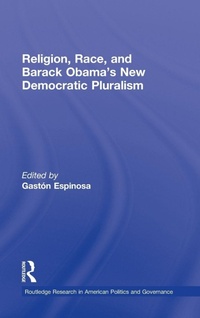
Religion, Race, and Barack Obama's New Democratic Pluralism
1. Auflage
Erschienen am 27. August 2012
Buch
Hardcover
296 Seiten
978-0-415-63376-5 (ISBN)
Beschreibung
Contrary to popular claims, religion played a critical role in Barack Obama's 2008 election as president of the United States. Religion, race, and gender entered the national and electoral dialogue in an unprecedented manner. What stood out most in the 2008 presidential campaign was not that Republicans reached out to religious voters but that Democrats did-and with a vengeance. This tightly edited volume demonstrates how Obama charted a new course for Democrats by staking out claims among moderate-conservative faith communities and emerged victorious in the presidential contest, in part, by promoting a new Democratic racial-ethnic and religious pluralism.
Comprising careful analysis by leading experts on religion and politics in the United States, Gaston Espinosa's book details how ten of the largest segments of the American electorate voted and why, drawing on the latest and best available data, interviews, and sources. The voting patterns of Mainline Protestants, Evangelicals, Catholics, Jews, Muslims, and seculars are dissected in detail, along with the intersection of religion and women, African Americans, Latinos, and Asian Americans. The story of Obama's historic election is an insightful prism through which to explore the growing influence of religion in American politics.
Comprising careful analysis by leading experts on religion and politics in the United States, Gaston Espinosa's book details how ten of the largest segments of the American electorate voted and why, drawing on the latest and best available data, interviews, and sources. The voting patterns of Mainline Protestants, Evangelicals, Catholics, Jews, Muslims, and seculars are dissected in detail, along with the intersection of religion and women, African Americans, Latinos, and Asian Americans. The story of Obama's historic election is an insightful prism through which to explore the growing influence of religion in American politics.
Rezensionen / Stimmen
"Gaston Epinosa and his coauthors have written a remarkably insightful book on key determinants of the vote in the 2008 presidential elections. In examining the complex relationship between religion, race, ethnicity, gender and cultural values, the authors challenge numerous conventional cliches about the role of religion in American politics and demonstrate how Barack Obama was able to close the electoral "God gap" that used to favor the Republican party. Obama's skillful outreach program towards Catholic and Protestant Latino voters, his promotion of faith-friendly public policies and his uncanny ability to "speak Catholic" on social issues and to court evangelical voters with his "conversion narratives" explain a good part of his success. Can this success be replicated in 2012? The eleven chapters of this well researched book give conflicting responses to this key question and make the book a must read for political analysts."-Denis Lacorne, Center for International Studies and Research (CERI) at Sciences Po University "Gaston Epinosa and his coauthors have written a remarkably insightful book on key determinants of the vote in the 2008 presidential elections. In examining the complex relationship between religion, race, ethnicity, gender and cultural values, the authors challenge numerous conventional cliches about the role of religion in American politics and demonstrate how Barack Obama was able to close the electoral "God gap" that used to favor the Republican party. Obama's skillful outreach program towards Catholic and Protestant Latino voters, his promotion of faith-friendly public policies and his uncanny ability to "speak Catholic" on social issues and to court evangelical voters with his "conversion narratives" explain a good part of his success. Can this success be replicated in 2012? The eleven chapters of this well researched book give conflicting responses to this key question and make the book a must read for political analysts."
-Professor Denis Lacorne, Center for International Studies and Research (CERI) at Sciences Po University, Paris, France
Weitere Details
Reihe
Sprache
Englisch
Verlagsort
London
Großbritannien
Verlagsgruppe
Taylor & Francis Ltd
Zielgruppe
Für höhere Schule und Studium
Illustrationen
44 s/w Tabellen
44 Tables, black and white
Maße
Höhe: 235 mm
Breite: 157 mm
Dicke: 21 mm
Gewicht
582 gr
ISBN-13
978-0-415-63376-5 (9780415633765)
Copyright in bibliographic data and cover images is held by Nielsen Book Services Limited or by the publishers or by their respective licensors: all rights reserved.
Schweitzer Klassifikation
Weitere Ausgaben
Andere Ausgaben
Gaston Espinosa
Religion, Race, and Barack Obama's New Democratic Pluralism
Buch
09/2021
1. Auflage
Routledge
67,70 €
Versand in 15-20 Tagen
Gaston Espinosa
Religion, Race, and Barack Obama's New Democratic Pluralism
E-Book
08/2012
1. Auflage
Routledge
60,49 €
Als Download verfügbar
Gaston Espinosa
Religion, Race, and Barack Obama's New Democratic Pluralism
E-Book
08/2012
1. Auflage
Routledge
60,49 €
Als Download verfügbar
Person
Gaston Espinosa is the Arthur V. Stoughton associate professor of religious studies at Claremont McKenna College and co-editor of the Columbia University Press Series in Religion and Politics. He served as research director of the Pew Charitable Trusts-funded Hispanic Churches in American Public Life research and Latino Religions and Politics national survey. His books include Religion, Race, and the American Presidency (2008), Religion and the American Presidency: George Washington to George W. Bush with Commentary and Sources (2009), and Latino Religions and Politics in American Public Life (forthcoming).
Inhalt
Preface. 1 - Religion, Politics, and American Society, Gaston Espinosa 2 - Mainline Protestants and the 2008 Election, Laura R. Olson, Adam L. Warber, Kevin R. den Dulk 3 - Evangelicals and the 2008 Election, Corwin Smidt 4. Catholics and the 2008 Election, David C. Leege and Stephen T. Mockabee 5 - Jews and the 2008 Election, Kenneth Wald 6 - Muslims and the 2008 Election, Brian Calfano, Paul A. Djupe, John C. Green 7 - Seculars and the 2008 Election, Lyman Kellstedt and James L. Guth 8 - Women, Religion, and the 2008 Election, Katherine Knutson 9 - African Americans, Religion, and the 2008 Election, Valerie Cooper and Corwin Smidt 10 - Latinos, Religion, and the 2008 Election, Gaston Espinosa 11 - Asian Americans, Religion, and the 2008 Election, So Young Kim and Russell Jeung 12. Conclusion, Gaston Espinosa