

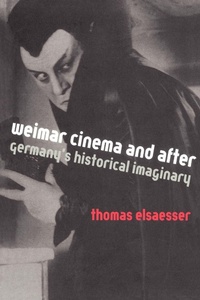
Weimar Cinema and After
Germany's Historical Imaginary
1. Auflage
Erschienen am 15. Juni 2000
Buch
Softcover
480 Seiten
978-0-415-01235-5 (ISBN)
Beschreibung
German cinema of the 1920s is still regarded as one of the 'golden ages' of world cinema. Films such as The Cabinet of Dr Caligari, Dr Mabuse the Gambler, Nosferatu, Metropolis, Pandora's Box and The Blue Angel have long been canonised as classics, but they are also among the key films defining an image of Germany as a nation uneasy with itself. The work of directors like Fritz Lang, F.W. Murnau and G.W. Pabst, which having apparently announced the horrors of fascism, while testifying to the traumas of a defeated nation, still casts a long shadow over cinema in Germany, leaving film history and political history permanently intertwined.
Weimar Cinema and After offers a fresh perspective on this most 'national' of national cinemas, re-evaluating the arguments which view genres and movements such as 'films of the fantastic', 'Nazi Cinema', 'film noir' and 'New German Cinema' as typically German contributions to twentieth century visual culture. Thomas Elsaesser questions conventional readings which link these genres to romanticism and expressionism, and offers new approaches to analysing the function of national cinema in an advanced 'culture industry' and in a Germany constantly reinventing itself both geographically and politically.
Elsaesser argues that German cinema's significance lies less in its ability to promote democracy or predict fascism than in its contribution to the creation of a community sharing a 'historical imaginary' rather than a 'national identity'. In this respect, he argues, German cinema anticipated some of the problems facing contemporary nations in reconstituting their identities by means of media images, memory, and invented traditions.
Weimar Cinema and After offers a fresh perspective on this most 'national' of national cinemas, re-evaluating the arguments which view genres and movements such as 'films of the fantastic', 'Nazi Cinema', 'film noir' and 'New German Cinema' as typically German contributions to twentieth century visual culture. Thomas Elsaesser questions conventional readings which link these genres to romanticism and expressionism, and offers new approaches to analysing the function of national cinema in an advanced 'culture industry' and in a Germany constantly reinventing itself both geographically and politically.
Elsaesser argues that German cinema's significance lies less in its ability to promote democracy or predict fascism than in its contribution to the creation of a community sharing a 'historical imaginary' rather than a 'national identity'. In this respect, he argues, German cinema anticipated some of the problems facing contemporary nations in reconstituting their identities by means of media images, memory, and invented traditions.
Rezensionen / Stimmen
'A monumental work of research by any standard.' - Sight and SoundWeitere Details
Sprache
Englisch
Verlagsort
London
Großbritannien
Verlagsgruppe
Taylor & Francis Ltd
Zielgruppe
Für höhere Schule und Studium
Undergraduate
Produkt-Hinweis
Broschur/Paperback
Klebebindung
Maße
Höhe: 237 mm
Breite: 156 mm
Dicke: 32 mm
Gewicht
687 gr
ISBN-13
978-0-415-01235-5 (9780415012355)
Copyright in bibliographic data and cover images is held by Nielsen Book Services Limited or by the publishers or by their respective licensors: all rights reserved.
Schweitzer Klassifikation
Weitere Ausgaben
Andere Ausgaben
E-Book
04/2013
1. Auflage
Routledge
53,99 €
Als Download verfügbar
E-Book
04/2013
1. Auflage
Routledge
53,99 €
Als Download verfügbar
Buch
06/2000
1. Auflage
Routledge
192,50 €
Versand in 15-20 Tagen
Person
Thomas Elsaesser is at the University of Amsterdam
Inhalt
1. Haunted Screens, Caligari's Cabinets and a German Studio-System 2. In the Realm of the Look: Lang, Lubitsch, Murnau and Pabst 3. Transparent Duplicities: Comedy, Opera, Operetta 4. After Weimar: Avantgarde and Modernisation, Emigration and Film Noir