

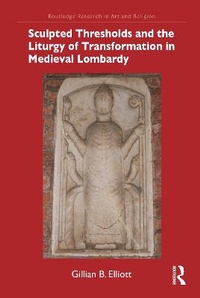
Sculpted Thresholds and the Liturgy of Transformation in Medieval Lombardy
1. Auflage
Erschienen am 24. Juni 2022
Buch
Hardcover
238 Seiten
978-1-032-11709-6 (ISBN)
Beschreibung
This book explores the issue of ecclesiastical authority in Romanesque sculpture on the portals and other sculpted "gateways" of churches in the north Italian region of Lombardy.
Gillian B. Elliott examines the liturgical connection between the ciborium over the altar (the most sacred threshold inside the church), and the sculpted portals that appeared on church exteriors in medieval Lombardy. In cities such as Milan, Civate, Como, and Pavia, the liturgy of Saint Ambrose was practiced as an alternative to the Roman liturgy and the churches were constructed to respond to the needs of Ambrosian liturgy. Not only do the Romanesque churches in these places correspond stylistically and iconographically, but they were also linked politically in an era of intense struggle for ultimate regional authority. The book considers liturgical and artistic links between interior church furnishings and exterior church sculptural programs, and also applies new spatial methodologies to the interior and exterior of churches in Lombardy.
The book will be of interest to scholars working in art history, medieval studies, architectural history, and religious studies.
Gillian B. Elliott examines the liturgical connection between the ciborium over the altar (the most sacred threshold inside the church), and the sculpted portals that appeared on church exteriors in medieval Lombardy. In cities such as Milan, Civate, Como, and Pavia, the liturgy of Saint Ambrose was practiced as an alternative to the Roman liturgy and the churches were constructed to respond to the needs of Ambrosian liturgy. Not only do the Romanesque churches in these places correspond stylistically and iconographically, but they were also linked politically in an era of intense struggle for ultimate regional authority. The book considers liturgical and artistic links between interior church furnishings and exterior church sculptural programs, and also applies new spatial methodologies to the interior and exterior of churches in Lombardy.
The book will be of interest to scholars working in art history, medieval studies, architectural history, and religious studies.
Weitere Details
Reihe
Sprache
Englisch
Verlagsort
London
Großbritannien
Verlagsgruppe
Taylor & Francis Ltd
Zielgruppe
Für Beruf und Forschung
Academic, Postgraduate, and Undergraduate
Illustrationen
69 s/w Abbildungen, 69 s/w Photographien bzw. Rasterbilder
69 Halftones, black and white; 69 Illustrations, black and white
Maße
Höhe: 246 mm
Breite: 174 mm
Gewicht
940 gr
ISBN-13
978-1-032-11709-6 (9781032117096)
Copyright in bibliographic data and cover images is held by Nielsen Book Services Limited or by the publishers or by their respective licensors: all rights reserved.
Schweitzer Klassifikation
Weitere Ausgaben
Andere Ausgaben
Gillian B. Elliott
Sculpted Thresholds and the Liturgy of Transformation in Medieval Lombardy
Buch
10/2024
1. Auflage
Routledge
55,00 €
Versand in 10-20 Tagen
Gillian B. Elliott
Sculpted Thresholds and the Liturgy of Transformation in Medieval Lombardy
E-Book
06/2022
1. Auflage
Routledge
53,99 €
Als Download verfügbar
Gillian B. Elliott
Sculpted Thresholds and the Liturgy of Transformation in Medieval Lombardy
E-Book
06/2022
1. Auflage
Routledge
53,99 €
Als Download verfügbar
Person
Gillian B. Elliott is Professorial Lecturer of Art History at George Washington University.
Inhalt
Introduction: Sculpted Thresholds and the Liturgy of Transformation in Medieval Lombardy, 1. The Origins of the porta coeli in Milan: Saint Ambrose and the Progression of the Soul through Sacred Space, 2. Activating the Ciborium at Sant'Ambrogio in Milan: Liturgical Gestures and Neoplatonic Gifts, 3. Saint Ambrose Enthroned at the Gate: Bishop as Judge in the Atrium, 4. From Jerusalem to Civate: The Ciborium as Ark and Tomb, 5. The Saint at the Dragon Portal of San Fedele in Como, 6. San Pietro in Ciel d'Oro at Pavia: The Angel at the porta coeli, 7. Conclusion