

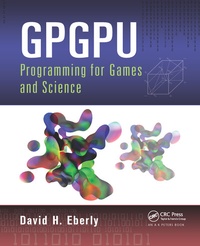
GPGPU Programming for Games and Science
1. Auflage
Erschienen am 30. September 2020
Buch
Softcover
472 Seiten
978-0-367-65909-7 (ISBN)
Beschreibung
An In-Depth, Practical Guide to GPGPU Programming Using Direct3D 11
GPGPU Programming for Games and Science demonstrates how to achieve the following requirements to tackle practical problems in computer science and software engineering:
Robustness
Accuracy
Speed
Quality source code that is easily maintained, reusable, and readable
The book primarily addresses programming on a graphics processing unit (GPU) while covering some material also relevant to programming on a central processing unit (CPU). It discusses many concepts of general purpose GPU (GPGPU) programming and presents practical examples in game programming and scientific programming.
The author first describes numerical issues that arise when computing with floating-point arithmetic, including making trade-offs among robustness, accuracy, and speed. He then shows how single instruction multiple data (SIMD) extensions work on CPUs since GPUs also use SIMD.
The core of the book focuses on the GPU from the perspective of Direct3D 11 (D3D11) and the High Level Shading Language (HLSL). This chapter covers drawing 3D objects; vertex, geometry, pixel, and compute shaders; input and output resources for shaders; copying data between CPU and GPU; configuring two or more GPUs to act as one; and IEEE floating-point support on a GPU.
The book goes on to explore practical matters of programming a GPU, including code sharing among applications and performing basic tasks on the GPU. Focusing on mathematics, it next discusses vector and matrix algebra, rotations and quaternions, and coordinate systems. The final chapter gives several sample GPGPU applications on relatively advanced topics.
Web ResourceAvailable on a supporting website, the author's fully featured Geometric Tools Engine for computing and graphics saves you from having to write a large amount of infrastructure code necessary for even the simplest of applications involving shader programming. The engine provides robust and accurate source code with SIMD when appropriate and GPU versions of algorithms when possible.
GPGPU Programming for Games and Science demonstrates how to achieve the following requirements to tackle practical problems in computer science and software engineering:
Robustness
Accuracy
Speed
Quality source code that is easily maintained, reusable, and readable
The book primarily addresses programming on a graphics processing unit (GPU) while covering some material also relevant to programming on a central processing unit (CPU). It discusses many concepts of general purpose GPU (GPGPU) programming and presents practical examples in game programming and scientific programming.
The author first describes numerical issues that arise when computing with floating-point arithmetic, including making trade-offs among robustness, accuracy, and speed. He then shows how single instruction multiple data (SIMD) extensions work on CPUs since GPUs also use SIMD.
The core of the book focuses on the GPU from the perspective of Direct3D 11 (D3D11) and the High Level Shading Language (HLSL). This chapter covers drawing 3D objects; vertex, geometry, pixel, and compute shaders; input and output resources for shaders; copying data between CPU and GPU; configuring two or more GPUs to act as one; and IEEE floating-point support on a GPU.
The book goes on to explore practical matters of programming a GPU, including code sharing among applications and performing basic tasks on the GPU. Focusing on mathematics, it next discusses vector and matrix algebra, rotations and quaternions, and coordinate systems. The final chapter gives several sample GPGPU applications on relatively advanced topics.
Web ResourceAvailable on a supporting website, the author's fully featured Geometric Tools Engine for computing and graphics saves you from having to write a large amount of infrastructure code necessary for even the simplest of applications involving shader programming. The engine provides robust and accurate source code with SIMD when appropriate and GPU versions of algorithms when possible.
Weitere Details
Sprache
Englisch
Verlagsort
London
Großbritannien
Verlagsgruppe
Taylor & Francis Ltd
Zielgruppe
Für Beruf und Forschung
Academic and Professional Practice & Development
Maße
Höhe: 235 mm
Breite: 191 mm
Gewicht
870 gr
ISBN-13
978-0-367-65909-7 (9780367659097)
Copyright in bibliographic data and cover images is held by Nielsen Book Services Limited or by the publishers or by their respective licensors: all rights reserved.
Schweitzer Klassifikation
Weitere Ausgaben
Andere Ausgaben
David H. Eberly
GPGPU Programming for Games and Science
Buch
08/2014
1. Auflage
A K Peters
200,46 €
Artikel z.Zt. nicht lieferbar
David H. Eberly
GPGPU Programming for Games and Science
E-Book
08/2014
1. Auflage
CRC Press
63,49 €
Als Download verfügbar
David H. Eberly
GPGPU Programming for Games and Science
E-Book
08/2014
1. Auflage
CRC Press
63,49 €
Als Download verfügbar
Person
David H. Eberly
Inhalt
Introduction. CPU Computing. SIMD Computing. GPU Computing. Practical Matters. Linear and Affine Algebra. Sample Applications. Bibliography.