

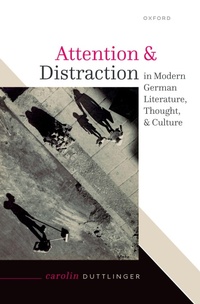
Attention and Distraction in Modern German Literature, Thought, and Culture
Erschienen am 26. November 2024
Buch
Softcover
456 Seiten
978-0-19-894436-2 (ISBN)
Beschreibung
Attention is fundamental to how we experience reality, and yet this notion has been understood and practised in very different ways across history. This interdisciplinary study explores the dynamic relationship between attention and its supposed opposite, distraction, as it unfolds from the eighteenth century to the present day. Its primary focus is on twentieth-century Germany and Austria, where matters of (in)attention gained a unique urgency during a period of social change and political crisis.
Building on Enlightenment practices of self-observation, nineteenth-century Germany was the birthplace of experimental psychology, a discipline which sought to measure and potentially enhance human attention. This approach was also adopted outside the psychological laboratory for instance in the First World War, when psychological testing were used to select soldiers for particular strategic positions. After the war these techniques filtered through into everyday life. Weimar Germany was unique in the western world in rolling out the methods of 'psychotechnics' across civilian society in fields such as work and education, advertising and mass entertainment. This state-sponsored programme aimed to reshape people's minds and behaviour in order to build a more efficient, streamlined society. But as this study shows, this initiative also had profound repercussions in the fields of thought, literature, and culture. New readings of leading writers and intellectuals of the period Kafka, Musil, Kracauer, Benjamin, and Adorno are interspersed with broader cultural-historical chapters dedicated to the history of psychology and psychiatry, to Weimar self-help literature, portrait photography, and musical culture.
Building on Enlightenment practices of self-observation, nineteenth-century Germany was the birthplace of experimental psychology, a discipline which sought to measure and potentially enhance human attention. This approach was also adopted outside the psychological laboratory for instance in the First World War, when psychological testing were used to select soldiers for particular strategic positions. After the war these techniques filtered through into everyday life. Weimar Germany was unique in the western world in rolling out the methods of 'psychotechnics' across civilian society in fields such as work and education, advertising and mass entertainment. This state-sponsored programme aimed to reshape people's minds and behaviour in order to build a more efficient, streamlined society. But as this study shows, this initiative also had profound repercussions in the fields of thought, literature, and culture. New readings of leading writers and intellectuals of the period Kafka, Musil, Kracauer, Benjamin, and Adorno are interspersed with broader cultural-historical chapters dedicated to the history of psychology and psychiatry, to Weimar self-help literature, portrait photography, and musical culture.
Rezensionen / Stimmen
Duttlinger's central claim that attention is itself inattentive, unpredictable, uncontrollable, that it is inseparable from distraction, guides her incisive readings, which emphasize the inconsistencies of attention's theorization and practical application. In this way, the book also adopts the dialectical thinking of Benjamin and Adorno. The result is a magnificent historical study, that will no doubt become a touchstone of future scholarship. * Samuel Frederick, Seminar: A Journal of Germanic Studies * Carolin Duttlinger must be admired for the originality and creativity of her approach, and for its learned execution. Attention and Distraction in Modern German Literature, Culture, and Thought could very well mark the beginning of an epoch in which one reads books and cultures through the lens of attention and distraction, and such linked phenomena as contemplation and diversion, literalness and allegory, teleology and digression, and melancholy and agitation. * Stanley Corngold, Times Literary Supplement * Duttlinger's book offers a profound overview not only of the debates of the time, but also of their concrete form in literary texts, photo books or scientific apparatus. * Bernd Stiegler, H/soz/kult * Duttlinger's book is a milestone publication which has set new standards for cultural and intellectual history. * Anne Fuchs, Modern Language Review * Duttlinger unearths in Attention and Distraction provide an exciting new direction for interdisciplinary modernist studies and make for an engaging and accessible reading experience that would, for student readers, double as an excellent introductory course in German modernism in context. * Paul Buchholz, Monatshefte *Weitere Details
Sprache
Englisch
Verlagsort
Oxford
Großbritannien
Zielgruppe
Für Beruf und Forschung
Produkt-Hinweis
Broschur/Paperback
Klebebindung
Maße
Höhe: 231 mm
Breite: 153 mm
Dicke: 28 mm
Gewicht
696 gr
ISBN-13
978-0-19-894436-2 (9780198944362)
Copyright in bibliographic data and cover images is held by Nielsen Book Services Limited or by the publishers or by their respective licensors: all rights reserved.
Schweitzer Klassifikation
Person
Carolin Duttlinger is Professor of German Literature and Culture at the University of Oxford and Fellow in German at Wadham College. Since 2009, she has been Co-Director of the Oxford Kafka Research Centre. She has published widely on German literature, thought, and culture from the eighteenth century to the present and has also spoken about these topics on radio and television both nationally and internationally. She is also the editor of the book series on Visual Culture, published by Legenda.
Inhalt
Preface
Introduction
1: Virtue, Reflex, Pathology: Attention from the Enlightenment to the Late Nineteenth Century
2: Modernity: Fragmentation and Resistance
3: Franz Kafka: Diversion, Vigilance, Paranoia
4: Psychotechnics: Training the Mind
5: Threshold States: Robert Musil
6: The Art of Concentration: Self-Help Literature
7: Stillness: Weimar Portrait Photography
8: Presence of Mind: Walter Benjamin
9: Musical Listening between Immersion and Detachment
10: Spellbound: Theodor W. Adorno on Music and Style
11: Celan, Sebald, Hoppe: Networks of Attention
Bibliography
Introduction
1: Virtue, Reflex, Pathology: Attention from the Enlightenment to the Late Nineteenth Century
2: Modernity: Fragmentation and Resistance
3: Franz Kafka: Diversion, Vigilance, Paranoia
4: Psychotechnics: Training the Mind
5: Threshold States: Robert Musil
6: The Art of Concentration: Self-Help Literature
7: Stillness: Weimar Portrait Photography
8: Presence of Mind: Walter Benjamin
9: Musical Listening between Immersion and Detachment
10: Spellbound: Theodor W. Adorno on Music and Style
11: Celan, Sebald, Hoppe: Networks of Attention
Bibliography