

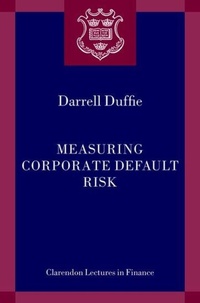
Measuring Corporate Default Risk
Erschienen am 22. September 2022
Buch
Softcover
128 Seiten
978-0-19-927924-1 (ISBN)
Beschreibung
This book, based on the author's Clarendon Lectures in Finance, examines the empirical behaviour of corporate default risk. A new and unified statistical methodology for default prediction, based on stochastic intensity modeling, is explained and implemented with data on U.S. public corporations since 1980. Special attention is given to the measurement of correlation of default risk across firms. The underlying work was developed in a series of collaborations over roughly the past decade with Sanjiv Das, Andreas Eckner, Guillaume Horel, Nikunj Kapadia, Leandro Saita, and Ke Wang. Where possible, the content based on methodology has been separated from the substantive empirical findings, in order to provide access to the latter for those less focused on the mathematical foundations.
A key finding is that corporate defaults are more clustered in time than would be suggested by their exposure to observable common or correlated risk factors. The methodology allows for hidden sources of default correlation, which are particularly important to include when estimating the likelihood that a portfolio of corporate loans will suffer large default losses. The data also reveal that a substantial amount of power for predicting the default of a corporation can be obtained from the firm's "distance to default," a volatility-adjusted measure of leverage that is the basis of the theoretical models of corporate debt pricing of Black, Scholes, and Merton. The findings are particularly relevant in the aftermath of the financial crisis, which revealed a lack of attention to the proper modelling of correlation of default risk across firms.
A key finding is that corporate defaults are more clustered in time than would be suggested by their exposure to observable common or correlated risk factors. The methodology allows for hidden sources of default correlation, which are particularly important to include when estimating the likelihood that a portfolio of corporate loans will suffer large default losses. The data also reveal that a substantial amount of power for predicting the default of a corporation can be obtained from the firm's "distance to default," a volatility-adjusted measure of leverage that is the basis of the theoretical models of corporate debt pricing of Black, Scholes, and Merton. The findings are particularly relevant in the aftermath of the financial crisis, which revealed a lack of attention to the proper modelling of correlation of default risk across firms.
Rezensionen / Stimmen
Darrell Duffie has been a leader in the field of credit risk, both its theory and empirical implementation, for over a decade. This book is a brilliant presentation of the methods, many originated by Darrell himself, for estimating corporate default risk. It is a necessary reference for beginners and professionals alike. Anyone interested in measuring default risk should have this book on their bookshelf. * Robert Jarrow, Susan E. Lynch Professor of Investment Management, Johnson Graduate School of Management, Cornell University * This book provides a brilliant summary of the numerous works on Corporate Default Risk that Darrell Duffie developed, with several co-authors, over the past decade. A striking feature of this monograph is the equal attention paid to theoretical and applied aspects. One the one hand, advanced probabilistic and statistical tools, like doubly stochastic intensity, censoring, frailty models or MCMC algorithms are presented in a very pedagogic way and, on the other hand, applications to North American corporations, based on rich datasets, are reported in great detail and discussed very carefully. It is a genuine "tour de force". * Alain Monfort, Professure CNAM, Centre de Recherche en Economie et Statistique * Darrel Duffie provides a lucid account of default risk modeling using dynamic intensity models and survival analysis. He covers both the case where the explanatory variables (covariates) are fully observed, and where they are unobserved, dynamic 'frailty' effects. The book will sharpen your modeling and risk management tools and help you selecting relevant covariates. You will also benefit from the author's brilliant sense of how these tools enhance our understanding of credit markets. * David Lando, Professor of Finance, Copenhagen Business School *Weitere Details
Reihe
Sprache
Englisch
Verlagsort
Oxford
Großbritannien
Zielgruppe
Für Beruf und Forschung
Produkt-Hinweis
Broschur/Paperback
Klebebindung
Illustrationen
22 Figures, 13 Tables
Maße
Höhe: 224 mm
Breite: 163 mm
Dicke: 13 mm
Gewicht
204 gr
ISBN-13
978-0-19-927924-1 (9780199279241)
Copyright in bibliographic data and cover images is held by Nielsen Book Services Limited or by the publishers or by their respective licensors: all rights reserved.
Schweitzer Klassifikation
Weitere Ausgaben
Andere Ausgaben
Darrell Duffie
Measuring Corporate Default Risk
Buch
06/2011
Oxford University Press
106,17 €
Versand in 15-20 Tagen
Person
Darrell Duffie is the The Adams Distinguished Professor of Management and Professor of Finance at Stanford Graduate School of Business and has been writing about financial markets since 1984. He is a fellow and member of the Council of the Econometric Society, a research fellow of the National Bureau of Economic Research, and a fellow of the American Academy of Arts and Sciences. Duffie was the 2009 president of the American Finance Association. In 2014, he chaired the Market Participants Group, charged by the Financial Stability Board with recommending reforms to Libor, Euribor, and other interest rate benchmarks. Duffie's recent books include How Big Banks Fail (Princeton University Press, 2010), Measuring Corporate Default Risk (Oxford University Press, 2011), and Dark Markets (Princeton University Press, 2012).
Inhalt
- 1: Objectives and Scope
- 2: Survival Modeling
- 3: How to Estimate Default Intensity Processes
- 4: The Default Intensities of Public Corporations
- 5: Default Correlation
- 6: Frailty-Induced Correlation
- 7: Empirical Evidence of Frailty
- A: Time-Series Parameter Estimates
- B: Residual Gaussian Copula Correlation
- C: Additional Tests for Mis-Specified Intensities
- D: Applying the Gibbs Sampler with Frailty
- E: Testing for Frailty
- F: Unobserved Heterogeneity
- G: Non-Linearity Check
- H: Bayesian Frailty Dynamics
- I: Risk-Neutral Default Probabilities