

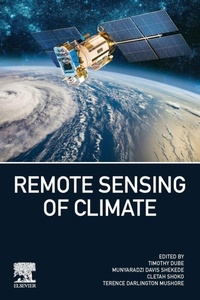
Remote Sensing of Climate
Erschienen am 9. August 2024
Buch
Softcover
270 Seiten
978-0-443-21731-9 (ISBN)
Beschreibung
Remote Sensing of Climate provides cutting-edge techniques in remote sensing of climate variability and the environment. The book focuses on methods and data analytics, advancements in scientific research in the field, and further proffers recommendations on the possible knowledge gaps and future scientific research directions. It covers eight key themes of remote sensing and climate variability, including discussions on how the various aspects from each chapter of the themes interrelate. It also integrates several divergent perspectives on remote sensing and climate variability and the environment to show the interrelationships between the perspectives.
This is an important reference for those in education and research working on remote sensing and climate science who need methods, data analytics, case studies, research strides, and key knowledge gaps in the field.
This is an important reference for those in education and research working on remote sensing and climate science who need methods, data analytics, case studies, research strides, and key knowledge gaps in the field.
Weitere Details
Sprache
Englisch
Verlagsort
Philadelphia
USA
Zielgruppe
Für höhere Schule und Studium
Produkt-Hinweis
Broschur/Paperback
Klebebindung
Maße
Höhe: 229 mm
Breite: 151 mm
Dicke: 23 mm
Gewicht
742 gr
ISBN-13
978-0-443-21731-9 (9780443217319)
Copyright in bibliographic data and cover images is held by Nielsen Book Services Limited or by the publishers or by their respective licensors: all rights reserved.
Schweitzer Klassifikation
Weitere Ausgaben
Andere Ausgaben
Timothy Dube | Munyaradzi Davis Shekede | Cletah Shoko
Remote Sensing of Climate
E-Book
08/2024
Elsevier
130,00 €
Als Download verfügbar
Personen
Timothy Dube is Professor of GIScience and Earth Observation in Environmental Science and Water. His research interests include the use of cutting-edge satellite and in-situ Earth Observation technologies in tracking the impacts of climate change, and in monitoring water resources and the environment. Professor Dube received the University of the Western Cape's 2018 DVC Research and Innovation Award, and is an editor for the journal of Remote Sensing Applications: Society and Environment' (RSASE) and the Scientific African Journal. Dr Munyradzi Davis Shekede is a spatial ecologist and a Senior Lecturer with experience in Geographic Information Science and Earth observation applications in natural resources management. Dr Shekede's research interests are in the applications of Earth observation and Geoinformation science to understanding Earth system dynamics focusing on climate change, socio-ecological systems, and water resources. He has expertise in GIS, earth observation, environmental modeling, natural hazard modeling and assessment, environmental impact assessments and spatial ecology. Dr Cletah Shoko is a Senior lecturer in Geospatial Sciences in the Department of Geography at the University of the Witwatersrand. She focuses on Geoinformation science and Earth observation applications in environmental assessment and monitoring, as well as their response to environmental change. Her research interests also include the development and testing of geospatial based models to derive essential information that can be used in biodiversity conservation, climate change mitigation and adaption, and disaster analysis. Dr Terence Darlington Mushore is an experienced research scientist in remote sensing, disaster management, environmental management and climate science. Recently he was involved in a national project which revised agroecological regions of Zimbabwe using geospatial techniques. Following Cyclone Idai of 2019, he was also involved in a project to help affected communities understand interactions between climate and the environment. He is a seasoned Climate Scientist with experience in short, medium and long range forecasting as well as in applied Climate fields. His research interests involve efforts to understand and minimize impacts of adverse climate to socio-economic activities. Currently his research focuses on observation, monitoring and modelling the interaction between land surface and the thermal environment in urban areas of Africa using Remote Sensing.
Herausgeber*in
Department of Earth Sciences, University of the Western Cape, Cape Town, South Africa
Department of Geography Geospatial Sciences and Earth Observation, University of Zimbabwe, Harare, Zimbabwe
Division of Geography School of Geography, Archaeology and Environmental Studies, University of Witwatersrand, Johannesburg, South Africa
Physics Department, Faculty of Science, University of Zimbabwe, Harare, Zimbabwe
Inhalt
1. Climate Variability: An introduction
2. Remote Sensing Technology and Advancements
3. Measuring Climate Variability in Agriculture, Rangelands and Natural Ecosystems
4. Measuring Climate Variability Impacts on Wetlands
5. Measuring Climate Variability and Urban Environments
6. Measuring Climate Variability and Water Resources
7. Climate Management through Remote Sensing and Policy Development
8. Opportunities, Progress and Future Prospects
2. Remote Sensing Technology and Advancements
3. Measuring Climate Variability in Agriculture, Rangelands and Natural Ecosystems
4. Measuring Climate Variability Impacts on Wetlands
5. Measuring Climate Variability and Urban Environments
6. Measuring Climate Variability and Water Resources
7. Climate Management through Remote Sensing and Policy Development
8. Opportunities, Progress and Future Prospects