

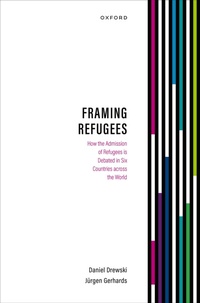
Framing Refugees
How the Admission of Refugees is Debated in Six Countries across the World
Erschienen am 6. August 2024
Buch
Hardcover
316 Seiten
978-0-19-890472-4 (ISBN)
Beschreibung
This is an open access title available under the terms of a CC BY-NC-ND 4.0 International licence. It is free to read at Oxford Academic and offered as a free PDF download from OUP and selected open access locations.
Across the world, the number of people forcibly displaced from their homes has more than doubled during the last decade. Although international law does not allow states to turn back refugees, some countries close their borders to refugees, some open their borders and grant extensive protection, while others admit some groups of refugees while excluding others. How can we make sense of these different responses to admitting refugees? In this book, Daniel Drewski and Juergen Gerhards show that governments' refugee policy, as well as the stance adopted by opposition parties on the issue, is heavily dependent on how they frame their country's collective identity on the one hand and the identity and characteristics of the refugees on the other. By defining the "we" and the "others", politicians draw on collectively shared cultural repertoires, which vary by country and by political constituency within a country. The book is based on a discourse analysis of parliamentary debates. It explores the specific framing of nations' identities and the corresponding perceptions of otherness by focusing on six countries that have been confronted with large numbers of refugees: Germany, Poland, and Turkey, all responding to the exodus of Syrian and Middle Eastern refugees; Chile's reaction to the Venezuelan displacement; Singapore and its stance towards Rohingya refugees; and Uganda's response to the displacement from South Sudan. The study explores not only differences between governments of different countries but also the conflicting views of different political parties within the same country.
This volume has emerged from research carried out as part of the Cluster of Excellence "Contestations of the Liberal Script - SCRIPTS", which analyzes the contemporary controversies about liberal ideas, institutions, and practices on the national and international level from a historical, global, and comparative perspective. It connects academic expertise in the social sciences and area studies and collaborates with research institutions in all world regions. Operating since 2019 and funded by the German Research Foundation (DFG), SCRIPTS unites eight major Berlin-based research institutions: Freie Universitaet Berlin, the Humboldt-Universitaet zu Berlin, the Berlin Social Science Center (WZB), the Hertie School, the German Institute for Economic Research (DIW), the Berlin branch of the German Institute of Global and Area Studies (GIGA), the Centre for East European and International Studies (ZOiS), and the Leibniz-Zentrum Moderner Orient (ZMO).
Across the world, the number of people forcibly displaced from their homes has more than doubled during the last decade. Although international law does not allow states to turn back refugees, some countries close their borders to refugees, some open their borders and grant extensive protection, while others admit some groups of refugees while excluding others. How can we make sense of these different responses to admitting refugees? In this book, Daniel Drewski and Juergen Gerhards show that governments' refugee policy, as well as the stance adopted by opposition parties on the issue, is heavily dependent on how they frame their country's collective identity on the one hand and the identity and characteristics of the refugees on the other. By defining the "we" and the "others", politicians draw on collectively shared cultural repertoires, which vary by country and by political constituency within a country. The book is based on a discourse analysis of parliamentary debates. It explores the specific framing of nations' identities and the corresponding perceptions of otherness by focusing on six countries that have been confronted with large numbers of refugees: Germany, Poland, and Turkey, all responding to the exodus of Syrian and Middle Eastern refugees; Chile's reaction to the Venezuelan displacement; Singapore and its stance towards Rohingya refugees; and Uganda's response to the displacement from South Sudan. The study explores not only differences between governments of different countries but also the conflicting views of different political parties within the same country.
This volume has emerged from research carried out as part of the Cluster of Excellence "Contestations of the Liberal Script - SCRIPTS", which analyzes the contemporary controversies about liberal ideas, institutions, and practices on the national and international level from a historical, global, and comparative perspective. It connects academic expertise in the social sciences and area studies and collaborates with research institutions in all world regions. Operating since 2019 and funded by the German Research Foundation (DFG), SCRIPTS unites eight major Berlin-based research institutions: Freie Universitaet Berlin, the Humboldt-Universitaet zu Berlin, the Berlin Social Science Center (WZB), the Hertie School, the German Institute for Economic Research (DIW), the Berlin branch of the German Institute of Global and Area Studies (GIGA), the Centre for East European and International Studies (ZOiS), and the Leibniz-Zentrum Moderner Orient (ZMO).
Rezensionen / Stimmen
In this strikingly original comparative study, the authors analyze how countries as diverse as Chile, Germany, Poland, Singapore, Turkey, and Uganda embrace or reject refugees. They focus on how politicians fit refugees in their countries' story and national cultural repertoires, using frames pertaining to security, as well as legal, moral, cultural and other concerns. They adroitly marry the older political sociology tradition focused on social cleavages and the newer cultural sociology literature on symbolic boundaries to show how the often-used cosmopolitan vs communitarian dichotomy cannot account for patterns. Framing Refugees is a brilliant and refreshing contribution that will leave its mark on how social scientists think about crucial issues facing our societies. * Michele Lamont, Harvard University * This carefully crafted study of political debates on refugees across six countries worldwide uncovers surprising findings at odds with much of existing theorizing. For instance, autocratic regimes are sometimes more welcoming to refugees than liberal democracies, and the political left may be more reluctant to accept refugees than the right. In a readable style and illustrated with numerous quotes from parliamentary debates, the authors show that even in a seemingly global policy field such as refugee migration, national political cultures, the historical references tied to them, and how concrete refugee populations fit (or not) into them, constitute the lens through which political controversy is structured. A key contribution to global and comparative politics, as well as to cultural sociology. * Ruud Koopmans, WZB Berlin Social Science Center & Humboldt University Berlin. * This book meticulously analyzes the political discourse shaping refugee policies of six countries from different regions of the world. By examining how politicians construct the identities of "us," the receiving nations, and "them," the refugees, the authors uncover the unique cultural narratives--such as Turkey's neo-Ottoman ideology, Uganda's Pan-Africanism, and Poland's Christian national identity--that influence these policies. This book challenges the notion of a global trend toward uniform refugee policy, revealing instead how deeply national identity and cultural values dictate responses. A must-read for anyone seeking to understand the nuanced interplay between culture and refugee policy in today's globalized world. * Naika Foroutan, German Center for Integration and Migration (DeZIM) * Drewski and Gerhards offer a meticulous and critical rethinking of assumptions that abound in the established literature on the "refugee crisis". Notably, in opening up study to a wider range of global cases beyond Europe, they dispel simplifications about how and why the dominant "script" of liberal democracy determines whether the doors of asylum are opened wide or slammed shut. For example, they show why sometimes authoritarian regimes are more open to admitting refugees than liberal democracies, and that political conflicts on the admission of refugees are not necessarily structured by a cleavage between cosmopolitans" and "communitarians". An impressive work in comparative political sociology. * Adrian Favell, University College Cork *Weitere Details
Sprache
Englisch
Verlagsort
Oxford
Großbritannien
Zielgruppe
Für Beruf und Forschung
Produkt-Hinweis
Fadenheftung
Gewebe-Einband
Maße
Höhe: 229 mm
Breite: 155 mm
Dicke: 30 mm
Gewicht
635 gr
ISBN-13
978-0-19-890472-4 (9780198904724)
Copyright in bibliographic data and cover images is held by Nielsen Book Services Limited or by the publishers or by their respective licensors: all rights reserved.
Schweitzer Klassifikation
Weitere Ausgaben
Andere Ausgaben
Daniel Drewski | Jürgen Gerhards
Framing Refugees
How the Admission of Refugees is Debated in Six Countries across the World
E-Book
07/2024
OUP eBook
98,99 €
Als Download verfügbar
Daniel Drewski | Jürgen Gerhards
Framing Refugees
How the Admission of Refugees is Debated in Six Countries across the World
E-Book
06/2024
OUP eBook
98,99 €
Als Download verfügbar
Personen
Daniel Drewski is Junior Professor for Sociology of Europe and Globalization at the University of Bamberg. Previously, he was a researcher at the Cluster of Excellence "Contestations of the Liberal Script" (SCRIPTS) and the Institute for Sociology at Freie Universitaet Berlin. His main research interests include the sociology of European integration and the sociology of migration, borders, and symbolic boundaries.
Juergen Gerhards is Professor of Sociology at Freie Universitaet Berlin. He is a member of the Nationale Akademie der Wissenschaften and the Berlin-Brandenburgische Akademie der Wissenschaften. His main research interests include comparative cultural sociology, and the sociology of European Integration.
Juergen Gerhards is Professor of Sociology at Freie Universitaet Berlin. He is a member of the Nationale Akademie der Wissenschaften and the Berlin-Brandenburgische Akademie der Wissenschaften. His main research interests include comparative cultural sociology, and the sociology of European Integration.
Inhalt
Part I. Introduction
1: Setting the stage
2: Conceptual framework
3: The design of the study
Part II. Responding to the exodus of Syrian refugees
4: Open doors for 'brothers and sisters' in faith: Turkey's refugee policy towards Syrians
5: A humanitarian role model: Germany's initial open door policy and restrictive turn towards Syrian refugees
6: Defending national sovereignty and cultural homogeneity: Poland's policy of closed doors towards Syrian refugees
Part III. Responding to refugee crises in other world regions
7: Pan-African solidarity and international reputation: Uganda's policy of open doors towards refugees
8: Between and anti-Socialist foreign policy and the historical memory of dictatorship: Chile's ambivalent policy towards displaced Venezuelans
9: An economic perspective on immigration: Singapore's closed doors for refugees and open doors for immigrants with human capital
Part IV. Conclusion
10: The liberal script on refugee admission and the significance of national cultural repertoires
References
Index
1: Setting the stage
2: Conceptual framework
3: The design of the study
Part II. Responding to the exodus of Syrian refugees
4: Open doors for 'brothers and sisters' in faith: Turkey's refugee policy towards Syrians
5: A humanitarian role model: Germany's initial open door policy and restrictive turn towards Syrian refugees
6: Defending national sovereignty and cultural homogeneity: Poland's policy of closed doors towards Syrian refugees
Part III. Responding to refugee crises in other world regions
7: Pan-African solidarity and international reputation: Uganda's policy of open doors towards refugees
8: Between and anti-Socialist foreign policy and the historical memory of dictatorship: Chile's ambivalent policy towards displaced Venezuelans
9: An economic perspective on immigration: Singapore's closed doors for refugees and open doors for immigrants with human capital
Part IV. Conclusion
10: The liberal script on refugee admission and the significance of national cultural repertoires
References
Index