

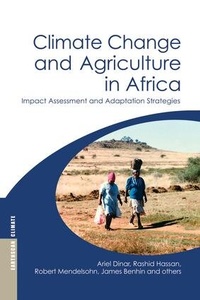
Climate Change and Agriculture in Africa
Impact Assessment and Adaptation Strategies
1. Auflage
Erschienen am 1. Juli 2015
Buch
Softcover
224 Seiten
978-0-415-85283-8 (ISBN)
Beschreibung
This landmark book encompasses a comprehensive assessment of the potential economic impacts of future climate change, and the value of adaptation measures in Africa for different zones, regions, countries and farm types. Researchers developed and applied multiple analytical procedures to assess quantitatively how climate affects current agricultural systems in Africa, enabling them to predict how these systems may be affected in the future by climate change under various global warming scenarios, and suggesting what role adaptation could play.
The study is the first to combine spatially referenced household survey data with climatic data at both national and international levels. This book provides vital knowledge about the impacts of climate change on Africa, serving as a guide to policy intervention strategies and investment in adaptation measures. It makes a major contribution to the analysis of climate change impacts and developing adaptation strategies, especially in the highly vulnerable farming communities in the developing world.
Published with CEEPA and supported by the World Bank.
The study is the first to combine spatially referenced household survey data with climatic data at both national and international levels. This book provides vital knowledge about the impacts of climate change on Africa, serving as a guide to policy intervention strategies and investment in adaptation measures. It makes a major contribution to the analysis of climate change impacts and developing adaptation strategies, especially in the highly vulnerable farming communities in the developing world.
Published with CEEPA and supported by the World Bank.
Rezensionen / Stimmen
'A well-researched, thorough and impressive work.'Jabavu Clifford Nkomo, senior programme specialist, IDRC
'Demonstrates the real need for both the physical and social science communities to work together toward integrated assessments of climate and society.'
Molly E. Brown, NASA and Brent McCusker, West Virginia University
'The book has a lot o fkey recommendations for policymakers to draw on as they develop policies and programmes to support farmers adapting to change.'
Trocaire Development Review
'A comprehensive assessment of the potential economic impacts of future climate change'
ICLEI, March 2010.
Weitere Details
Reihe
Sprache
Englisch
Verlagsort
London
Großbritannien
Verlagsgruppe
Taylor & Francis Ltd
Zielgruppe
Für höhere Schule und Studium
Maße
Höhe: 234 mm
Breite: 156 mm
Gewicht
294 gr
ISBN-13
978-0-415-85283-8 (9780415852838)
Copyright in bibliographic data and cover images is held by Nielsen Book Services Limited or by the publishers or by their respective licensors: all rights reserved.
Schweitzer Klassifikation
Weitere Ausgaben
Andere Ausgaben
Ariel Dinar | Rashid Hassan | Robert Mendelsohn
Climate Change and Agriculture in Africa
Impact Assessment and Adaptation Strategies
E-Book
05/2012
1. Auflage
Routledge
72,49 €
Als Download verfügbar
Ariel Dinar | Rashid Hassan | Robert Mendelsohn
Climate Change and Agriculture in Africa
Impact Assessment and Adaptation Strategies
E-Book
05/2012
1. Auflage
Routledge
72,49 €
Als Download verfügbar
Ariel Dinar | Rashid Hassan | Robert Mendelsohn
Climate Change and Agriculture in Africa
Impact Assessment and Adaptation Strategies
Buch
04/2008
1. Auflage
Earthscan Ltd
200,00 €
Artikel z.Zt. nicht lieferbar
Personen
Ariel Dinar is a lead economist at the Development Research Group of the World Bank, Washington DC, USA. Rashid Hassan is a professor and the director of the Centre for Environmental Economics and Policy in Africa (CEEPA) at the University of Pretoria, South Africa. Robert Mendelsohn is a professor of economics in the School of Forestry and Environmental Studies, Yale University, USA. James Benhin is technical coordinator at CEEPA, University of Pretoria, South Africa.
Inhalt
1. Introduction and Rationale 2. Study Objectives, Structure, Methodology, Organization and Countries' Agroclimatic Conditions 3. Methods and Models Developed and Used in the Study 4. Results of the Country Analyses 5. Results of the Regional Analyses 6. Summary, Conclusions and Policy Implications References