

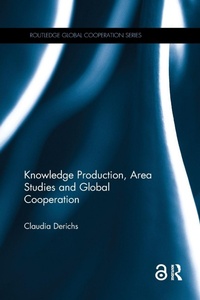
Knowledge Production, Area Studies and Global Cooperation
1. Auflage
Erschienen am 17. Januar 2019
Buch
Softcover
216 Seiten
978-0-367-17266-4 (ISBN)
Beschreibung
Whereas Area Studies and cross-border cooperation research conventionally demarcates groups of people by geographical boundaries, individuals might in fact feel more connected by shared values and principles than by conventional spatial dimensions. Knowledge Production, Area Studies and Global Cooperation asks what norms and principles lead to the creation of knowledge about cross-border cooperation and connection. It studies why theories, methods, and concepts originate in one place rather than another, how they travel, and what position the scholar adopts while doing research, particularly 'in the field'.
Taking case studies from Asia, the Middle East and North Africa, the book links the production of alternative epistemologies to the notion of global cooperation and reassesses the ways in which the concept of connectedness can be applied at the translocal and individual rather than the formal international and collective level.
Knowledge Production, Area Studies and Global Cooperation provides an innovative and critical approach towards established means of producing knowledge about different areas of the world, demonstrating that an understanding of pluri-local connectivity should be integrated into the production of knowledge about different areas of the world and the behavioural dimension of global cooperation. By shifting the view from the collective to the individual and from the formal to often invisible patterns of connectedness, this book provides an important fresh perspective which will be of interest to scholars and students of Area Studies, Politics, International Relations and Development Studies.
Taking case studies from Asia, the Middle East and North Africa, the book links the production of alternative epistemologies to the notion of global cooperation and reassesses the ways in which the concept of connectedness can be applied at the translocal and individual rather than the formal international and collective level.
Knowledge Production, Area Studies and Global Cooperation provides an innovative and critical approach towards established means of producing knowledge about different areas of the world, demonstrating that an understanding of pluri-local connectivity should be integrated into the production of knowledge about different areas of the world and the behavioural dimension of global cooperation. By shifting the view from the collective to the individual and from the formal to often invisible patterns of connectedness, this book provides an important fresh perspective which will be of interest to scholars and students of Area Studies, Politics, International Relations and Development Studies.
Weitere Details
Reihe
Sprache
Englisch
Verlagsort
London
Großbritannien
Verlagsgruppe
Taylor & Francis Ltd
Zielgruppe
Für höhere Schule und Studium
Maße
Höhe: 234 mm
Breite: 156 mm
Dicke: 12 mm
Gewicht
336 gr
ISBN-13
978-0-367-17266-4 (9780367172664)
Copyright in bibliographic data and cover images is held by Nielsen Book Services Limited or by the publishers or by their respective licensors: all rights reserved.
Schweitzer Klassifikation
Weitere Ausgaben
Andere Ausgaben
Claudia Derichs
Knowledge Production, Area Studies and Global Cooperation
E-Book
04/2017
Routledge
57,99 €
Als Download verfügbar
Claudia Derichs
Knowledge Production, Area Studies and Global Cooperation
E-Book
04/2017
Routledge
57,99 €
Als Download verfügbar
Claudia Derichs
Knowledge Production, Area Studies and Global Cooperation
Buch
04/2017
Routledge
163,34 €
Artikel z.Zt. nicht lieferbar
Claudia Derichs
Knowledge Production, Area Studies and Global Cooperation
Buch
04/2017
1. Auflage
Routledge
206,20 €
Versand in 10-20 Tagen
Person
Claudia Derichs is Professor of Comparative Politics and International Development Studies at Philipps University Marburg, Germany, and a senior associate fellow at the Kaete Hamburger Kolleg/Centre for Global Cooperation Research in Duisburg, Germany. Her research interests are Muslim societies and political transition in Southeast Asia and the Middle East, as well as gender and development studies in Asia and the Middle East. She has published various books and articles on Malaysia, Indonesia, Japan and the Arab world, and is an advisor to several academic and political institutions, journals and think tanks. Prior to her studies of Japanese and Arabic, she worked as a journalist.
Inhalt
Introduction: Knowledge Production, Area Studies and Global Cooperation
The problem of defining knowledge
Area studies and disciplines
Knowledge production, international relations and global cooperation
Part I: Alternative Epistemologies
The Islamisation of Knowledge
Naguib Al-Attas: Islam and secularism
Isma'il Al-Faruqi: the tauhidic worldview
Seyyed Hossein Nasr: sacred science
Fazlur Rahman: Islam and modernity
Evaluations of the Islamisation of knowledge project
IoK as a project of its time
Review: Spill-over and diffusion
Islamic resurgence
Islamisation in education and its political reception in Malaysia and Indonesia
Primary to tertiary education
Campus dakwah
Malaysia
Indonesia and the tarbiyah movement
Transregional connections
Diffusion into policymaking and economic practice
Laws and verdicts
Female perspectives on "Islamised" policymaking
Diffusion into economy
Conclusion
Empirical case studies: Islamic economy and Islamic feminism
Assessing religion, economy and advocacy
Commodification, commercialization and aestheticisation of religion
The Islamisation of knowledge and its repercussions
Domestic political contexts
Beyond domestic politics
Islamic economy and shari'aised workplaces
Gender justice and transnational Islamic feminism
Pulling the strings together
Part II: Areas and Pluri-Locality
At Home Away from Home (Emotional Geographies)
Trans- and pluri-local settings
Knowledge entrepreneurs
Trans- and pluri-local networks
Translocal areas
Conclusion
Tunnel Views in Area Studies
Critical assessments of area studies
Scales and geographies
Areas and disciplines in postcolonial perspective
Conclusion
Connectivity and Cooperation: Concluding Thoughts
Cooperation on a global level
The cooperation hexagon and meccanomics
Religion and international cooperation
Epistemic approaches and behavioural dimensions
Knowledge production, area studies and global cooperation
The problem of defining knowledge
Area studies and disciplines
Knowledge production, international relations and global cooperation
Part I: Alternative Epistemologies
The Islamisation of Knowledge
Naguib Al-Attas: Islam and secularism
Isma'il Al-Faruqi: the tauhidic worldview
Seyyed Hossein Nasr: sacred science
Fazlur Rahman: Islam and modernity
Evaluations of the Islamisation of knowledge project
IoK as a project of its time
Review: Spill-over and diffusion
Islamic resurgence
Islamisation in education and its political reception in Malaysia and Indonesia
Primary to tertiary education
Campus dakwah
Malaysia
Indonesia and the tarbiyah movement
Transregional connections
Diffusion into policymaking and economic practice
Laws and verdicts
Female perspectives on "Islamised" policymaking
Diffusion into economy
Conclusion
Empirical case studies: Islamic economy and Islamic feminism
Assessing religion, economy and advocacy
Commodification, commercialization and aestheticisation of religion
The Islamisation of knowledge and its repercussions
Domestic political contexts
Beyond domestic politics
Islamic economy and shari'aised workplaces
Gender justice and transnational Islamic feminism
Pulling the strings together
Part II: Areas and Pluri-Locality
At Home Away from Home (Emotional Geographies)
Trans- and pluri-local settings
Knowledge entrepreneurs
Trans- and pluri-local networks
Translocal areas
Conclusion
Tunnel Views in Area Studies
Critical assessments of area studies
Scales and geographies
Areas and disciplines in postcolonial perspective
Conclusion
Connectivity and Cooperation: Concluding Thoughts
Cooperation on a global level
The cooperation hexagon and meccanomics
Religion and international cooperation
Epistemic approaches and behavioural dimensions
Knowledge production, area studies and global cooperation