

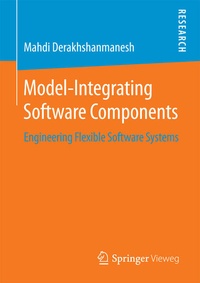
Model-Integrating Software Components
Engineering Flexible Software Systems
Erschienen am 12. Mai 2015
Buch
Softcover
XXI, 333 Seiten
978-3-658-09645-8 (ISBN)
Beschreibung
In his study, Mahdi Derakhshanmanesh builds on the state of the art in modeling by proposing to integrate models into running software on the component-level without translating them to code. Such so-called model-integrating software exploits all advantages of models: models implicitly support a good separation of concerns, they are self-documenting and thus improve understandability and maintainability and in contrast to model-driven approaches there is no synchronization problem anymore between the models and the code generated from them. Using model-integrating components, software will be easier to build and easier to evolve by just modifying the respective model in an editor. Furthermore, software may also adapt itself at runtime by transforming its own model part.
Weitere Details
Auflage
2015 ed.
Sprache
Englisch
Verlagsort
Wiesbaden
Deutschland
Verlagsgruppe
Springer Fachmedien Wiesbaden GmbH
Zielgruppe
Für Beruf und Forschung
- Software engineering researchers and students in the fields of component-based software engineering, self-adaptive software, (dynamic) software product line engineering and modelling
- Component developers and users as well as creators of domain-specific (modeling) languages
Illustrationen
43 s/w Abbildungen
XXI, 333 p. 43 illus.
Maße
Höhe: 210 mm
Breite: 148 mm
Dicke: 20 mm
Gewicht
461 gr
ISBN-13
978-3-658-09645-8 (9783658096458)
DOI
10.1007/978-3-658-09646-5
Schweitzer Klassifikation
Weitere Ausgaben
Andere Ausgaben
E-Book
04/2015
1. Auflage
Springer Vieweg
53,49 €
Als Download verfügbar
Person
Mahdi Derakhshanmanesh is a postdoctoral researcher and lecturer at the University of Koblenz-Landau, Institute for Software Technology.
Inhalt
Part I: Introduction and Foundations: Introduction.- Foundations and Related Work.- Part II: Solution Concept: Initial Design Considerations.- Component Realization Concept.- Part III: Proof of Concept: Reference Implementation.- Feasibility Studies.- Part IV: Finale: Conclusions and Future Work.