

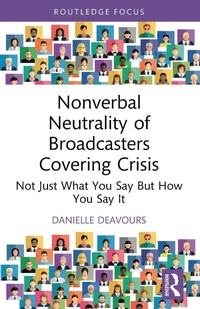
Nonverbal Neutrality of Broadcasters Covering Crisis
Not Just What You Say But How You Say It
1. Auflage
Erschienen am 19. Dezember 2024
Buch
Softcover
128 Seiten
978-1-032-45090-2 (ISBN)
Beschreibung
Offering a critical and sensitive reflection on journalists' nonverbal behaviors during their coverage of school shootings in the U.S., this book shows how individual- and social-level factors predict broadcasters' nonverbal neutrality.
Nonverbal behaviors have the ability to transmit bias, influence audiences, and impact perceptions of journalists. Yet journalists report receiving little to no training on nonverbal communication, despite often being placed in emotional, chaotic situations that affect their ability to remain neutral during coverage. This book provides theoretical and methodological contributions, as well as applicable advice, to assist researchers', instructors', and journalists' understandings of ongoing boundary negotiations of this rarely discussed but highly impactful aspect of objectivity. Through the proposal of the Nonverbal Neutrality Theory, it outlines predictive patterns and routines that contribute to the variability of nonverbal neutrality, and equips readers, including industry professionals and journalism educators, with examples of best practice to help better plan for crisis coverage. The work draws on journalists' reflections on professional norms and conceptualizations of nonverbal neutrality, vicarious traumatization, and social- and organizational-level influences.
As one of the first to explore nonverbal neutrality, its predictive factors, and patterns across crisis events, this book provides a much-needed insight into the nonverbal behaviors of broadcast journalists at a time when the media relies ever more on visual delivery on television, digital, and social media networks.
Nonverbal behaviors have the ability to transmit bias, influence audiences, and impact perceptions of journalists. Yet journalists report receiving little to no training on nonverbal communication, despite often being placed in emotional, chaotic situations that affect their ability to remain neutral during coverage. This book provides theoretical and methodological contributions, as well as applicable advice, to assist researchers', instructors', and journalists' understandings of ongoing boundary negotiations of this rarely discussed but highly impactful aspect of objectivity. Through the proposal of the Nonverbal Neutrality Theory, it outlines predictive patterns and routines that contribute to the variability of nonverbal neutrality, and equips readers, including industry professionals and journalism educators, with examples of best practice to help better plan for crisis coverage. The work draws on journalists' reflections on professional norms and conceptualizations of nonverbal neutrality, vicarious traumatization, and social- and organizational-level influences.
As one of the first to explore nonverbal neutrality, its predictive factors, and patterns across crisis events, this book provides a much-needed insight into the nonverbal behaviors of broadcast journalists at a time when the media relies ever more on visual delivery on television, digital, and social media networks.
Weitere Details
Reihe
Sprache
Englisch
Verlagsort
London
Großbritannien
Verlagsgruppe
Taylor & Francis Ltd
Zielgruppe
Für höhere Schule und Studium
Postgraduate
Illustrationen
16 s/w Abbildungen, 16 s/w Photographien bzw. Rasterbilder, 12 s/w Tabellen
12 Tables, black and white; 16 Halftones, black and white; 16 Illustrations, black and white
Maße
Höhe: 216 mm
Breite: 140 mm
Dicke: 8 mm
Gewicht
186 gr
ISBN-13
978-1-032-45090-2 (9781032450902)
Copyright in bibliographic data and cover images is held by Nielsen Book Services Limited or by the publishers or by their respective licensors: all rights reserved.
Schweitzer Klassifikation
Weitere Ausgaben
Andere Ausgaben
Danielle Deavours
Nonverbal Neutrality of Broadcasters Covering Crisis
Not Just What You Say But How You Say It
E-Book
09/2023
1. Auflage
Routledge
25,99 €
Als Download verfügbar
Danielle Deavours
Nonverbal Neutrality of Broadcasters Covering Crisis
Not Just What You Say But How You Say It
Buch
09/2023
1. Auflage
Routledge
76,60 €
Versand in 10-20 Tagen
Danielle Deavours
Nonverbal Neutrality of Broadcasters Covering Crisis
Not Just What You Say But How You Say It
E-Book
09/2023
1. Auflage
Routledge
25,99 €
Als Download verfügbar
Person
Danielle Deavours is Assistant Professor of Broadcast Journalism at Samford University, USA. She currently serves as the 2023-2024 chair of the AEJMC Broadcast and Mobile Journalism Division. She is also 2023-2024 chair of the BEA Interactive Media and Emerging Technology Division, as well as a co-chair for the IMET student category in the BEA Festival of Media Arts.
In 2022, Deavours received the Emerging Scholar Award from the Nonverbal Communication Division of the National Communication Association. She is a former Emmy- and Murrow-award winning broadcast journalist with over a decade of experience in local television news.
In 2022, Deavours received the Emerging Scholar Award from the Nonverbal Communication Division of the National Communication Association. She is a former Emmy- and Murrow-award winning broadcast journalist with over a decade of experience in local television news.
Inhalt
Preface
Acknowledgments
Chapter 1. Introduction
Chapter 2. Nonverbal theories: BET/BECV
Chapter 3. Nonverbal neutrality norm
Chapter 4. Nonverbal neutrality influence factors
Chapter 5. Measuring nonverbal neutrality
Chapter 6. Predictive influences on nonverbal neutrality: Findings
Chapter 7. The Nonverbal Neutrality Theory
Chapter 8. Understanding nonverbal neutrality variability
Chapter 9. Applications to research, industry and beyond
Appendix
Index
Acknowledgments
Chapter 1. Introduction
Chapter 2. Nonverbal theories: BET/BECV
Chapter 3. Nonverbal neutrality norm
Chapter 4. Nonverbal neutrality influence factors
Chapter 5. Measuring nonverbal neutrality
Chapter 6. Predictive influences on nonverbal neutrality: Findings
Chapter 7. The Nonverbal Neutrality Theory
Chapter 8. Understanding nonverbal neutrality variability
Chapter 9. Applications to research, industry and beyond
Appendix
Index